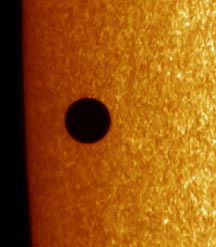
The dark disk of Mercury seen against the backdrop of the Sun during the transit. The transit is almost over, and Mercury appears near the edge of the Sun. This picture was taken with the Swedish 1 meter Solar Telescope (SST), which is located at La Palma in the Canary Islands.
Click on image for full size
Image courtesy of The Royal Swedish Academy of Sciences.
Mercury Transit on May 7, 2003
News story originally written on July 2, 2003
The planet Mercury appeared to cross in
front of the Sun on May 7, 2003. Astronomers
call the event a transit. A transit is like a solar
eclipse. However, a transit occurs when a planet, instead of Earth's Moon,
passes between the Sun and Earth. Planets are much further away
than the Moon, so the planet does not completely cover the Sun during a transit
like the Moon does during an eclipse.
Transits of Mercury happen about once every seven years on average. There
will be 14 transits of Mercury this century. This one was the first. The last
transit of Mercury before this one was on November 15, 1999. The next will
be on November 8, 2006.
Only two planets ever
transit the Sun as viewed from Earth. The two planets are Mercury and Venus.
All of the other planets orbit the Sun
further from Earth and never pass between Earth and the Sun.
Transits of Venus are much rarer than transits of Mercury. Venus transits
happen only twice per century. We're in luck though - the next transit of Venus
is coming along pretty soon on June 8, 2004! Astronomers in the 1700's used transits
of Venus to make the first good measurements of the distance between Earth
and the Sun. They did that by carefully measuring the time of the transit from
different places on Earth.
You might also be interested in:
A "transit" is the name of a type of astronomical event. A transit is like a solar eclipse, when the moon blocks out the Sun. During a transit a planet, not the Moon, moves between Earth and the Sun. There
...moreThe planet Mercury will cross in front of the Sun on Wednesday, November 8, 2006. Astronomers call the event a transit. A transit is like a solar eclipse. However, a transit occurs when a planet, instead
...more
Here you will find links to all sorts of pictures, animations, videos, sounds, and interactive multimedia that are on Windows to the Universe Explore collections of images in the Image Galleries. Watch
...more
Astronomers have discovered twelve new moons of Jupiter so far in 2003. Jupiter now has a total of 52 moons that we know of. Jupiter, the largest planet in our Solar System, has more moons than any other
...more
On August 27, 2003, Earth and Mars will be closer together than they have been in thousands of years. Mars will pass within 55,758,006 kilometers (34,646,418 miles) from Earth. Astronomers have calculated
...more
Astronomers have recently discovered nine new moons. The astronomers found eight new moons of Jupiter and one new moon of Saturn. We now know of 60 moons orbiting Jupiter and 31 orbiting Saturn. The new
...moreThe planet Mercury appeared to cross in front of the Sun on May 7, 2003. Astronomers call the event a transit. A transit is like a solar eclipse. However, a transit occurs when a planet, instead of Earth's
...more
Two very large groups of sunspots have appeared on the Sun. Each of the groups is about as big as the planet Jupiter, which is the largest planet in our Solar System! Sunspots are places on the Sun where
...more