Current Events

  • Kansas Legislator Proposes Bill to Outlaw Sustainability Education
    A bill has been introduced in the Kansas legislature this week that would prohibit the promotion of ...Read more

    x

    Kansas Legislator Proposes Bill to Outlaw Sustainability Education

    A bill has been introduced in the Kansas legislature this week that would prohibit the promotion of sustainability. Here is a link to the one-page bill: http://www.kslegislature.org/li/b2013_14/measures/documents/hb2366_00_0000.pdf. See report on Bloomberg News.
  • Earth's Center Is 1,000 Degrees Hotter Than Previously Thought, Synchrotron X-Ray Experiment Shows
    Scientists have determined the temperature near the Earth’s center to be 6000 degrees Celsius, 1000 ...Read more

    x

    Earth's Center Is 1,000 Degrees Hotter Than Previously Thought, Synchrotron X-Ray Experiment Shows

    Scientists have determined the temperature near the Earth’s center to be 6000 degrees Celsius, 1000 degrees hotter than in a previous experiment run 20 years ago. These measurements confirm geophysical models that the temperature difference between the solid core and the mantle above, must be at least 1500 degrees to explain why the Earth has a magnetic field. For more information about this study, see the press release from the European Synchrotron Radiation Facility.
  • Ocean Volcanic Rocks Contain Samples of Recycled Crust
    Scientists have long believed that lava erupted from certain oceanic volcanoes contains materials fr...Read more

    x

    Ocean Volcanic Rocks Contain Samples of Recycled Crust

    Scientists have long believed that lava erupted from certain oceanic volcanoes contains materials from the early Earth’s crust. But decisive evidence for this phenomenon has proven elusive. New research from a team including Carnegie’s Erik Hauri demonstrates that oceanic volcanic rocks contain samples of recycled crust dating back to the Archean era 2.5 billion years ago. Their work is published in Nature. Oceanic crust sinks into the Earth’s mantle at so-called subduction zones, where two plates come together. Much of what happens to the crust during this journey is unknown. Model-dependent studies for how long subducted material can exist in the mantle are uncertain and evidence of very old crust returning to Earth’s surface via upwellings of magma has not been found until now. For more information about these results, see the press release from the Carnegie Institution.
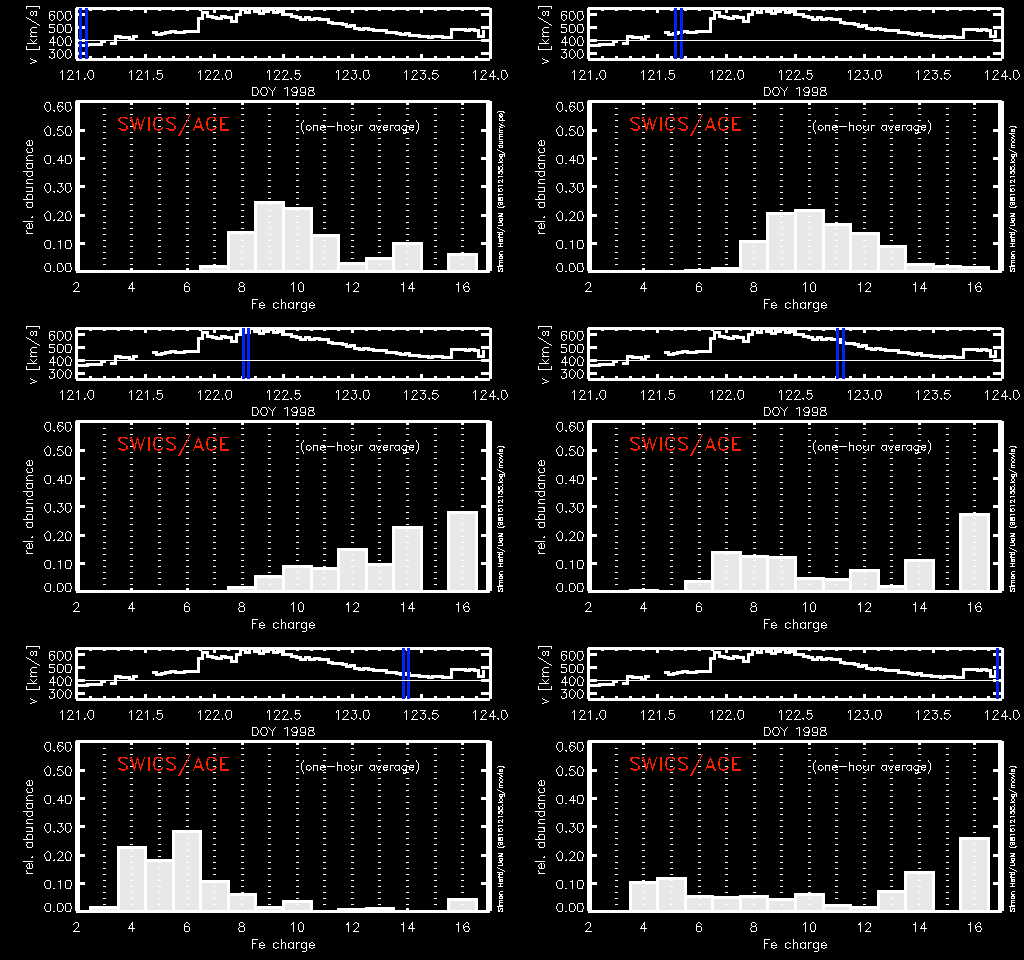
This figure shows the composition of a large event which was measured by ACE-SWICS on May 3 and compares it to standard solar wind composition (labelled slow solar wind). The Fe and O charge state show that the CME plasma is composed of a very hot (about 2.5-3 million K) and a very cold (less than 0.3 million K) component.
Click on image for full size
Image courtesy of ACE-SWICS

ACE Satellite Probes Solar Event
News story originally written on June 8, 1998

During the last months increasing solar activity has resulted in a higher occurence rate of Coronal Mass Ejections (CMEs) than usual. In fact, one such event was recorded by SOHO on June 2, 1998. Another CME was recorded by the ACE spacecraft on May 3, 1998. SOHO observed a dramatic ejection of solar gas on the southwest limb of the Sun. The ACE satellite measurements have shown that the composition of these CMEs exhibits surprising patterns.

These explosion events, first discovered in the 1970's, originate at the Sun's visible surface, the photosphere, and travel upward through its atmosphere, and then into its super-hot corona before speeding out into space, sometimes towards Earth. Before this May 3rd CME hit the Earth, the CME material passed the ACE satellite. On this occasion, the SWICS (Solar Wind Ionic Charge Spectrometer) instrument did not measure one homogeneous mass of material as the CME passed ACE. Instead, it was found that the CME consisted of an extremely hot region, followed by a cooler region and then another hot region of solar material. Further analysis is being done, but this discovery could change what scientists know about CMEs and about how CMEs affect the Earth's environment.

The ACE spacecraft will continue to track the solar wind coming from the Sun while solar activity increases. The ACE satellite serves as a spaceweather station while in orbit. The location of ACE enables it to provide about one-hour advance warning of any major geomagnetic activity that can cause aurorae or power losses here on Earth.

As we near solar maximum, more and more CMEs are likely to occur.

Shop Windows to the Universe Science Store!

Our online store includes issues of NESTA's quarterly journal, The Earth Scientist, full of classroom activities on different topics in Earth and space science, as well as books on science education!

Windows to the Universe Community

News

Opportunities

You might also be interested in:

Traveling Nitrogen Classroom Activity Kit

Check out our online store - minerals, fossils, books, activities, jewelry, and household items!...more

Spiral Path of Material

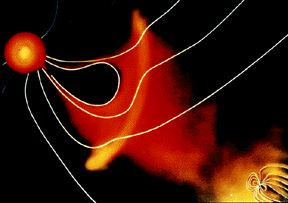
For a planet to be affected by a blob of material being ejected by the sun, the planet must be in the path of the blob, as shown in this picture. The Earth and its magnetosphere are shown in the bottom...more

1999--A Year in Review...

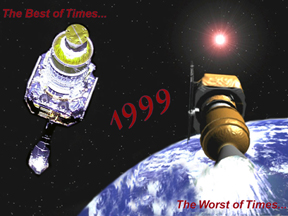
It was another exciting and frustrating year for the space science program. It seemed that every step forward led to one backwards. Either way, NASA led the way to a great century of discovery. Unfortunately,...more

STS-95 Launch: "Let the wings of Discovery lift us on to the future."

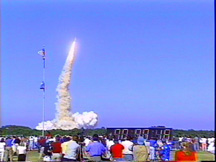
The Space Shuttle Discovery lifted off from Kennedy Space Center at 2:19 p.m. EST, October 29th. The sky was clear and the weather was great as Discovery took 8 1/2 minutes to reach orbit for the Unitied...more

Moon Found Orbiting Asteroid

A moon was discovered orbiting the asteroid, Eugenia. This is only the second time in history that a satellite has been seen circling an asteroid. A special mirror allowed scientists to find the moon...more

U.S. is Fed Up with Russia

Will Russia ever put the service module for the International Space Station in space? NASA officials are demanding an answer from the Russian government. The necessary service module is currently waiting...more

More on Recent Coronal Mass Ejection

During a period of about two days in early May, 1998, the ACE spacecraft was immersed in plasma associated with a coronal mass ejection (CME). The SWICS instrument on ACE, which determines unambiguously...more

Mother Nature's Air Conditioning

J.S. Maini of the Canadian Forest Service has referred to forests as the "heart and lungs of the world." Forests reduce soil erosion, maintain water quality, contribute to atmospheric humidity and cloud...more

Shop Windows to the Universe

Please help support Windows to the Universe, and our activities to help Earth and space science teachers, with a tax-exempt donation today!

Windows to the Universe, a project of the National Earth Science Teachers Association, is sponsored in part by the National Science Foundation and NASA, our Founding Partners (the American Geophysical Union and American Geosciences Institute) as well as through Institutional, Contributing, and Affiliate Partners, individual memberships and generous donors. Thank you for your support! NASA AGU AGI NSF