Current Events

  • Atmospheric CO2 Level Tops 400 ppm
    During the week of May 13th, the CO2 level at the Mauna Loa Observatory in Hawaii topped 400 ppm rep...Read more

    x

    Atmospheric CO2 Level Tops 400 ppm

    During the week of May 13th, the CO2 level at the Mauna Loa Observatory in Hawaii topped 400 ppm repeatedly. Daily levels of CO2 can vary due to weather, and there are seasonal trends as well. The level of atmospheric greenhouse gases continues to increase, now over 120 ppm since the Industrial Revolution began. For more on the Keeling Curve, see http://keelingcurve.ucsd.edu/. Find out more about greenhouse gases and warming.
  • Massive Tornado Outbreak on Tornado Alley
    The week of May 19 brings dozens of tornadoes to Tornado Alley in the states of Oklahoma, Kansas, Io...Read more

    x

    Massive Tornado Outbreak on Tornado Alley

    The week of May 19 brings dozens of tornadoes to Tornado Alley in the states of Oklahoma, Kansas, Iowa, Illinois and Missouri. On May 20th, a massive tornado struck Moore, Oklahoma, devastating communities - destroying over 100 homes and hitting two elementary schools and a hospital - with many casualties and deaths. Our thoughts are with our friends and colleagues suffering from these storms. For more on the May 20th storms, see the NOAA Storm Prediction Center Storm Report.
  • Kansas Legislator Proposes Bill to Outlaw Sustainability Education
    A bill has been introduced in the Kansas legislature this week that would prohibit the promotion of ...Read more

    x

    Kansas Legislator Proposes Bill to Outlaw Sustainability Education

    A bill has been introduced in the Kansas legislature this week that would prohibit the promotion of sustainability. Here is a link to the one-page bill: http://www.kslegislature.org/li/b2013_14/measures/documents/hb2366_00_0000.pdf. See report on Bloomberg News.
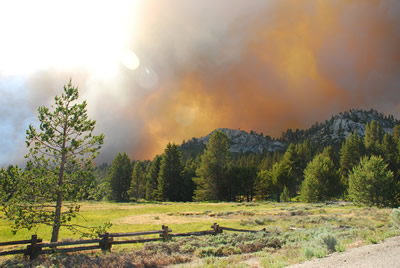
Wildfires across much of California and Nevada increased ground-level ozone to high levels.
Click on image for full size
Image Courtesy of the Wikipedia Commons

Health Standards Exceeded by Ozone Pollution in Wildfires
News story originally written on October 9, 2008

Scientists from the National Center of Atmospheric Research (NCAR) have published a new paper about how wildfires affect air pollution. They have learned that wildfires make ozone levels high enough to cause problems for humans and the environment.

The scientists focused on California wildfires that broke out in September and October 2007. They learned that the wildfires caused ground-level ozone to spike to unhealthy levels across a large area, including much of rural California as well as neighboring Nevada.

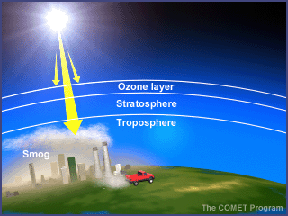
Fires make ozone levels higher because they release chemicals called nitrogen oxides and hydrocarbons. These chemicals react with sunlight and can form ozone near the fire or far downwind of the fire. Ozone that is found higher up in the atmosphere (in the stratosphere) helps life on Earth by blocking ultraviolet radiation from the Sun, but ozone in the lower atmosphere can trigger a number of health problems. These include coughing, throat irritation, and making asthma, bronchitis, and emphysema worse. Ozone pollution also damages crops and other plants.

"It's important to understand the health impacts of wildfires," says NCAR scientist Gabriele Pfister. "We found that ozone can hit unhealthy levels even in places where you are not seeing any smoke."

Last modified January 27, 2009 by Becca Hatheway.

Shop Windows to the Universe Science Store!

Our online store includes books on science education, ranging from evolution, classroom research, and the need for science and math literacy!

Windows to the Universe Community

News

Opportunities

You might also be interested in:

Cool It! Game

Check out our online store - minerals, fossils, books, activities, jewelry, and household items!...more

Ozone - An Overview

Have you ever heard of ozone? That's a word that shows up in the news a lot! Do you know what ozone is and why it is important in the Earth's atmosphere? Ozone is made of three oxygen atoms (O3). You've...more

Ozone in the Troposphere

Did you know that ozone is found in two different layers of the atmosphere? You may have heard of the ozone hole problem - that is where ozone is missing in the stratosphere (the 2nd layer of the Earth's...more

Triggers of Volcanic Eruptions in Oregon's Mount Hood Investigated

Scientists have learned that Mount Hood, Oregon's tallest mountain, has erupted in the past due to the mixing of two different types of magma. Adam Kent, a geologist at Oregon State University, says this...more

Oldest Earth Mantle Reservoir Discovered

The Earth's mantle is a rocky, solid shell that is between the Earth's crust and the outer core. The mantle is made up of many different reservoirs that have different chemical compositions. Scientists...more

It’s Not Your Fault – A Typical Fault, Geologically Speaking, That Is

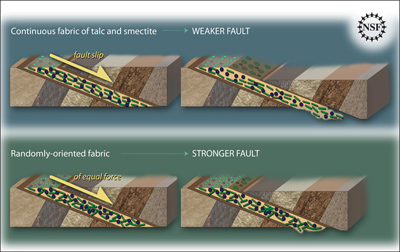
Some faults look strong and like they wouldn’t cause an earthquake. But it turns out that they can slip and slide like weak faults causing earthquakes. Scientists have been looking at one of these faults...more

Lower Solar Activity Linked to Changes in Sun's Conveyor Belt

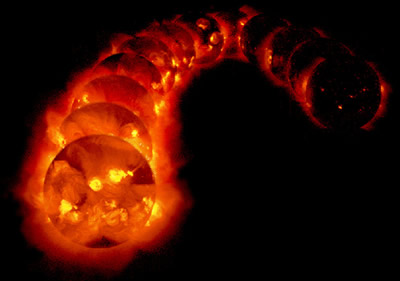
The sun goes through cycles that last approximately 11 years. These solar cycle include phases with more magnetic activity, sunspots, and solar flares. They also include phases with less activity. The...more

Growth Spurt in Tree Rings Prompts Questions About Climate Change

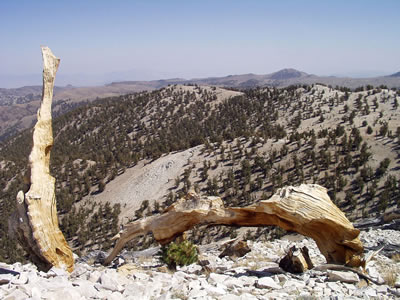
Studying tree rings doesn't only tell us the age of that tree. Tree rings also show what climate was like while the tree was alive. This means that tree rings can tell us about climates of the past. Two...more

Shop Windows to the Universe

We now offer the Cool It! card game in our Science Store. Cool It! is the new card game from UCS that teaches kids about the choices we have when it comes to climate change.

Windows to the Universe, a project of the National Earth Science Teachers Association, is sponsored in part by the National Science Foundation and NASA, our Founding Partners (the American Geophysical Union and American Geosciences Institute) as well as through Institutional, Contributing, and Affiliate Partners, individual memberships and generous donors. Thank you for your support! NASA AGU AGI NSF