Current Events

  • Atmospheric CO2 Level Tops 400 ppm
    During the week of May 13th, the CO2 level at the Mauna Loa Observatory in Hawaii topped 400 ppm rep...Read more

    x

    Atmospheric CO2 Level Tops 400 ppm

    During the week of May 13th, the CO2 level at the Mauna Loa Observatory in Hawaii topped 400 ppm repeatedly. Daily levels of CO2 can vary due to weather, and there are seasonal trends as well. The level of atmospheric greenhouse gases continues to increase, now over 120 ppm since the Industrial Revolution began. For more on the Keeling Curve, see http://keelingcurve.ucsd.edu/. Find out more about greenhouse gases and warming.
  • Massive Tornado Outbreak on Tornado Alley
    The week of May 19 brings dozens of tornadoes to Tornado Alley in the states of Oklahoma, Kansas, Io...Read more

    x

    Massive Tornado Outbreak on Tornado Alley

    The week of May 19 brings dozens of tornadoes to Tornado Alley in the states of Oklahoma, Kansas, Iowa, Illinois and Missouri. On May 20th, a massive tornado struck Moore, Oklahoma, devastating communities - destroying over 100 homes and hitting two elementary schools and a hospital - with many casualties and deaths. Our thoughts are with our friends and colleagues suffering from these storms. For more on the May 20th storms, see the NOAA Storm Prediction Center Storm Report.
  • Kansas Legislator Proposes Bill to Outlaw Sustainability Education
    A bill has been introduced in the Kansas legislature this week that would prohibit the promotion of ...Read more

    x

    Kansas Legislator Proposes Bill to Outlaw Sustainability Education

    A bill has been introduced in the Kansas legislature this week that would prohibit the promotion of sustainability. Here is a link to the one-page bill: http://www.kslegislature.org/li/b2013_14/measures/documents/hb2366_00_0000.pdf. See report on Bloomberg News.
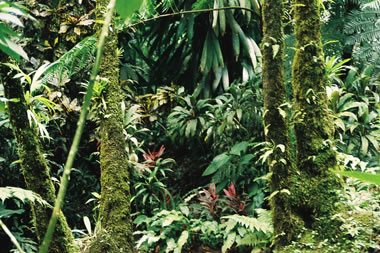
There are about 42 million square kilometers of forest on Earth, which covers almost a third of the land surface. Those wooded environments play a key role in both lessening and adding to global warming.
Click on image for full size
Image Courtesy of Nicolle Rager Fuller, National Science Foundation

If a Tree Falls in the Forest, and No One Is Around to Hear It, Does Climate Change?
News story originally written on June 12, 2008

Forests cover almost a third of the land surface on Earth. A new report is out about forests and how they impact global climate. Scientists know that forests play a role in both lessening and adding to global warming, so they are now trying to learn more about how these complex processes happen.

Gordon Bonan, the atmospheric scientist who wrote the report, explained that as people become more aware of climate change, there will be a bigger interest in finding ways to decrease global warming. "Forests have been proposed as a possible solution, so it is imperative that we understand fully how forests influence climate," he added.

Forests have complex relationships with the Sun, the atmosphere, the water cycle and the carbon cycle. Forests are also impacted by human activities. These relationships both add to and subtract from the equations that affect the warming of the planet. For example, in the Amazon, tropical rainforests remove carbon dioxide from the atmosphere. This helps lessen global warming by lowering the levels of greenhouse gases in the atmosphere. These forests also put moisture into the atmosphere, which cools climate and also helps to lessen global warming.

Researchers have realized that it is extremely complicated to calculate the damage that comes from a specific activity, such as cutting down a section of tropical rainforest or burning fossil fuels. Because of this, we need a better understanding of the many influences of forests on climate and how these will change as climate changes. Then we will be able to understand how forests can potentially help lessen global warming.

Last modified July 22, 2008 by Becca Hatheway.

Shop Windows to the Universe Science Store!

Our online store includes issues of NESTA's quarterly journal, The Earth Scientist, full of classroom activities on different topics in Earth and space science, ranging from seismology, rocks and minerals, oceanography, and Earth system science to astronomy!

Windows to the Universe Community

News

Opportunities

You might also be interested in:

Traveling Nitrogen Classroom Activity Kit

Check out our online store - minerals, fossils, books, activities, jewelry, and household items!...more

What Is Climate?

The climate where you live is called regional climate. It is the average weather in a place over more than thirty years. To describe the regional climate of a place, people often tell what the temperatures...more

Global Warming: Scientists Say Earth Is Heating Up

Earth’s climate is warming. During the 20th Century Earth’s average temperature rose 0.6° Celsius (1.1°F). Scientists are finding that the change in temperature has been causing other aspects of our planet...more

Tropical Rainforests

Tropical rainforests are home to thousands of species of animals, plants, fungi and microbes. Scientists suspect that there are many species living in rainforests have not yet been found or described....more

Carbon Dioxide - CO2

Carbon dioxide (CO2) is a kind of gas. There isn't that much carbon dioxide in Earth's atmosphere, but it is still very important. Carbon dioxide is a greenhouse gas. That means it helps trap heat coming...more

Earth's Greenhouse Gases

Even though only a tiny amount of the gases in Earth’s atmosphere are greenhouse gases, they have a huge effect on climate. There are several different types of greenhouse gases. The major ones are carbon...more

Triggers of Volcanic Eruptions in Oregon's Mount Hood Investigated

Scientists have learned that Mount Hood, Oregon's tallest mountain, has erupted in the past due to the mixing of two different types of magma. "The data will help give us a better road map to what a future...more

Oldest Earth Mantle Reservoir Discovered

The Earth's mantle is a rocky, solid shell that is between the Earth's crust and the outer core, and makes up about 84 percent of the Earth's volume. The mantle is made up of many distinct portions or...more

Shop Windows to the Universe

Earth Science Rocks! Select one of our four cool NESTA t-shirts from our online store, and express your love of Earth and space science!

Windows to the Universe, a project of the National Earth Science Teachers Association, is sponsored in part by the National Science Foundation and NASA, our Founding Partners (the American Geophysical Union and American Geosciences Institute) as well as through Institutional, Contributing, and Affiliate Partners, individual memberships and generous donors. Thank you for your support! NASA AGU AGI NSF