Current Events

  • Kansas Legislator Proposes Bill to Outlaw Sustainability Education
    A bill has been introduced in the Kansas legislature this week that would prohibit the promotion of ...Read more

    x

    Kansas Legislator Proposes Bill to Outlaw Sustainability Education

    A bill has been introduced in the Kansas legislature this week that would prohibit the promotion of sustainability. Here is a link to the one-page bill: http://www.kslegislature.org/li/b2013_14/measures/documents/hb2366_00_0000.pdf. See report on Bloomberg News.
  • Earth's Center Is 1,000 Degrees Hotter Than Previously Thought, Synchrotron X-Ray Experiment Shows
    Scientists have determined the temperature near the Earth’s center to be 6000 degrees Celsius, 1000 ...Read more

    x

    Earth's Center Is 1,000 Degrees Hotter Than Previously Thought, Synchrotron X-Ray Experiment Shows

    Scientists have determined the temperature near the Earth’s center to be 6000 degrees Celsius, 1000 degrees hotter than in a previous experiment run 20 years ago. These measurements confirm geophysical models that the temperature difference between the solid core and the mantle above, must be at least 1500 degrees to explain why the Earth has a magnetic field. For more information about this study, see the press release from the European Synchrotron Radiation Facility.
  • Ocean Volcanic Rocks Contain Samples of Recycled Crust
    Scientists have long believed that lava erupted from certain oceanic volcanoes contains materials fr...Read more

    x

    Ocean Volcanic Rocks Contain Samples of Recycled Crust

    Scientists have long believed that lava erupted from certain oceanic volcanoes contains materials from the early Earth’s crust. But decisive evidence for this phenomenon has proven elusive. New research from a team including Carnegie’s Erik Hauri demonstrates that oceanic volcanic rocks contain samples of recycled crust dating back to the Archean era 2.5 billion years ago. Their work is published in Nature. Oceanic crust sinks into the Earth’s mantle at so-called subduction zones, where two plates come together. Much of what happens to the crust during this journey is unknown. Model-dependent studies for how long subducted material can exist in the mantle are uncertain and evidence of very old crust returning to Earth’s surface via upwellings of magma has not been found until now. For more information about these results, see the press release from the Carnegie Institution.
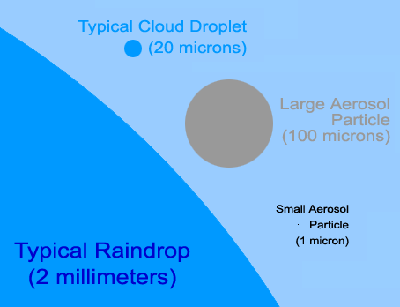
Biological particles--bacteria, pollen, fungi--act as nuclei for formation of ice in clouds
Click on image for full size
Image Courtesy of the National Center for Atmospheric Research

Scientists Make First Direct Observations of Biological Particles in High-Altitude Clouds
News story originally written on May 17, 2009

For a long time, scientists have known that microorganisms can get into the atmosphere and travel long distances. But a new study shows how they help influence cloud formation. The effects of tiny airborne particles called aerosols on cloud formation have been some of the most difficult aspects of weather and climate for scientists to understand.

"If we understand the sources of the particles that nucleate clouds, and their relative abundance, we can determine their impact on climate," said Dr. Kerri Pratt from the University of California at San Diego, Scripps Institution of Oceanography.

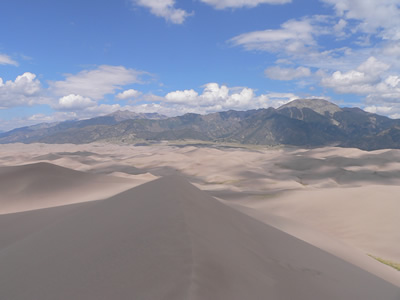
During the project, called Ice in Clouds Experiment - Layer Clouds (ICE-L), scientists sampled water droplets and ice crystals at high speeds while flying through clouds in the skies over Wyoming. Analysis of the ice crystals revealed that the particles that started their growth were made up almost entirely of either dust or biological material such as bacteria, fungal spores, and plant material.

Scientists want to learn more about the interactions between aerosols and clouds because this information will help them predict the future of climate change. Aerosols, including dust, soot, and sea salt, and organic materials, some of which travel thousands of miles, form the skeletons of clouds. Water and ice in the atmosphere condense around these particles and grow, leading to precipitation. Scientists are trying to understand more about this, as clouds play a critical role by both cooling the atmosphere and affecting regional precipitation processes.

During ICE-L, the scientists studied cloud ice crystals and found that half were mineral dust and about a third were made up of inorganic ions mixed with nitrogen, phosphorus and carbon--the signature elements of biological matter.

The findings suggest that the biological particles that get swept up in dust storms help to start the formation of cloud ice, and that their region of origin makes a difference. For example, it seems that dust transported from Asia could be influencing precipitation in North America. Researchers hope to use the ICE-L data to design future studies timed to events when such particles may play a bigger role in triggering rain or snowfall.

Last modified July 7, 2009 by Becca Hatheway.

Shop Windows to the Universe Science Store!

Our online store includes books on science education, classroom activities in The Earth Scientist, mineral and fossil specimens, and educational games!

Windows to the Universe Community

News

Opportunities

You might also be interested in:

Traveling Nitrogen Classroom Activity Kit

Check out our online store - minerals, fossils, books, activities, jewelry, and household items!...more

How Clouds Form

A cloud is composed of tiny water droplets or ice crystals that are suspended in the air. A series of processes have to happen in order for these water droplets or ice crystals to form into clouds in the...more

Aerosols: Tiny Particulates in the Air

When you look up at the sky, you are looking at more than just air. There are also billions of tiny bits of solid and liquid floating in the atmosphere. Those tiny floating particles are called aerosols...more

Modeling the Future of Climate Change

To figure out the future of climate change, scientists need tools to measure how Earth responds to change. Some of these tools are global climate models. Using models, scientists can better understand...more

Condensation

Condensation is the process by which water changes its state from a vapor or gas to a liquid. Condensation is responsible for the formation of clouds. Common examples of condensation are: dew forming on...more

Element (Chemical Element)

An element (also called a "chemical element") is a substance made up entirely of atoms having the same atomic number; that is, all of the atoms have the same number of protons. Hydrogen, helium, oxygen,...more

Rain

Rain is precipitation that falls to the Earth in drops of 5mm or more in diameter according to the US National Weather Service. Virga is rain that evaporates before reaching the ground. Raindrops form...more

Triggers of Volcanic Eruptions in Oregon's Mount Hood Investigated

Scientists have learned that Mount Hood, Oregon's tallest mountain, has erupted in the past due to the mixing of two different types of magma. "The data will help give us a better road map to what a future...more

Shop Windows to the Universe

Warnings: The True Story of How Science Tamed the Weather by Mike Smith tells the story of our storm warning system. See our online store book collection.

Windows to the Universe, a project of the National Earth Science Teachers Association, is sponsored in part by the National Science Foundation and NASA, our Founding Partners (the American Geophysical Union and American Geosciences Institute) as well as through Institutional, Contributing, and Affiliate Partners, individual memberships and generous donors. Thank you for your support! NASA AGU AGI NSF