Current Events

  • Atmospheric CO2 Level Tops 400 ppm
    During the week of May 13th, the CO2 level at the Mauna Loa Observatory in Hawaii topped 400 ppm rep...Read more

    x

    Atmospheric CO2 Level Tops 400 ppm

    During the week of May 13th, the CO2 level at the Mauna Loa Observatory in Hawaii topped 400 ppm repeatedly. Daily levels of CO2 can vary due to weather, and there are seasonal trends as well. The level of atmospheric greenhouse gases continues to increase, now over 120 ppm since the Industrial Revolution began. For more on the Keeling Curve, see http://keelingcurve.ucsd.edu/. Find out more about greenhouse gases and warming.
  • Massive Tornado Outbreak on Tornado Alley
    The week of May 19 brings dozens of tornadoes to Tornado Alley in the states of Oklahoma, Kansas, Io...Read more

    x

    Massive Tornado Outbreak on Tornado Alley

    The week of May 19 brings dozens of tornadoes to Tornado Alley in the states of Oklahoma, Kansas, Iowa, Illinois and Missouri. On May 20th, a massive tornado struck Moore, Oklahoma, devastating communities - destroying over 100 homes and hitting two elementary schools and a hospital - with many casualties and deaths. Our thoughts are with our friends and colleagues suffering from these storms. For more on the May 20th storms, see the NOAA Storm Prediction Center Storm Report.
  • Kansas Legislator Proposes Bill to Outlaw Sustainability Education
    A bill has been introduced in the Kansas legislature this week that would prohibit the promotion of ...Read more

    x

    Kansas Legislator Proposes Bill to Outlaw Sustainability Education

    A bill has been introduced in the Kansas legislature this week that would prohibit the promotion of sustainability. Here is a link to the one-page bill: http://www.kslegislature.org/li/b2013_14/measures/documents/hb2366_00_0000.pdf. See report on Bloomberg News.
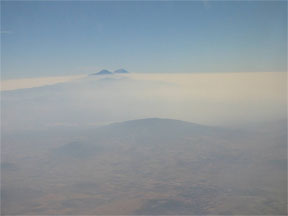
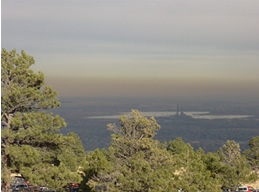
Thick smog often obscures the sky over Beijing and nearby regions. Residents are frequently warned to spend as little time as possible outdoors, due to the air pollution.
Click on image for full size
Image Courtesy of NASA

Scientists to Assess Beijing Olympics Air Pollution Control Efforts
News story originally written on August 7, 2008

During the Summer Olympics in Beijing, China, scientists have a once-in-a-lifetime opportunity to observe what happens in the atmosphere a heavily populated part of the world cuts back on everyday industrial emissions. Chinese officials have cut back on industrial activity by as much as 30 percent and required that people don't drive their cars very much in order to make the air in Beijing cleaner for the athletes competing in the Olympics.

An unmanned aircraft that has special scientific equipment will go on a series of flights to measure smog and and how it affects conditions in the atmosphere. The flights will start at the South Korean island of Cheju, located about 1,165 kilometers (725 miles) southeast of Beijing. Cheju is in the path of pollution plumes that begin in various cities in China, including Beijing.

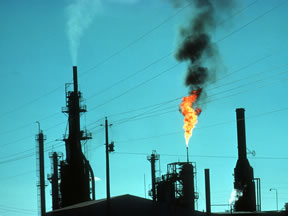
Dust, soot, and other pollution aerosols are a major contributor to global warming. Scientists are interested in learning what happens in the atmosphere when less soot is released during the Olympics.

Last modified August 12, 2008 by Becca Hatheway.

Shop Windows to the Universe Science Store!

Learn about Earth and space science, and have fun while doing it! The games section of our online store includes a climate change card game and the Traveling Nitrogen game!

Windows to the Universe Community

News

Opportunities

You might also be interested in:

Cool It! Game

Check out our online store - minerals, fossils, books, activities, jewelry, and household items!...more

Air Pollution Sources

Air pollution comes from many sources. Some natural sources affect air quality. Volcanoes produce sulfur, chlorine, and ash. Wildfires make smoke and carbon monoxide. Cattle and other animals release methane...more

Air Pollution

Have you ever heard of air pollution? Air pollution is not new. 700 years ago, when people started burning large amounts of coal 700 years ago in London, England, they complained about the dust and soot...more

Aerosols: Tiny Particulates in the Air

When you look up at the sky, you are looking at more than just air. There are also billions of tiny bits of solid and liquid floating in the air. These tiny particles are called aerosols or particulates....more

Global Warming: Scientists Say Earth Is Heating Up

Earth’s climate is getting warmer. During the past 100 years Earth’s average temperature rose about 0.6° Celsius (1.0° F). Things that people are doing like burning fossil fuels, changing the way land...more

Pollution's Effects on Us

The air is shared by everyone and everything on Earth. Living things breathe it and depend upon on it for life. When pollution is added to it, we can’t stop breathing or escape from it. After all, air...more

Finding Answers in the Clouds

Scientists are sending tiny airplanes buzzing in the sky to find out how air pollution can impact weather, climate, and global warming. The tiny airplanes look like regular planes but they have only a...more

Triggers of Volcanic Eruptions in Oregon's Mount Hood Investigated

Scientists have learned that Mount Hood, Oregon's tallest mountain, has erupted in the past due to the mixing of two different types of magma. Adam Kent, a geologist at Oregon State University, says this...more

Windows to the Universe, a project of the National Earth Science Teachers Association, is sponsored in part by the National Science Foundation and NASA, our Founding Partners (the American Geophysical Union and American Geosciences Institute) as well as through Institutional, Contributing, and Affiliate Partners, individual memberships and generous donors. Thank you for your support! NASA AGU AGI NSF