Click on image for full size
NASA
Pathfinder Science Results Are In!
News story originally written on July 28, 1997
Though the Mars Pathfinder has just completed its third week on the surface of Mars, the mission has already shown itself to be extremely successful. In fact, the Pathfinder mission has fulfilled all of its primary science goals and is still operating flawlessly.
More than 300 megabits of data were returned in the last week and Pathfinder project scientists are starting to release preliminary science findings. One such finding is the diversity of the rocks located very near the lander. Within close proximity of the lander area, there are many rocks of varying color and varying composition. In fact, the rover's spectral analysis has shown variance in the amount of iron within the rocks and the amount of weathering that the rocks in the surrounding area have undergone. The possibility is that these rocks are not volcanic as once hyphothesized, but rather they may be the result of a past impact event.
Although the rocks surrounding the Carl Sagan Memorial station show much diversity, the soil in the area does not. In fact, the three Sojourner anaylses are all quite similar to past Viking soil samples taken over 1000 kilometers away from the Pathfinder landing area. This implies that there is a globally homogeneous soil layer on Mars, probably the result of many years of mixing by the Martian winds. As a result, the Sojourner rover will continue to concentrate on analyzing rocks for the rest of the mission.



Shop Windows to the Universe Science Store!
Our
online store includes fun
classroom activities for you and your students.
Issues of NESTA's quarterly journal, The Earth Scientist are also full of classroom activities on different topics in Earth and space science!
You might also be interested in:

It was another exciting and frustrating year for the space science program. It seemed that every step forward led to one backwards. Either way, NASA led the way to a great century of discovery. Unfortunately,
...more
The Space Shuttle Discovery lifted off from Kennedy Space Center at 2:19 p.m. EST, October 29th. The sky was clear and the weather was great as Discovery took 8 1/2 minutes to reach orbit for the Unitied
...more
A moon was discovered orbiting the asteroid, Eugenia. This is only the second time in history that a satellite has been seen circling an asteroid. A special mirror allowed scientists to find the moon
...more
Will Russia ever put the service module for the International Space Station in space? NASA officials are demanding an answer from the Russian government. The necessary service module is currently waiting
...more
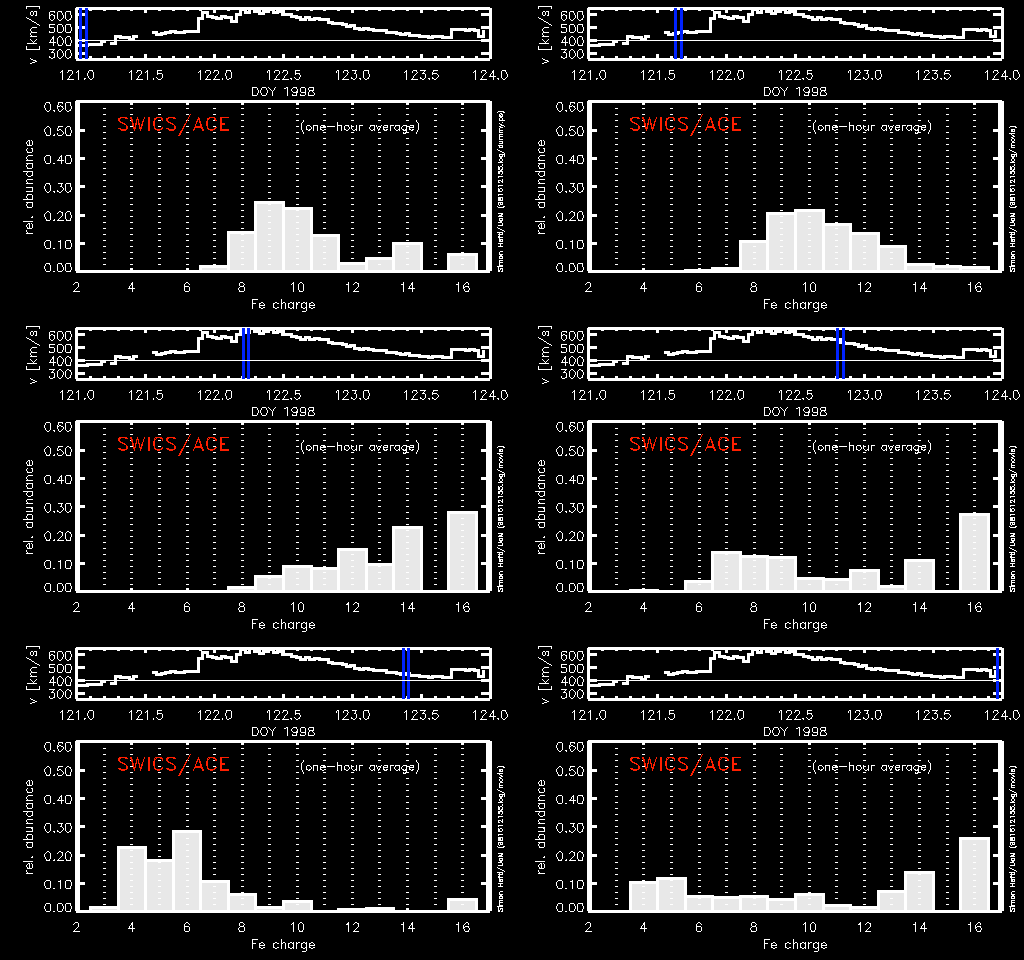
During a period of about two days in early May, 1998, the ACE spacecraft was immersed in plasma associated with a coronal mass ejection (CME). The SWICS instrument on ACE, which determines unambiguously
...more
J.S. Maini of the Canadian Forest Service has referred to forests as the "heart and lungs of the world." Forests reduce soil erosion, maintain water quality, contribute to atmospheric humidity and cloud
...more
In late April through mid-May 2002, all five naked-eye planets are visible simultaneously in the night sky! This is includes Mercury which is generally very hard to see because of its proximity to the
...more