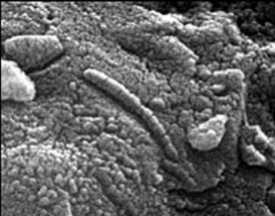
An image of the interior of a Martian rock. Some scientists believe the worm-like shape is a fossil of a microbe from Mars.
Click on image for full size
Courtesy of NASA
Are We From Mars?
News story originally written on January 19, 2000
A recent study shows there is a possibility that we came from Mars! No, that doesn't mean a spaceship flew here and dropped us off. Rather, scientists say chunks of rock were thrown off the Red Planet billions of years ago. These rocks may have contained tiny microbes
that started life on Earth.
"The ancestral cell for life on Earth must have originated somewhere in our own solar
system," said Curt Mileikowsky, an astronomer of the Royal Institute of Technology
in Stockholm and a leader of the research team.
Scientists say Mars is a logical source of life. They say trillions of rocks were broken off Mars by colliding asteroids. If this is true, then a large number of these rocks would have made it to Earth. Unfortunately, only a few Martian rocks have been found, but scientists say there are more to be discovered.
Although there is no chance for life to exist on Mars now, long ago the planet was capable of supporting life. At that time, it had mild temperatures, the proper atmosphere and water. In order for the microbes to make it to Earth, they must have been buried deep inside the rocks. The rock itself would protect the microbes from radiation and the intense heat that would come from entering our atmosphere.
"If the size (of the rock) is more than a football," he said, "heat would not have
time to get inside."



Shop Windows to the Universe Science Store!
Our
online store includes
books on science education,
classroom activities in The Earth Scientist,
mineral and
fossil specimens, and
educational games!
You might also be interested in:

It was another exciting and frustrating year for the space science program. It seemed that every step forward led to one backwards. Either way, NASA led the way to a great century of discovery. Unfortunately,
...more
The Space Shuttle Discovery lifted off from Kennedy Space Center at 2:19 p.m. EST, October 29th. The sky was clear and the weather was great as Discovery took 8 1/2 minutes to reach orbit for the Unitied
...more
A moon was discovered orbiting the asteroid, Eugenia. This is only the second time in history that a satellite has been seen circling an asteroid. A special mirror allowed scientists to find the moon
...more
Will Russia ever put the service module for the International Space Station in space? NASA officials are demanding an answer from the Russian government. The necessary service module is currently waiting
...more
During a period of about two days in early May, 1998, the ACE spacecraft was immersed in plasma associated with a coronal mass ejection (CME). The SWICS instrument on ACE, which determines unambiguously
...more
J.S. Maini of the Canadian Forest Service has referred to forests as the "heart and lungs of the world." Forests reduce soil erosion, maintain water quality, contribute to atmospheric humidity and cloud
...more
In late April through mid-May 2002, all five naked-eye planets are visible simultaneously in the night sky! This is includes Mercury which is generally very hard to see because of its proximity to the
...more