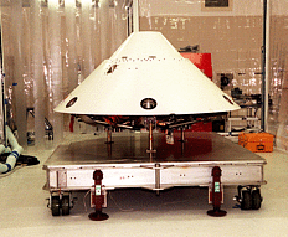
The Mars Polar Lander was lost on December 3, 1999.
Click on image for full size
Courtesy of NASA
Still Looking for Lander
News story originally written on January 10, 2000
Amongst reports that the Mars Polar Lander fell into a deep canyon, scientists are reporting
the cause of the disaster is still unknown.Organizers of the mission also pointed out they knew
the canyon was near the landing site. A recent article in the Post suggested scientists didn't know the canyone existed.
This huge 'hole' is 30 X 8 miles with slopes greater than 20 percent. Scientists say that slopes greater than 16 percent could cause the Lander to topple over.
“It’s closer than we wanted to be,” said Richard Zurek, the mission’s project scientist.
“We knew about this deep valley and the crater right from the beginning of our site selection. We knew this was an area we didn’t particularly want
to set down in.”
Still, Zurek says it was the safest possible landing site. Strong winds of 75 miles per hour would be necessary from the surface to 30 miles in altitude
for the spacecraft to be blown into the pit. Scientists are not ruling this out, but they believe it is more likely there was a failure aboard the craft.
“Definitely, the surface is one possible explanation of the
apparent loss of the Mars Polar Lander,” Zurek said. “There’s
nothing that points to that as the sole reason for that failure.”
The Mars Surveyor is mapping the area near the landing site, looking for any evidence. Until then, leaders of the mission are taking the blame. “I don’t think any of us are off
the hook here,” Zurek said.



Shop Windows to the Universe Science Store!
Our
online store includes fun
classroom activities for you and your students.
Issues of NESTA's quarterly journal, The Earth Scientist are also full of classroom activities on different topics in Earth and space science!
You might also be interested in:

Just when everyone had given up hope, a faint signal was received at Stanford University. Scientists say it most likely came from Mars, although they won't know for sure until later this week. The signals
...more
It was another exciting and frustrating year for the space science program. It seemed that every step forward led to one backwards. Either way, NASA led the way to a great century of discovery. Unfortunately,
...more
The Space Shuttle Discovery lifted off from Kennedy Space Center at 2:19 p.m. EST, October 29th. The sky was clear and the weather was great as Discovery took 8 1/2 minutes to reach orbit for the Unitied
...more
A moon was discovered orbiting the asteroid, Eugenia. This is only the second time in history that a satellite has been seen circling an asteroid. A special mirror allowed scientists to find the moon
...more
Will Russia ever put the service module for the International Space Station in space? NASA officials are demanding an answer from the Russian government. The necessary service module is currently waiting
...more
During a period of about two days in early May, 1998, the ACE spacecraft was immersed in plasma associated with a coronal mass ejection (CME). The SWICS instrument on ACE, which determines unambiguously
...more
J.S. Maini of the Canadian Forest Service has referred to forests as the "heart and lungs of the world." Forests reduce soil erosion, maintain water quality, contribute to atmospheric humidity and cloud
...more