Current Events

  • Atmospheric CO2 Level Tops 400 ppm
    During the week of May 13th, the CO2 level at the Mauna Loa Observatory in Hawaii topped 400 ppm rep...Read more

    x

    Atmospheric CO2 Level Tops 400 ppm

    During the week of May 13th, the CO2 level at the Mauna Loa Observatory in Hawaii topped 400 ppm repeatedly. Daily levels of CO2 can vary due to weather, and there are seasonal trends as well. The level of atmospheric greenhouse gases continues to increase, now over 120 ppm since the Industrial Revolution began. For more on the Keeling Curve, see http://keelingcurve.ucsd.edu/. Find out more about greenhouse gases and warming.
  • Massive Tornado Outbreak on Tornado Alley
    The week of May 19 brings dozens of tornadoes to Tornado Alley in the states of Oklahoma, Kansas, Io...Read more

    x

    Massive Tornado Outbreak on Tornado Alley

    The week of May 19 brings dozens of tornadoes to Tornado Alley in the states of Oklahoma, Kansas, Iowa, Illinois and Missouri. On May 20th, a massive tornado struck Moore, Oklahoma, devastating communities - destroying over 100 homes and hitting two elementary schools and a hospital - with many casualties and deaths. Our thoughts are with our friends and colleagues suffering from these storms. For more on the May 20th storms, see the NOAA Storm Prediction Center Storm Report.
  • Kansas Legislator Proposes Bill to Outlaw Sustainability Education
    A bill has been introduced in the Kansas legislature this week that would prohibit the promotion of ...Read more

    x

    Kansas Legislator Proposes Bill to Outlaw Sustainability Education

    A bill has been introduced in the Kansas legislature this week that would prohibit the promotion of sustainability. Here is a link to the one-page bill: http://www.kslegislature.org/li/b2013_14/measures/documents/hb2366_00_0000.pdf. See report on Bloomberg News.
This is the Hubble Deep Field-South, an exposure taken over ten days in October, 1998.
Click on image for full size
Hubble Space Telescope image courtesy of STScI

Hubble Heads South for the Winter
News story originally written on November 23, 1998

Scientists now have a compliment to the Hubble Deep Field--it's the Hubble Deep Field-South. The HDF-S is a 10-day-long exposure of a piece of the southern hemisphere sky taken in October 1998.

"We have eagerly awaited this new set of images ever since the first HDF, which had a dramatic impact on the entire science of astronomy," said STScI astronomer Robert Williams. "Hubble's deep field views revealed a large, heretofore unseen fraction of the universe and opened it up to interpretation and understanding."

The Hubble Space Telescope looked at a section of of the constellation Tucana to create the HDF-S. The original HDF was taken from a section of space near the Big Dipper. Scientists also wanted the HDF-S to look at a distant quasar to gather more information than they had through the HDF.

The two cosmic "core samples" appear to support the theory that the universe is uniform (on a large scale) regardless of the direction you look. If scientists tried to map the entire sky using the technique they used to get the two deep fields, it would take 900,000 years.

Shop Windows to the Universe Science Store!

Learn about Earth and space science, and have fun while doing it! The games section of our online store includes a climate change card game and the Traveling Nitrogen game!

Windows to the Universe Community

News

Opportunities

You might also be interested in:

Cool It! Game

Check out our online store - minerals, fossils, books, activities, jewelry, and household items!...more

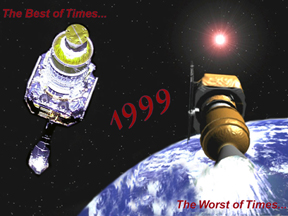
1999--A Year in Review...

It was another exciting and frustrating year for the space science program. It seemed that every step forward led to one backwards. Either way, NASA led the way to a great century of discovery. Unfortunately,...more

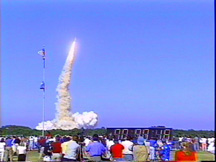
STS-95 Launch: "Let the wings of Discovery lift us on to the future."

The Space Shuttle Discovery lifted off from Kennedy Space Center at 2:19 p.m. EST, October 29th. The sky was clear and the weather was great as Discovery took 8 1/2 minutes to reach orbit for the Unitied...more

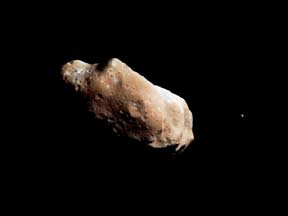
Moon Found Orbiting Asteroid

A moon was discovered orbiting the asteroid, Eugenia. This is only the second time in history that a satellite has been seen circling an asteroid. A special mirror allowed scientists to find the moon...more

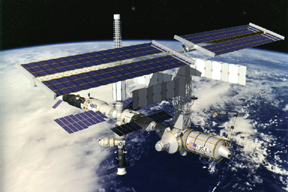
U.S. is Fed Up with Russia

Will Russia ever put the service module for the International Space Station in space? NASA officials are demanding an answer from the Russian government. The necessary service module is currently waiting...more

More on Recent Coronal Mass Ejection

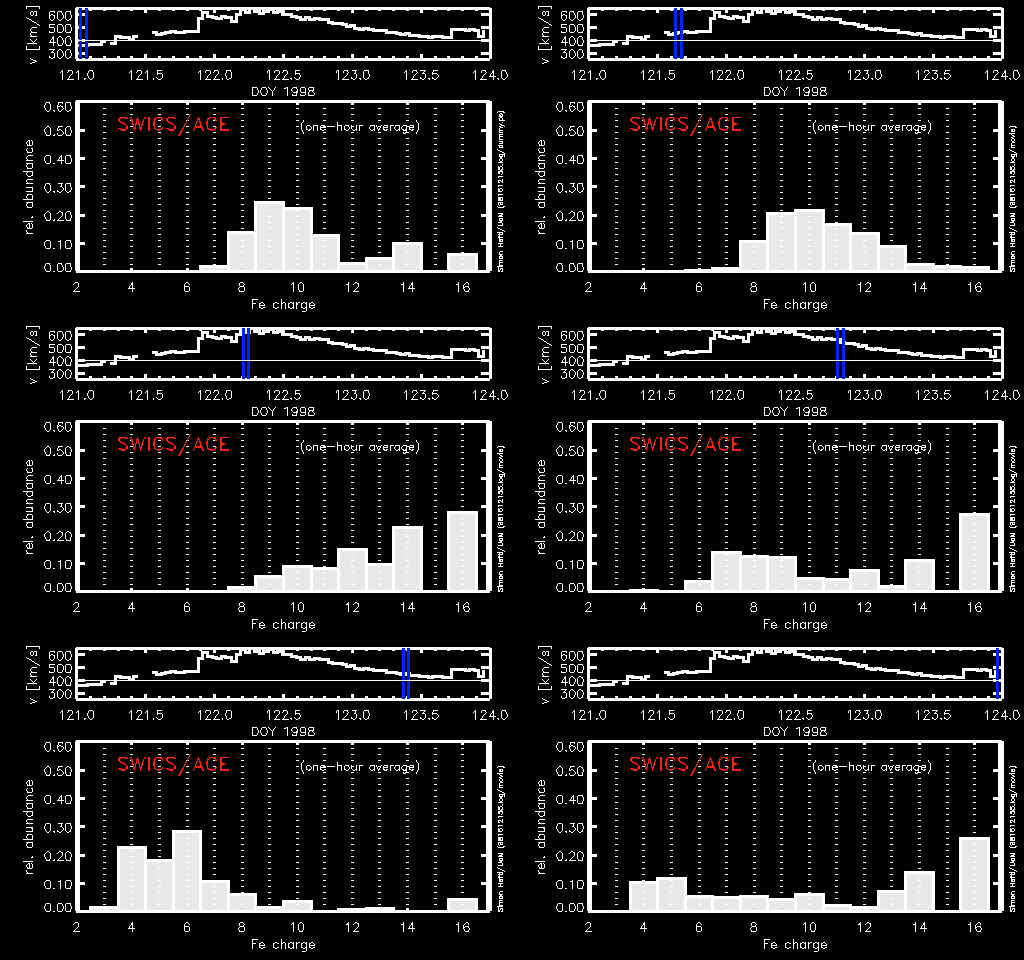
During a period of about two days in early May, 1998, the ACE spacecraft was immersed in plasma associated with a coronal mass ejection (CME). The SWICS instrument on ACE, which determines unambiguously...more

Mother Nature's Air Conditioning

J.S. Maini of the Canadian Forest Service has referred to forests as the "heart and lungs of the world." Forests reduce soil erosion, maintain water quality, contribute to atmospheric humidity and cloud...more

Planetary Alignment 2002

In late April through mid-May 2002, all five naked-eye planets are visible simultaneously in the night sky! This is includes Mercury which is generally very hard to see because of its proximity to the...more

Shop Windows to the Universe

The Universe at Your Fingertips 2.0 DVD from the Astronomical Society of the Pacific is in our online store, filled with Earth and space science resources.

Windows to the Universe, a project of the National Earth Science Teachers Association, is sponsored in part by the National Science Foundation and NASA, our Founding Partners (the American Geophysical Union and American Geosciences Institute) as well as through Institutional, Contributing, and Affiliate Partners, individual memberships and generous donors. Thank you for your support! NASA AGU AGI NSF