This pair of pictures was taken by the Galileo spacecraft. It shows a dynamic eruption at Tvashtar Catena, a chain of volcanic bowls on Jupiter's moon Io. You can see that the location of lava from November 1999 to November 2000 has changed. Galileo really is a special spacecraft in that it allows us to see cool things like volcanoes on other worlds!
Click on image for full size
Courtesy of NASA/JPL
Galileo - Still Earning Frequent Flyer Miles!
News story originally written on May 22, 2001
The
Galileo spacecraft was launched in October 1989. So, Galileo has been in space more than 10 years and it has been orbiting
Jupiter for more than five years. Galileo is still going strong!
"We're proud that this workhorse of a spacecraft has kept
performing well enough that we can ask it to keep serving
science a little longer," commented Dr. Jay Bergstralh, Acting
Director of Solar System Exploration at NASA Headquarters.
Galileo has already survived 3 times the radiation exposure it was built to withstand. And its mission has already been extended twice. But, NASA is extending Galileo's mission one last time!
Galileo will do 5 more flybys of Jupiter's moons. Then, in August 2003, Galileo will head straight for Jupiter. It will plunge into the atmosphere and burn up!
Galileo has already been a great success! Here's some of Galileo's accomplishments:
Data collected from Galileo has provided evidence that there may be liquid, saltwater oceans underneath the icy surfaces of Europa, Ganymede and Callisto.
Galileo has been able to make a lot of observations of Io's volcanoes.
The first atmospheric probe to dive into Jupiter's atmosphere was delivered by Galileo in 1995.
Galileo also discovered the origin of Jupiter's Rings.
The first discovery of an asteroid to have a moon was made by Galileo in 1993.
Galileo was the only direct observer of comet Shoemaker-Levy's impact into Jupiter.
You might also be interested in:
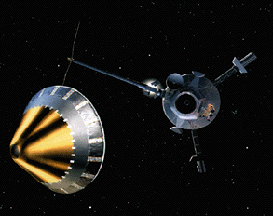
The Galileo spacecraft was launched on October 19, 1989. Galileo had two parts: an orbiter and a descent probe that parachuted into Jupiter's atmosphere. Galileo's main mission was to explore Jupiter and
...more
The Galileo spacecraft photographed volcanoes on the surface of Io, one of Jupiter's moons. Scientists believe there are at least 300 volcanoes on the moon. These volcanoes are somewhat different than
...more
Scientists recently discovered the origin of Jupiter's rings. With the help of the Galileo spacecraft, scientists figured out that the rings are made from dust that was kicked off of the small moons surrounding
...more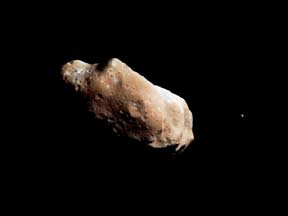
A moon was discovered orbiting the asteroid, Eugenia. This is only the second time in history that a satellite has been seen circling an asteroid. A special mirror allowed scientists to find the moon
...more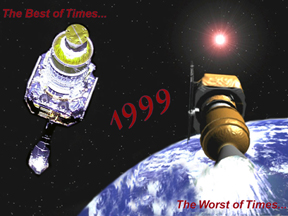
It was another exciting and frustrating year for the space science program. It seemed that every step forward led to one backwards. Either way, NASA led the way to a great century of discovery. Unfortunately,
...more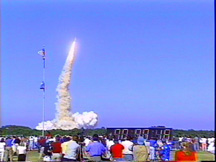
The Space Shuttle Discovery lifted off from Kennedy Space Center on October 29th at 2:19 p.m. EST. The weather was great as Discovery took 8 1/2 minutes to reach orbit. This was the United States' 123rd
...more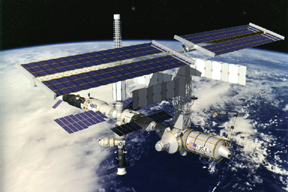
Will Russia ever put the service module for the International Space Station in space? NASA officials want an answer from the Russian government. The necessary service module is currently waiting to be
...more