The Coqui Dos decal featuring the Coqui frog riding aboard a rocket...
Click on image for full size
Courtesy of NASA
Frogs in Space!?!
News story originally written on February 9, 1998
Some of you may remember the
Muppet Show that hosted a segment named 'Pigs in Spaaaace!' Well, now people are talking about 'Frogs in Spaaaace!' It isn't real frogs people are talking about; this is NASA's program that will launch 11 rockets in 2 months...What are the details?
NASA will begin its rocket launching campaign February 12, 1998. All 11 of the rockets will be launched from Puerto Rico. The campaign has been named El Coqui after the native Puerto Rican frog which is of ecological and cultural significance.
The purpose of the Coqui program is to increase our understanding of space weather and its interaction with the upper atmosphere. "People tend to think that space is a quiet place with no activity. However, over the years we have come to realize that the contrary is true," said Mike Kelley, a professor at Cornell University and principal investigator for two of the rocket launches. The layers that El Coqui will investigate are the layers where radio, television and satellite communications get disrupted. So you see, this mission is very important!
Five of the rockets have payloads that carry the chemical trimethyaluminum (TMA). This chemical will be released in the ionosphere at an altitude between 50-93 miles. This chemical forms a cloud that will luminesce for 10-20 minutes. These clouds will be tracked to see where atmospheric turbulent layers occur. NASA has promised that this chemical, which has been a concern for local Puerto Ricans, is harmless.
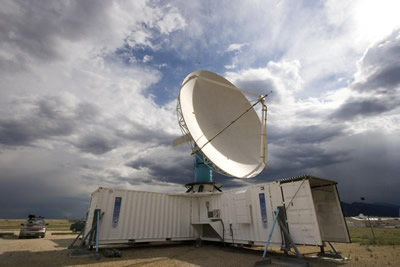
The El Coqui project will work in combination with the Arecibo radio telescope in Puerto Rico.



Shop Windows to the Universe Science Store!
Our
online store includes
issues of NESTA's quarterly journal, The Earth Scientist, full of classroom activities on different topics in Earth and space science, ranging from
seismology,
rocks and minerals,
oceanography, and
Earth system science to
astronomy!
You might also be interested in:

Radar is short for "radio detection and ranging". A transmitter emits pulses of high frequency electromagnetic waves (radio waves). These waves strike conductive objects and are backscattered to the receiver.
...more
It was another exciting and frustrating year for the space science program. It seemed that every step forward led to one backwards. Either way, NASA led the way to a great century of discovery. Unfortunately,
...more
The Space Shuttle Discovery lifted off from Kennedy Space Center at 2:19 p.m. EST, October 29th. The sky was clear and the weather was great as Discovery took 8 1/2 minutes to reach orbit for the Unitied
...more
A moon was discovered orbiting the asteroid, Eugenia. This is only the second time in history that a satellite has been seen circling an asteroid. A special mirror allowed scientists to find the moon
...more
Will Russia ever put the service module for the International Space Station in space? NASA officials are demanding an answer from the Russian government. The necessary service module is currently waiting
...more
During a period of about two days in early May, 1998, the ACE spacecraft was immersed in plasma associated with a coronal mass ejection (CME). The SWICS instrument on ACE, which determines unambiguously
...more
J.S. Maini of the Canadian Forest Service has referred to forests as the "heart and lungs of the world." Forests reduce soil erosion, maintain water quality, contribute to atmospheric humidity and cloud
...more