This is a picture made by an artist to show what the Jupiter-like planet orbiting the star, 55 Cancri, might look like. We do not have photographs of what it actually looks like because the planet is about 41 light years from Earth. A small moon is shown in front of the planet because moons are thought to be common around this type of planet, but no moon has been found.
Click on image for full size
An Exoplanet that Looks Like Jupiter!
News story originally written on June 18, 2002
Astronomers Dr. Geoffrey Marcy and Dr. Paul Butler announced that, after 15 years of observation, their team has found 13 extrasolar planets (or exoplanets), and that one of these exoplanets may be somewhat like Jupiter. The planet that reminds the scientists of Jupiter is orbiting a star called 55 Cancri, within the Cancer constellation.
The research team is very excited about the discovery of this planet because it is very different from any of the other 90 or so exoplanets that have been identified so far. As Dr Marcy states, “all other extrasolar planets discovered up to now orbit closer to the parent star, and most of them have had elongated, eccentric orbits. This new planet orbits as far from its star as Jupiter orbits from the Sun.”
Jupiter is about four and a half times further from the Sun than Earth and it takes the planet about 12 years to complete one orbit around the Sun. The new planet, a similar distance from 55 Cancri, takes 13 years to orbit around the star.
The new planet is not the only one orbiting 55 Cancri. There is another exoplanet, discovered in 1996, that orbits very close to the star. Scientists suspect that there may be a third exoplanet orbiting the star as well.
The new planet is not exactly like Jupiter, however. It is much more massive than Jupiter, with a mass about 3.5-5 times greater. Its orbit is also different than Jupiter’s, taking an elliptical route around the star. Even though differences exist, the scientific team is encouraged that we may someday find more exoplanets that are like those in our own solar system.
Last modified June 24, 2002 by Lisa Gardiner.
You might also be interested in:
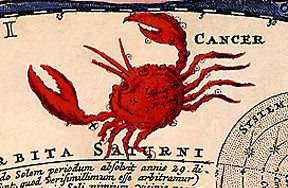
According to an ancient Greek legend, the figure of a gigantic crab was placed in the nighttime sky by the goddess Hera to form the constellation Cancer. Hera was the jealous wife of the sky god, Zeus.
...more
It was another exciting and frustrating year for the space science program. It seemed that every step forward led to one backwards. Either way, NASA led the way to a great century of discovery. Unfortunately,
...more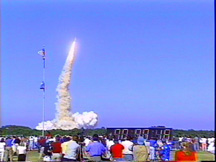
The Space Shuttle Discovery lifted off from Kennedy Space Center at 2:19 p.m. EST, October 29th. The sky was clear and the weather was great as Discovery took 8 1/2 minutes to reach orbit for the Unitied
...more
A moon was discovered orbiting the asteroid, Eugenia. This is only the second time in history that a satellite has been seen circling an asteroid. A special mirror allowed scientists to find the moon
...more
Will Russia ever put the service module for the International Space Station in space? NASA officials are demanding an answer from the Russian government. The necessary service module is currently waiting
...more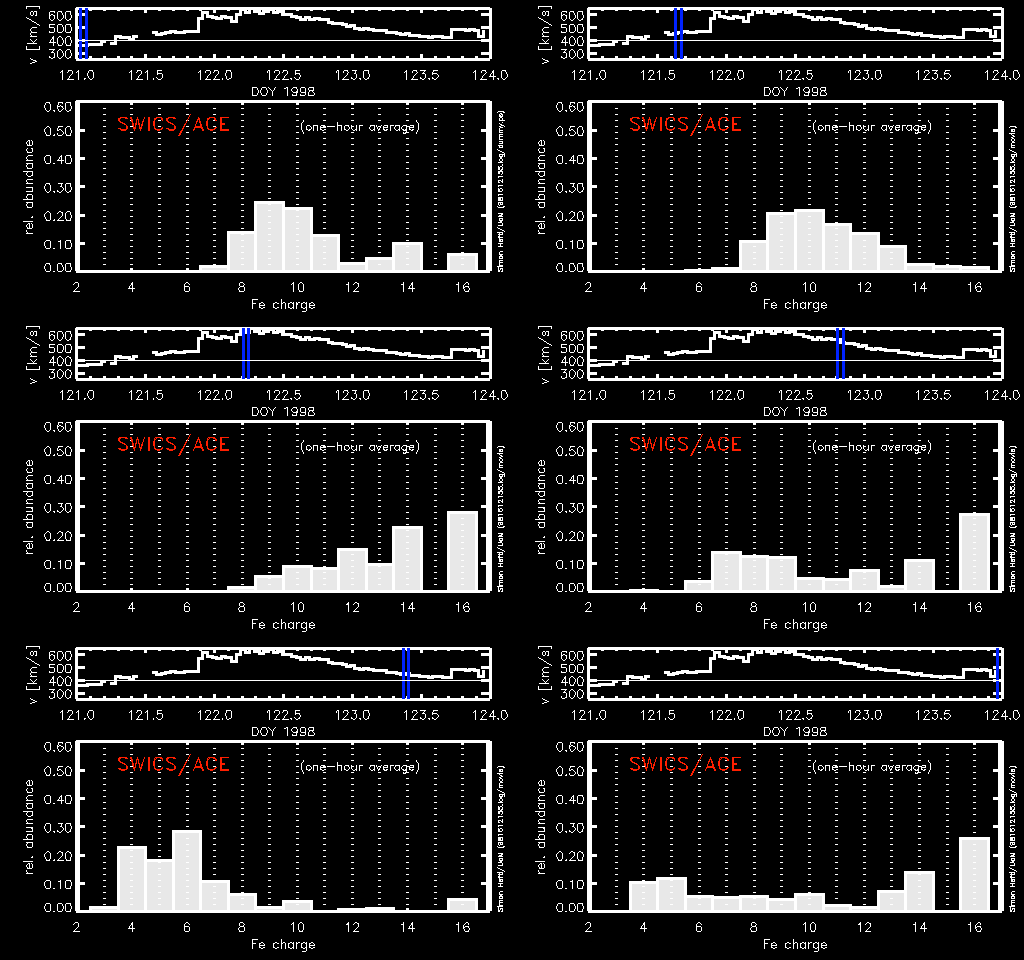
During a period of about two days in early May, 1998, the ACE spacecraft was immersed in plasma associated with a coronal mass ejection (CME). The SWICS instrument on ACE, which determines unambiguously
...more
J.S. Maini of the Canadian Forest Service has referred to forests as the "heart and lungs of the world." Forests reduce soil erosion, maintain water quality, contribute to atmospheric humidity and cloud
...more