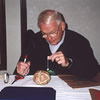
The Moon during an eclipse in 1993.
Click on image for full size
Courtesy of Andy Steere
Lunar Eclipse - November 2003
News story originally written on November 7, 2003
There will be an eclipse of the Moon on Saturday
night, November 8, 2003. It will be the second lunar eclipse in 2003. This eclipse
is a total eclipse of the Moon, which
means the Moon will pass through the darkest part of Earth's shadow.
During the eclipse, the Moon will look dark red. Even the darkest part of
Earth's shadow lets a little light through. The light that gets through passes
through Earth's atmosphere, which blocks out the light that isn't red. That's
why the Sun looks red at sunset, too.
The main part of the eclipse will last about 25 minutes. Check out the link
to NASA's site (below) to find out when the eclipse can be seen from where you
live.
You might also be interested in:
Scientists have recently discovered that thousands of Adelie Penguins thrive in patches of the chilly Southern Ocean near Antarctica's coastline. In these special areas of the ocean, called polynyas,
...more
Mount St. Helens, a volcano in Washington on the west coast of the United States, has been quiet for 18 years but now it is quiet no more! It has been puffing steam and ash as scientists look for clues
...more
Today, our climate is changing very rapidly. To better understand how speedy climate change may affect plants and animals in the future, scientists are looking at the past. The scientists are looking
...more
A large meteor exploded in the sky near Chicago shortly after midnight on the morning of March 28, 2003. People in Wisconsin, Illinois, Indiana, and Ohio saw the meteor break apart in Earth's atmosphere.
...more
Take a look at this picture! The light blue parts are coral reefs just under the surface of the Red Sea. The crew of the International Space Station (ISS) took the picture on May 20, 2003 as they looked
...more
There will be an eclipse of the Moon on Thursday night, May 15, 2003. It will be the first eclipse in 2003. This eclipse is a total eclipse of the Moon, which means the Moon will pass through the darkest
...more
Figuring out what tomorrow's weather will be can be a tough job. But now scientists have made a new tool that will make it easier. It looks at the weather from above! The tool is orbiting Earth aboard
...more