Current Events

  • Kansas Legislator Proposes Bill to Outlaw Sustainability Education
    A bill has been introduced in the Kansas legislature this week that would prohibit the promotion of ...Read more

    x

    Kansas Legislator Proposes Bill to Outlaw Sustainability Education

    A bill has been introduced in the Kansas legislature this week that would prohibit the promotion of sustainability. Here is a link to the one-page bill: http://www.kslegislature.org/li/b2013_14/measures/documents/hb2366_00_0000.pdf. See report on Bloomberg News.
  • Earth's Center Is 1,000 Degrees Hotter Than Previously Thought, Synchrotron X-Ray Experiment Shows
    Scientists have determined the temperature near the Earth’s center to be 6000 degrees Celsius, 1000 ...Read more

    x

    Earth's Center Is 1,000 Degrees Hotter Than Previously Thought, Synchrotron X-Ray Experiment Shows

    Scientists have determined the temperature near the Earth’s center to be 6000 degrees Celsius, 1000 degrees hotter than in a previous experiment run 20 years ago. These measurements confirm geophysical models that the temperature difference between the solid core and the mantle above, must be at least 1500 degrees to explain why the Earth has a magnetic field. For more information about this study, see the press release from the European Synchrotron Radiation Facility.
  • Ocean Volcanic Rocks Contain Samples of Recycled Crust
    Scientists have long believed that lava erupted from certain oceanic volcanoes contains materials fr...Read more

    x

    Ocean Volcanic Rocks Contain Samples of Recycled Crust

    Scientists have long believed that lava erupted from certain oceanic volcanoes contains materials from the early Earth’s crust. But decisive evidence for this phenomenon has proven elusive. New research from a team including Carnegie’s Erik Hauri demonstrates that oceanic volcanic rocks contain samples of recycled crust dating back to the Archean era 2.5 billion years ago. Their work is published in Nature. Oceanic crust sinks into the Earth’s mantle at so-called subduction zones, where two plates come together. Much of what happens to the crust during this journey is unknown. Model-dependent studies for how long subducted material can exist in the mantle are uncertain and evidence of very old crust returning to Earth’s surface via upwellings of magma has not been found until now. For more information about these results, see the press release from the Carnegie Institution.
Huge tabular icebergs, calved from the ice shelf in the Southern Ocean's Weddell Sea
Mike Vecchione/NOAA

Intergovernmental Panel on Climate Change 4th Assessment Report
News story originally written on February 1, 2007

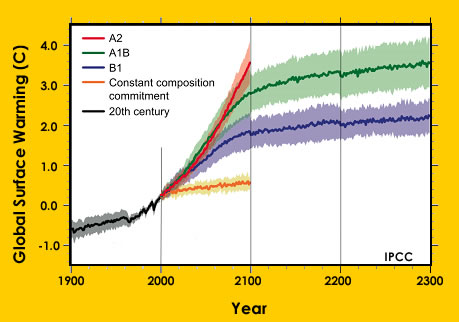
The 4th Assessment Report Summary for Policymakers of the Intergovernmental Panel on Climate Change (IPCC) is scheduled to be released on February 2, 2007 in Paris, France. The IPCC has been established to assess scientific, technical and socio- economic information relevant for the understanding of climate change, its potential impacts and options for adaptation and mitigation. This summary will provide information on recent progress made in understanding and attributing climate change, what observations tell us, how climate has changed in the past, and projections of future changes.
Last modified February 2, 2007 by Roberta Johnson.

Shop Windows to the Universe Science Store!

Our online store includes books on science education, ranging from evolution, classroom research, and the need for science and math literacy!

Windows to the Universe Community

News

Opportunities

You might also be interested in:

Traveling Nitrogen Classroom Activity Kit

Check out our online store - minerals, fossils, books, activities, jewelry, and household items!...more

What Controls the Climate?

Some of the factors that have an affect on climate, like volcanic eruptions and changes in the amount of solar energy, are natural. Others, like the addition of greenhouse gases to the atmosphere, are...more

Effects of Climate Change Today

Over 100 years ago, people worldwide began burning more coal and oil for homes, factories, and transportation. Burning these fossil fuels releases carbon dioxide and other greenhouse gases into the atmosphere....more

Global Warming: Scientists Say Earth Is Heating Up

Earth’s climate is warming. During the 20th Century Earth’s average temperature rose 0.6° Celsius (1.1°F). Scientists are finding that the change in temperature has been causing other aspects of our planet...more

Several tornadoes hit Arkansas, 24 killed

Several severe thunderstorms hit the U.S. over the weekend, wreaking havoc on the Midwestern and Southern states. Fourteen tornadoes hit Arkansas on Saturday, March 1, 1997, killing 24 people and injuring...more

Severe thunderstorms cause flooding, deaths

Several severe thunderstorms hit the U.S. over the weekend, wreaking havoc on the Midwestern and Southern states. Storms on Saturday, March 1, have killed at least 21 in Kentucky, Mississippi, Ohio, Tennessee,...more

Tornadoes strike in Tennessee and Kentucky

Twelve tornadoes hit Tennessee early Saturday morning, injuring at least 44 people. Two people were killed when six more tornadoes touched down in Kentucky. The tornadoes came from a broad band of severe...more

Most recent global image of ozone concentration

NASA's instrument Total Ozone Mapping Spectrometer (TOMS) aboard Japanese Advanced Earth Orbiting Satellite (ADEOS) has provided the most recent image showing the total ozone concentration. Ozone is a...more

Shop Windows to the Universe

Hands On Mineral Identification helps you to identify over 14,500 minerals! By M. Darby Dyar, Ph.D. See our DVD collection.

Windows to the Universe, a project of the National Earth Science Teachers Association, is sponsored in part by the National Science Foundation and NASA, our Founding Partners (the American Geophysical Union and American Geosciences Institute) as well as through Institutional, Contributing, and Affiliate Partners, individual memberships and generous donors. Thank you for your support! NASA AGU AGI NSF