Current Events

  • Irish Chronicles Document Links Between Volcanoes and Weather
    A study of over 40,000 written entries in Irish Annals and ice core measurements shows a strong corr...Read more

    x

    Irish Chronicles Document Links Between Volcanoes and Weather

    A study of over 40,000 written entries in Irish Annals and ice core measurements shows a strong correlation between the occurrence of volcanic eruptions and extreme cold weather in Ireland over a 1200 year period. Data analyzed in this study cover the period from 431 to 1649, during which time up to 48 volcanic eruptions are identified in Greenland ice core records through deposition of volcanic sulfate in annual layers of ice. You can find the study (open access), published on 6 June 2013 in IOP Publishing's journal Environmental Research Letters, at http://iopscience.iop.org/1748-9326/8/2/024035/article. Find out more about how volcanoes can influence climate.
  • EF-5 Tornado in El Reno, Oklahoma Widest Ever Recorded in US
    The EF-5 tornado that hit El Reno, Oklahoma on May 31st was the widest ever recorded in the US, acco...Read more

    x

    EF-5 Tornado in El Reno, Oklahoma Widest Ever Recorded in US

    The EF-5 tornado that hit El Reno, Oklahoma on May 31st was the widest ever recorded in the US, according to the National Weather Service in Norman Oklahoma. The tornado, which remained on the ground for 40 minutes and reached 2.6 miles across (4.2 km), took the lives of 18 people including storm chasers Tim Samaras, Paul Samaras and Carl Young. For more information on the tornado, visit http://ow.ly/i/2hfDG.
  • Atmospheric CO2 Level Tops 400 ppm
    During the week of May 13th, the CO2 level at the Mauna Loa Observatory in Hawaii topped 400 ppm rep...Read more

    x

    Atmospheric CO2 Level Tops 400 ppm

    During the week of May 13th, the CO2 level at the Mauna Loa Observatory in Hawaii topped 400 ppm repeatedly. Daily levels of CO2 can vary due to weather, and there are seasonal trends as well. The level of atmospheric greenhouse gases continues to increase, now over 120 ppm since the Industrial Revolution began. For more on the Keeling Curve, see http://keelingcurve.ucsd.edu/. Find out more about greenhouse gases and warming.
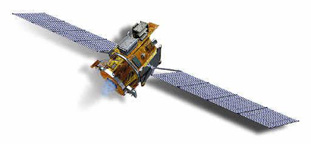
An artist's conception of Deep Space 1
Click on image for full size
Image courtesy of NASA

NASA Tests New Technologies with Deep Space 1
News story originally written on October 25, 1998

NASA launched a spacecraft that will test twelve new technologies, including an ion propulsion drive and an artificial intelligence navigation system. In testing the new equipment, it will fly past the Near-Earth Asteroid 1992 KD. If all goes well, the mission may be extended to include fly-bys of Comets Wilson-Harrington and Borrelly.

The spacecraft, Deep Space 1, is the first launch from NASA's New Millennium program, a program which will test new technology with the hopes of making space travel easier and more affordable. "Deep Space 1 is taking the risks so that future missions don't have to," said Marc Rayman, chief engineer and deputy mission manager at the Jet Propulsion Laboratory.

The engines will ionize xenon gas and accelerate it through an electric field to speeds of 65,000 mph. The thrust will exert less force than the weight of a single piece of paper. But, this is still enough to accelerate the spacecraft about 20 mph each day. Since there isn't air resistance in the vacuum of space, the speed will continue to build.

Ion-propulsion engines are ten times more efficient than regular rockets engines. The probe will use solar energy to ionize the xenon and accelerate it. While normal rocket engines operate on the order of minutes, the ion engine will operate on the order of weeks.

Deep Space 1 will also control its own destiny, in a manner of speaking. It has an onboard navigation system which can locate stars and calculate its position, rather than relying on ground operators to tell it where it is. The probe will also determine how close to the asteroid it can safely fly.

Shop Windows to the Universe Science Store!

Our online store includes issues of NESTA's quarterly journal, The Earth Scientist, full of classroom activities on different topics in Earth and space science, ranging from seismology, rocks and minerals, oceanography, and Earth system science to astronomy!

Windows to the Universe Community

News

Opportunities

You might also be interested in:

Cool It! Game

Check out our online store - minerals, fossils, books, activities, jewelry, and household items!...more

1999--A Year in Review...

It was another exciting and frustrating year for the space science program. It seemed that every step forward led to one backwards. Either way, NASA led the way to a great century of discovery. Unfortunately,...more

STS-95 Launch: "Let the wings of Discovery lift us on to the future."

The Space Shuttle Discovery lifted off from Kennedy Space Center at 2:19 p.m. EST, October 29th. The sky was clear and the weather was great as Discovery took 8 1/2 minutes to reach orbit for the Unitied...more

Moon Found Orbiting Asteroid

A moon was discovered orbiting the asteroid, Eugenia. This is only the second time in history that a satellite has been seen circling an asteroid. A special mirror allowed scientists to find the moon...more

U.S. is Fed Up with Russia

Will Russia ever put the service module for the International Space Station in space? NASA officials are demanding an answer from the Russian government. The necessary service module is currently waiting...more

More on Recent Coronal Mass Ejection

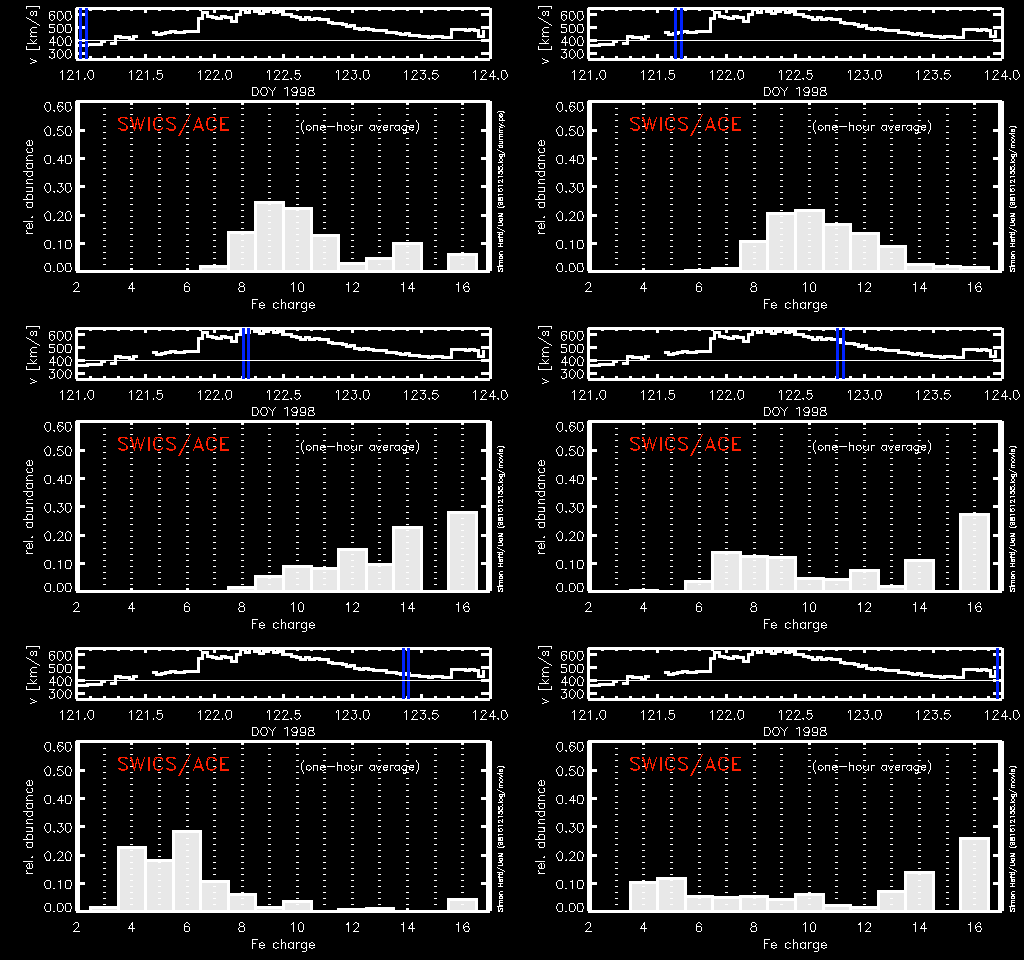
During a period of about two days in early May, 1998, the ACE spacecraft was immersed in plasma associated with a coronal mass ejection (CME). The SWICS instrument on ACE, which determines unambiguously...more

Mother Nature's Air Conditioning

J.S. Maini of the Canadian Forest Service has referred to forests as the "heart and lungs of the world." Forests reduce soil erosion, maintain water quality, contribute to atmospheric humidity and cloud...more

Planetary Alignment 2002

In late April through mid-May 2002, all five naked-eye planets are visible simultaneously in the night sky! This is includes Mercury which is generally very hard to see because of its proximity to the...more

Shop Windows to the Universe

With Explore the Planets, investigate the planets, their moons, and understand the processes that shape them. By G. Jeffrey Taylor, Ph.D. See our DVD collection.

Windows to the Universe, a project of the National Earth Science Teachers Association, is sponsored in part by the National Science Foundation and NASA, our Founding Partners (the American Geophysical Union and American Geosciences Institute) as well as through Institutional, Contributing, and Affiliate Partners, individual memberships and generous donors. Thank you for your support! NASA AGU AGI NSF