This is a picture of the Pathfinder UAV. It was manufactured by AeroVironment. It weighs 540 pounds and has a 98.4 foot wingspan!
Courtesy of NASA
What Do Coffee and Lightning Have in Common?
News story originally written on May 18, 2001
Do they both give you a jolt? Well, that's not exactly what we had in mind! Coffee and
lightning are the two subjects that will be studied by NASA's unmanned aerial vehicles or UAV's during the next few years!
NASA has a whole fleet of unmanned aerial vehicles. They range in size from a vehicle that could be held in your hand to runway-operated giants. Their weights range from just a few pounds to 2,000 pounds! They can carry a variety of payload. What they all don't carry is humans. The Unmanned part of UAV means the vehicles are all controlled from the ground. So, maybe playing all of those video games will come in handy someday if you became a pilot who flew a UAV by remote control!
One of these UAV's, the Pathfinder-Plus, will take pictures of coffee plantations in Hawaii. These pictures will tell the growers when the best time for harvesting the coffee beans is, bringing the best flavor to consumers. Coffee is a multi-billion dollar industry in the U.S. The Pathfinder UAV will help U.S. coffee growers compete in this market! Using a UAV in this survey will also provide for long-duration, high-altitude surveys that human pilots just wouldn't be able to endure.
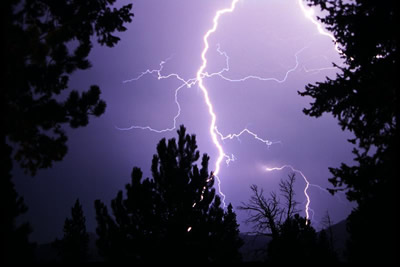
Another UAV called Altus will explore how lightning forms during thunderstorms. Researchers will chase down thunderstorms in Florida, sending the Altus above and around the storm, while remote pilots stay safely on the ground. NASA hopes that data collected in this study will increase understanding of lightning and storms, leading to better protection of human life and human possessions.


Shop Windows to the Universe Science Store!
Our
online store includes
issues of NESTA's quarterly journal, The Earth Scientist, full of classroom activities on different topics in Earth and space science, ranging from
seismology,
rocks and minerals,
oceanography, and
Earth system science to
astronomy!
You might also be interested in:

Lightning is the most spectacular element of a thunderstorm. In fact it is how thunderstorms got their name. Wait a minute, what does thunder have to do with lightning? Well, lightning causes thunder.
...more
Thunderstorms are one of the most thrilling and dangerous types of weather phenomena. Over 40,000 thunderstorms occur throughout the world each day. Thunderstorms form when very warm, moist air rises into
...more
It was another exciting and frustrating year for the space science program. It seemed that every step forward led to one backwards. Either way, NASA led the way to a great century of discovery. Unfortunately,
...more
The Space Shuttle Discovery lifted off from Kennedy Space Center on October 29th at 2:19 p.m. EST. The weather was great as Discovery took 8 1/2 minutes to reach orbit. This was the United States' 123rd
...more
A moon was discovered orbiting the asteroid, Eugenia. This is only the second time in history that a satellite has been seen circling an asteroid. A special mirror allowed scientists to find the moon
...more
Will Russia ever put the service module for the International Space Station in space? NASA officials want an answer from the Russian government. The necessary service module is currently waiting to be
...more
A coronal mass ejection (CME) happened on the Sun early last month. The material that was thrown out from this explosion passed the ACE spacecraft. The SWICS instrument on ACE has produced a new and very
...more