Current Events

  • Irish Chronicles Document Links Between Volcanoes and Weather
    A study of over 40,000 written entries in Irish Annals and ice core measurements shows a strong corr...Read more

    x

    Irish Chronicles Document Links Between Volcanoes and Weather

    A study of over 40,000 written entries in Irish Annals and ice core measurements shows a strong correlation between the occurrence of volcanic eruptions and extreme cold weather in Ireland over a 1200 year period. Data analyzed in this study cover the period from 431 to 1649, during which time up to 48 volcanic eruptions are identified in Greenland ice core records through deposition of volcanic sulfate in annual layers of ice. You can find the study (open access), published on 6 June 2013 in IOP Publishing's journal Environmental Research Letters, at http://iopscience.iop.org/1748-9326/8/2/024035/article. Find out more about how volcanoes can influence climate.
  • EF-5 Tornado in El Reno, Oklahoma Widest Ever Recorded in US
    The EF-5 tornado that hit El Reno, Oklahoma on May 31st was the widest ever recorded in the US, acco...Read more

    x

    EF-5 Tornado in El Reno, Oklahoma Widest Ever Recorded in US

    The EF-5 tornado that hit El Reno, Oklahoma on May 31st was the widest ever recorded in the US, according to the National Weather Service in Norman Oklahoma. The tornado, which remained on the ground for 40 minutes and reached 2.6 miles across (4.2 km), took the lives of 18 people including storm chasers Tim Samaras, Paul Samaras and Carl Young. For more information on the tornado, visit http://ow.ly/i/2hfDG.
  • Atmospheric CO2 Level Tops 400 ppm
    During the week of May 13th, the CO2 level at the Mauna Loa Observatory in Hawaii topped 400 ppm rep...Read more

    x

    Atmospheric CO2 Level Tops 400 ppm

    During the week of May 13th, the CO2 level at the Mauna Loa Observatory in Hawaii topped 400 ppm repeatedly. Daily levels of CO2 can vary due to weather, and there are seasonal trends as well. The level of atmospheric greenhouse gases continues to increase, now over 120 ppm since the Industrial Revolution began. For more on the Keeling Curve, see http://keelingcurve.ucsd.edu/. Find out more about greenhouse gases and warming.
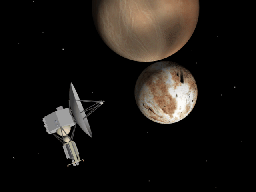
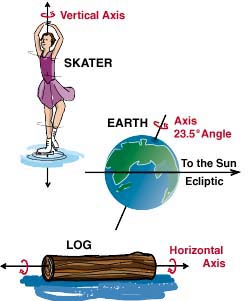
This image shows different objects that rotate. Rotational period is the time it takes for that object to rotate just once.

Rotational Period

Rotational period is the term describing the length of time necessary for a space object to make one complete rotation. This time varies from planet to planet, and on Earth it is 1 day.

This length of time is not always constant, and in fact the Earth’s rotational period is slowing (by 0.002 seconds every hundred years). This is because of the Moon’s influence on our rotation.

One planet that has already slowed down a lot is Venus. Scientists think this is because a long time ago something big hit Venus and slowed down its rotation. Now, Venus spins so slowly that it revolves around the Sun faster than it spins on its own axis. That means that a Venus day is longer than a Venus year!

Shop Windows to the Universe Science Store!

Learn about Earth and space science, and have fun while doing it! The games section of our online store includes a climate change card game and the Traveling Nitrogen game!

Windows to the Universe Community

News

Opportunities

You might also be interested in:

Traveling Nitrogen Classroom Activity Kit

Check out our online store - minerals, fossils, books, activities, jewelry, and household items!...more

AU

AU stands for Astronomical Units. It is a useful way to measure the distances in interplanetary space. It is the distance between the Earth and the Sun, which is about 93 million miles. For reference,...more

The Spiral of the IMF

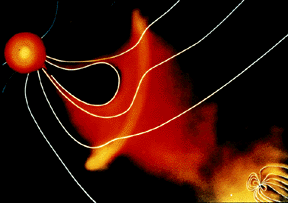
The solar wind is formed as the Sun's top layer blows off into space, carrying magnetic fields still attached to the Sun. Gusts form in the solar wind associated with violent events on the Sun. Particles...more

Spiral Path of Material

For a planet to be affected by a blob of material being ejected by the sun, the planet must be in the path of the blob, as shown in this picture. The Earth and its magnetosphere are shown in the bottom...more

The SAR Arc

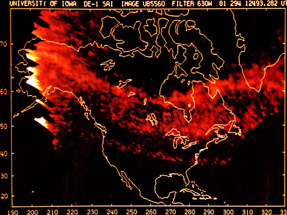
The aurora we are most familiar with is the polar aurora. This is what people are talking about when they say the northern or southern lights. But there are other less-known aurora, such as SAR arcs....more

The Effect of Aurora on the Atmosphere

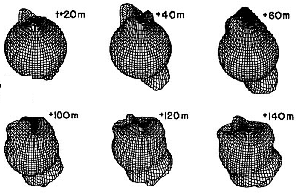
This figure shows the effect of the aurora on the atmosphere. When FAC's enter the atmosphere and create the aurora, they heat the atmosphere suddenly and abruptly. This creates an impulse which travels...more

The forming Aurora

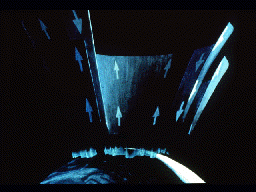
This picture shows the flowing of particles into and out of the auroral zone, as Field-Aligned currents (FAC's) take at short-cut through the atmosphere. Some of the particles entering the auroral zone...more

The Expanding Auroral Oval

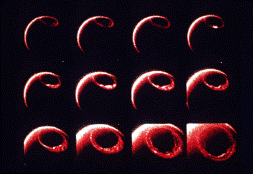
This figure shows a series of images of the auroral oval as it expands over the course of about an hour in response to a geomagnetic storm. This is an animation of the auroral oval expanding....more

Shop Windows to the Universe

Earth Science Rocks! Select one of our four cool NESTA t-shirts from our online store, and express your love of Earth and space science!

Windows to the Universe, a project of the National Earth Science Teachers Association, is sponsored in part by the National Science Foundation and NASA, our Founding Partners (the American Geophysical Union and American Geosciences Institute) as well as through Institutional, Contributing, and Affiliate Partners, individual memberships and generous donors. Thank you for your support! NASA AGU AGI NSF