Current Events

  • Irish Chronicles Document Links Between Volcanoes and Weather
    A study of over 40,000 written entries in Irish Annals and ice core measurements shows a strong corr...Read more

    x

    Irish Chronicles Document Links Between Volcanoes and Weather

    A study of over 40,000 written entries in Irish Annals and ice core measurements shows a strong correlation between the occurrence of volcanic eruptions and extreme cold weather in Ireland over a 1200 year period. Data analyzed in this study cover the period from 431 to 1649, during which time up to 48 volcanic eruptions are identified in Greenland ice core records through deposition of volcanic sulfate in annual layers of ice. You can find the study (open access), published on 6 June 2013 in IOP Publishing's journal Environmental Research Letters, at http://iopscience.iop.org/1748-9326/8/2/024035/article. Find out more about how volcanoes can influence climate.
  • EF-5 Tornado in El Reno, Oklahoma Widest Ever Recorded in US
    The EF-5 tornado that hit El Reno, Oklahoma on May 31st was the widest ever recorded in the US, acco...Read more

    x

    EF-5 Tornado in El Reno, Oklahoma Widest Ever Recorded in US

    The EF-5 tornado that hit El Reno, Oklahoma on May 31st was the widest ever recorded in the US, according to the National Weather Service in Norman Oklahoma. The tornado, which remained on the ground for 40 minutes and reached 2.6 miles across (4.2 km), took the lives of 18 people including storm chasers Tim Samaras, Paul Samaras and Carl Young. For more information on the tornado, visit http://ow.ly/i/2hfDG.
  • Atmospheric CO2 Level Tops 400 ppm
    During the week of May 13th, the CO2 level at the Mauna Loa Observatory in Hawaii topped 400 ppm rep...Read more

    x

    Atmospheric CO2 Level Tops 400 ppm

    During the week of May 13th, the CO2 level at the Mauna Loa Observatory in Hawaii topped 400 ppm repeatedly. Daily levels of CO2 can vary due to weather, and there are seasonal trends as well. The level of atmospheric greenhouse gases continues to increase, now over 120 ppm since the Industrial Revolution began. For more on the Keeling Curve, see http://keelingcurve.ucsd.edu/. Find out more about greenhouse gases and warming.
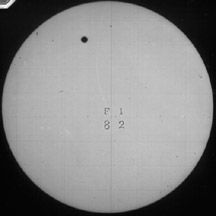
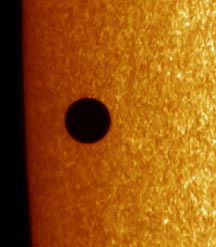
The dark disk of Mercury can be seen against the backdrop of the Sun during a transit on May 7, 2003. The transit is almost over and Mercury appears near the edge of the Sun.
Click on image for full size
Image courtesy of The Royal Swedish Academy of Sciences.

Transit

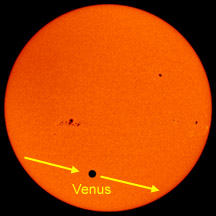
A "transit" is the name of a type of astronomical event. A transit is similar to a solar eclipse, except a transit involves a planet, instead of the Moon, passing in front of the Sun. As viewed from Earth, only two planets can ever transit the Sun. The two are Mercury and Venus, since they have orbits that are closer to the Sun than is Earth's orbit.

Since the distances to planets are much greater than the distance to the Moon, planets look much smaller in the sky. When a planet transits the Sun, it does not completely block out the Sun's light the way the Moon does during a total solar eclipse. Instead, a transit appears as a small black dot moving slowly across the face of the Sun.

The orbital planes of the planets are tilted with respect to one another. Even though Mercury and Venus pass Earth on "the inside lane" fairly often as they move more rapidly around their orbits than does our home planet, most passes do not coincide with a transit. The planets usually seem to swing by the Sun slightly above or below the solar disk. Rarely, Venus or Mercury is right in the same plane as Earth when it passes between us and the Sun, and a transit occurs.

Transits of Mercury occur 13 or 14 times per century. Transits of Venus are much rarer; they come in pairs eight years apart, but the interval between one pair and the next is more than 100 years. The last Venus transit was in 1882; the next is in June 2004!

Recently, astronomers have begun to use transits to discover planets orbiting other stars! Although stars other than our Sun are too far away to see as anything other than tiny dots in even the most powerful telescopes, scientists have found a way to notice planets passing in front of some stars. We cannot see a tiny black dot traversing the face of a distant star, but we can detect the miniscule change in the amount of light reaching us from the star as the dark planet crosses in front of it. Measuring the time between such events allows us to determine the orbital periods, or lengths of the "years", of such extrasolar planets.

Last modified May 17, 2004 by Randy Russell.

Shop Windows to the Universe Science Store!

Our online store includes issues of NESTA's quarterly journal, The Earth Scientist, full of classroom activities on different topics in Earth and space science, ranging from seismology, rocks and minerals, oceanography, and Earth system science to astronomy!

Windows to the Universe Community

News

Opportunities

You might also be interested in:

Mercury Transit on May 7, 2003

The planet Mercury appeared to cross in front of the disk of the Sun on May 7, 2003. Astronomers call the event a transit. A transit is similar to a solar eclipse. However, a transit occurs when a planet,...more

Transits of Venus

The planet Venus periodically passes directly between Earth and the Sun. This event, which is somewhat similar to a solar eclipse, is called a transit of Venus. Viewed from Earth, Venus and Mercury are...more

More than 100 planets orbit distant stars!

Astronomers have identified another exoplanet, that is, a planet outside our solar system. This makes a total of 102 exoplanets that have so far been found by astronomers! The astronomers that identified...more

History of Venus Transits

Transits of Venus are extremely rare astronomical phenomena. They occur in pairs, separated by eight years, with more than a century elapsing between successive pairs of transits. There will be two Venus...more

Venus Transit in June 2004

A rare astronomical event will occur in early June 2004. For the first time since 1882, Earthlings will be able to view a transit of the planet Venus. "Transit" is a term used by astronomers when a planet...more

History of Sunspot Observations

Surprisingly, humans have observed sunspots for a very long time, so historical sunspot observations provide us with some of our best long-duration records of solar activity. Large sunspots can sometimes...more

Mercury Transit on November 8, 2006

The planet Mercury will cross in front of the disk of the Sun on Wednesday, November 8, 2006. Astronomers call the event a transit. A transit is similar to a solar eclipse. However, a transit occurs when...more

Transit

A "transit" is the name of a type of astronomical event. A transit is similar to a solar eclipse, except a transit involves a planet, instead of the Moon, passing in front of the Sun. As viewed from Earth,...more

Shop Windows to the Universe

Please help support Windows to the Universe, and our activities to help Earth and space science teachers, with a tax-exempt donation today!

Windows to the Universe, a project of the National Earth Science Teachers Association, is sponsored in part by the National Science Foundation and NASA, our Founding Partners (the American Geophysical Union and American Geosciences Institute) as well as through Institutional, Contributing, and Affiliate Partners, individual memberships and generous donors. Thank you for your support! NASA AGU AGI NSF