This animation demonstrates very simply how different elements at different heights, let off energy that we see as different colors.
Click on image for full size
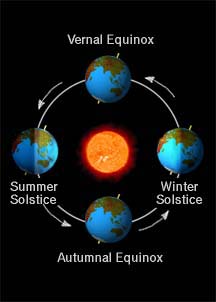
Axis Tilt
When we talk about the movement of a planet, we talk about its rotation (spinning around its internal axis) and revolution (revolving around
the Sun). Axis tilt occurs when a planet rotates around an axis that is tilted relative to the plane of its revolution around a larger object. Put simply, that means that as the planet revolves around the Sun, it is tilted.
The Earth is tilted by 23.5 degrees, which means that sometimes the northern hemisphere is tilted toward the Sun and sometimes it is tilted away from the Sun. This tilt of a planet is what gives us seasons.
Not all the planets have the same amount of tilt. Jupiter, for instance, has almost no tilt (3 degrees), while Venus has almost 180 degrees of tilt, which means that it’s spinning upside-down (at least relative to our definition of up). Uranus has a tilt of almost 90 degrees, which means that this planet is spinning on its side!
You might also be interested in:
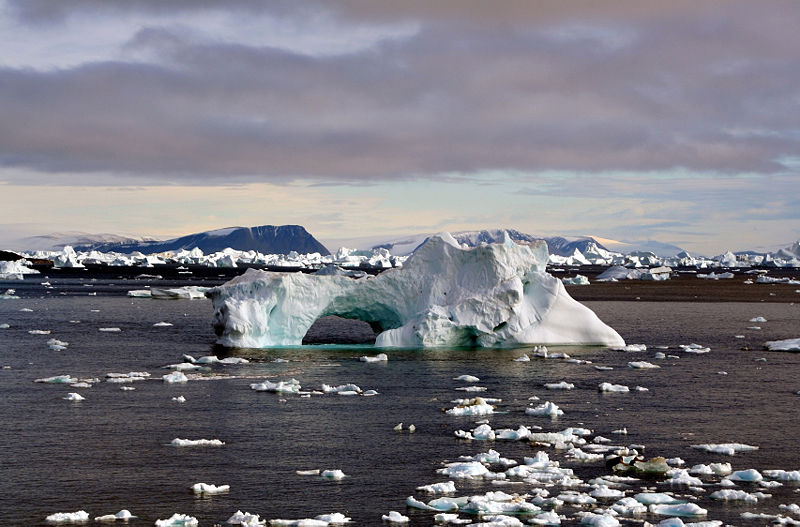
Climate change refers to changes in global or regional climate determined over a long term - typically a minimum of 30 years. A short-term weather event such as an intense storm or heat wave are a normal
...more
AU stands for Astronomical Units. It is a useful way to measure the distances in interplanetary space. It is the distance between the Earth and the Sun, which is about 93 million miles. For reference,
...more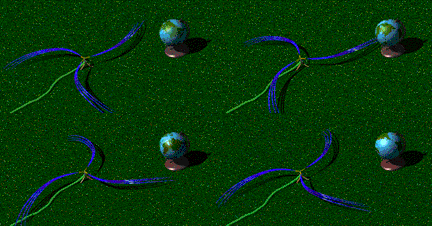
The solar wind is formed as the Sun's top layer blows off into space, carrying magnetic fields still attached to the Sun. Gusts form in the solar wind associated with violent events on the Sun. Particles
...more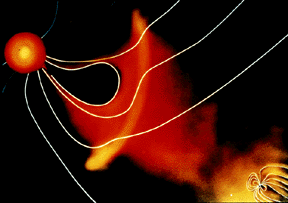
For a planet to be affected by a blob of material being ejected by the sun, the planet must be in the path of the blob, as shown in this picture. The Earth and its magnetosphere are shown in the bottom
...more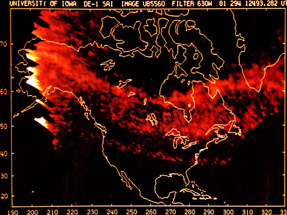
The aurora we are most familiar with is the polar aurora. This is what people are talking about when they say the northern or southern lights. But there are other less-known aurora, such as SAR arcs.
...more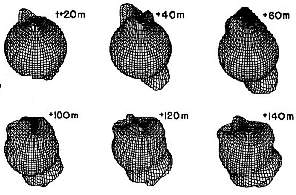
This figure shows the effect of the aurora on the atmosphere. When FAC's enter the atmosphere and create the aurora, they heat the atmosphere suddenly and abruptly. This creates an impulse which travels
...more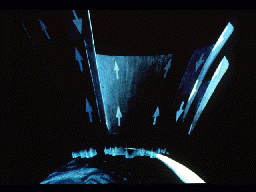
This picture shows the flowing of particles into and out of the auroral zone, as Field-Aligned currents (FAC's) take at short-cut through the atmosphere. Some of the particles entering the auroral zone
...more