Current Events

  • Irish Chronicles Document Links Between Volcanoes and Weather
    A study of over 40,000 written entries in Irish Annals and ice core measurements shows a strong corr...Read more

    x

    Irish Chronicles Document Links Between Volcanoes and Weather

    A study of over 40,000 written entries in Irish Annals and ice core measurements shows a strong correlation between the occurrence of volcanic eruptions and extreme cold weather in Ireland over a 1200 year period. Data analyzed in this study cover the period from 431 to 1649, during which time up to 48 volcanic eruptions are identified in Greenland ice core records through deposition of volcanic sulfate in annual layers of ice. You can find the study (open access), published on 6 June 2013 in IOP Publishing's journal Environmental Research Letters, at http://iopscience.iop.org/1748-9326/8/2/024035/article. Find out more about how volcanoes can influence climate.
  • EF-5 Tornado in El Reno, Oklahoma Widest Ever Recorded in US
    The EF-5 tornado that hit El Reno, Oklahoma on May 31st was the widest ever recorded in the US, acco...Read more

    x

    EF-5 Tornado in El Reno, Oklahoma Widest Ever Recorded in US

    The EF-5 tornado that hit El Reno, Oklahoma on May 31st was the widest ever recorded in the US, according to the National Weather Service in Norman Oklahoma. The tornado, which remained on the ground for 40 minutes and reached 2.6 miles across (4.2 km), took the lives of 18 people including storm chasers Tim Samaras, Paul Samaras and Carl Young. For more information on the tornado, visit http://ow.ly/i/2hfDG.
  • Atmospheric CO2 Level Tops 400 ppm
    During the week of May 13th, the CO2 level at the Mauna Loa Observatory in Hawaii topped 400 ppm rep...Read more

    x

    Atmospheric CO2 Level Tops 400 ppm

    During the week of May 13th, the CO2 level at the Mauna Loa Observatory in Hawaii topped 400 ppm repeatedly. Daily levels of CO2 can vary due to weather, and there are seasonal trends as well. The level of atmospheric greenhouse gases continues to increase, now over 120 ppm since the Industrial Revolution began. For more on the Keeling Curve, see http://keelingcurve.ucsd.edu/. Find out more about greenhouse gases and warming.
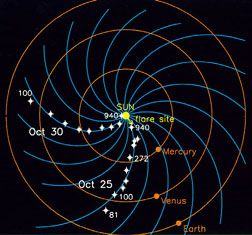
The IMF is represented by the blue arcs in the picture above. This picture shows the spiral nature of the IMF.
Click on image for full size
NASA

IMF

IMF stands for Interplanetary Magnetic Field. It is another name for the Sun's magnetic field.

The Sun's magnetic field is enormous and is carried by the solar wind. The solar wind and magnetic field are twisted into a spiral by the Sun's rotation. All the planets reside within this field, which is why the Sun's magnetic field can be called interplanetary.

Eventually the solar wind and IMF encounter the interstellar magnetic field and plasma of interstellar space. The boundary between space dominated by the Sun (or the heliosphere) and interstellar space is called the heliopause.

Shop Windows to the Universe Science Store!

Our online store includes books on science education, classroom activities in The Earth Scientist, mineral and fossil specimens, and educational games!

Windows to the Universe Community

News

Opportunities

You might also be interested in:

Traveling Nitrogen Classroom Activity Kit

Check out our online store - minerals, fossils, books, activities, jewelry, and household items!...more

The Magnetic Field

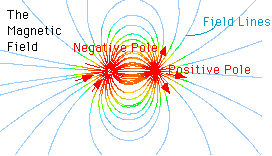
The force of magnetism causes material to point along the direction the magnetic force points. This property implies that the force of magnetism has a direction. As shown in the diagram to the left, the...more

The Spiral of the IMF

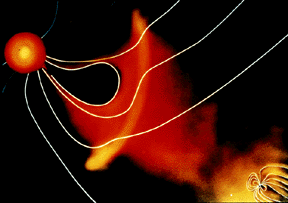
The solar wind is formed as the Sun's topmost layer blows off into space carrying with it magnetic fields still attached to the Sun. Gusts and disturbances form in the solar wind associated with violent...more

Charged Particle Motion in Earth's Magnetosphere

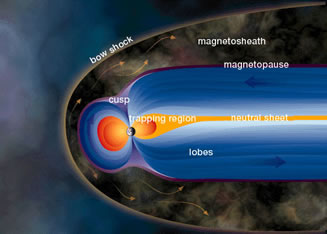
Motions within Earth's metallic core generate the planet's global magnetic field. This magnetic field extends beyond Earth's surface and atmosphere into the space surrounding our home planet. The interaction...more

AU

AU stands for Astronomical Units. Distances in space are too large to measure in Earth standards like miles or kilometers. For distances too large to measue in AU, we use light years. A light year is the...more

Spiral Path of Material

For a planet to be affected by a blob of material being ejected by the sun, the planet must be in the path of the blob, as shown in this picture. The Earth and its magnetosphere are shown in the bottom...more

The SAR Arc

The aurora we are most familiar with is the polar aurora. This is what people are referring to when they speak of the northern or southern lights. But there are other less-known auroral activity, such...more

The Effect of Aurora on the Atmosphere

This figure shows the effect of the aurora on the atmosphere. When FAC's enter the atmosphere and create the aurora, they warm the atmosphere impulsively. This impulse travels throughout the atmosphere...more

Shop Windows to the Universe

Young Voices for the Planet DVD in our online store includes 8 films where students speak out and take action on climate change.

Windows to the Universe, a project of the National Earth Science Teachers Association, is sponsored in part by the National Science Foundation and NASA, our Founding Partners (the American Geophysical Union and American Geosciences Institute) as well as through Institutional, Contributing, and Affiliate Partners, individual memberships and generous donors. Thank you for your support! NASA AGU AGI NSF