Current Events

  • Atmospheric CO2 Level Tops 400 ppm
    During the week of May 13th, the CO2 level at the Mauna Loa Observatory in Hawaii topped 400 ppm rep...Read more

    x

    Atmospheric CO2 Level Tops 400 ppm

    During the week of May 13th, the CO2 level at the Mauna Loa Observatory in Hawaii topped 400 ppm repeatedly. Daily levels of CO2 can vary due to weather, and there are seasonal trends as well. The level of atmospheric greenhouse gases continues to increase, now over 120 ppm since the Industrial Revolution began. For more on the Keeling Curve, see http://keelingcurve.ucsd.edu/. Find out more about greenhouse gases and warming.
  • Massive Tornado Outbreak on Tornado Alley
    The week of May 19 brings dozens of tornadoes to Tornado Alley in the states of Oklahoma, Kansas, Io...Read more

    x

    Massive Tornado Outbreak on Tornado Alley

    The week of May 19 brings dozens of tornadoes to Tornado Alley in the states of Oklahoma, Kansas, Iowa, Illinois and Missouri. On May 20th, a massive tornado struck Moore, Oklahoma, devastating communities - destroying over 100 homes and hitting two elementary schools and a hospital - with many casualties and deaths. Our thoughts are with our friends and colleagues suffering from these storms. For more on the May 20th storms, see the NOAA Storm Prediction Center Storm Report.
  • Kansas Legislator Proposes Bill to Outlaw Sustainability Education
    A bill has been introduced in the Kansas legislature this week that would prohibit the promotion of ...Read more

    x

    Kansas Legislator Proposes Bill to Outlaw Sustainability Education

    A bill has been introduced in the Kansas legislature this week that would prohibit the promotion of sustainability. Here is a link to the one-page bill: http://www.kslegislature.org/li/b2013_14/measures/documents/hb2366_00_0000.pdf. See report on Bloomberg News.
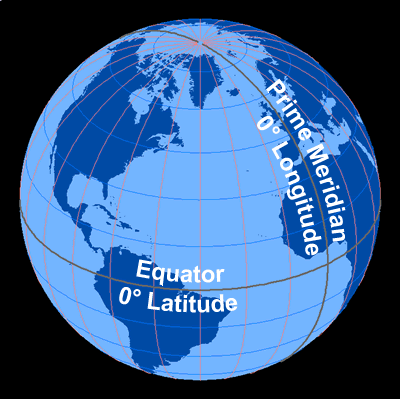
This cutaway view of the Earth shows the angular measurement of latitude and longitude.
Click on image for full size
Image Courtesy of Dennis Ward/UCAR

Angles Determine Latitude and Longitude

This cutaway view of the Earth illustrates the angular measurement of latitude and longitude.

Latitude, shown in blue, is the angular distance from the Equator to a point on the Earth's surface. Latitude can either be North or South, depending on the hemisphere in which the location is located. GPS units and digital mapping applications, such as Google Earth, often indicate northern latitudes as being positive (0 to +90 degrees), and give southern latitudes negative values (0 to -90 degrees).

Longitude, shown in red, is the angular distance from the Prime Meridian to a point on the Earth's surface. Longitude is described as being either East or West, depending on which way you measure from the Prime Meriadian, and ranges from 0 degrees at the Prime Meridian, to 180 degrees at the Antimeridian. Digital maps use positive numbers for eastern latitudes (0 to +180 degrees) and negative numbers for western latitudes (0 to -180 degrees).

Last modified July 23, 2008 by Becca Hatheway.

Shop Windows to the Universe Science Store!

Our online store includes books on science education, ranging from evolution, classroom research, and the need for science and math literacy!

Windows to the Universe Community

News

Opportunities

You might also be interested in:

Latitude and Longitude

The most common way to locate points on the surface of the Earth is by standard, geographic coordinates called latitude and longitude. These coordinates are measured in degrees and represent angular distances...more

Angles Determine Latitude and Longitude

This cutaway view of the Earth illustrates the angular measurement of latitude and longitude. Latitude, shown in blue, is the angular distance from the Equator to a point on the Earth's surface. Latitude...more

The Andes Mountains

The Andes Mountains form one of the longest continuous mountain ranges on Earth, extending over 7,000 km (4,400 miles) along the west coast of South America. One of the more surprising aspects of this...more

Shop Windows to the Universe

The Universe at Your Fingertips 2.0 DVD from the Astronomical Society of the Pacific is in our online store, filled with Earth and space science resources.

Windows to the Universe, a project of the National Earth Science Teachers Association, is sponsored in part by the National Science Foundation and NASA, our Founding Partners (the American Geophysical Union and American Geosciences Institute) as well as through Institutional, Contributing, and Affiliate Partners, individual memberships and generous donors. Thank you for your support! NASA AGU AGI NSF