Current Events

  • Atmospheric CO2 Level Tops 400 ppm
    During the week of May 13th, the CO2 level at the Mauna Loa Observatory in Hawaii topped 400 ppm rep...Read more

    x

    Atmospheric CO2 Level Tops 400 ppm

    During the week of May 13th, the CO2 level at the Mauna Loa Observatory in Hawaii topped 400 ppm repeatedly. Daily levels of CO2 can vary due to weather, and there are seasonal trends as well. The level of atmospheric greenhouse gases continues to increase, now over 120 ppm since the Industrial Revolution began. For more on the Keeling Curve, see http://keelingcurve.ucsd.edu/. Find out more about greenhouse gases and warming.
  • Massive Tornado Outbreak on Tornado Alley
    The week of May 19 brings dozens of tornadoes to Tornado Alley in the states of Oklahoma, Kansas, Io...Read more

    x

    Massive Tornado Outbreak on Tornado Alley

    The week of May 19 brings dozens of tornadoes to Tornado Alley in the states of Oklahoma, Kansas, Iowa, Illinois and Missouri. On May 20th, a massive tornado struck Moore, Oklahoma, devastating communities - destroying over 100 homes and hitting two elementary schools and a hospital - with many casualties and deaths. Our thoughts are with our friends and colleagues suffering from these storms. For more on the May 20th storms, see the NOAA Storm Prediction Center Storm Report.
  • Kansas Legislator Proposes Bill to Outlaw Sustainability Education
    A bill has been introduced in the Kansas legislature this week that would prohibit the promotion of ...Read more

    x

    Kansas Legislator Proposes Bill to Outlaw Sustainability Education

    A bill has been introduced in the Kansas legislature this week that would prohibit the promotion of sustainability. Here is a link to the one-page bill: http://www.kslegislature.org/li/b2013_14/measures/documents/hb2366_00_0000.pdf. See report on Bloomberg News.
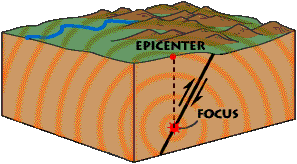
When movement along a fault moves the seafloor upward, water is also pushed upward and becomes tsunami waves. As the waves approach shallower water, they become higher.
Click on image for full size
NOAA

How Tsunamis Form

A tsunami is several large waves made in an ocean or other body of water by a disturbance. The disturbance could be from an earthquake, landslide, volcano, or meteorite. The picture at the left shows how an earthquake can make a tsunami in the water that lies above.

Earthquakes under the sea
Earthquakes happen when Earth’s tectonic plates move against each other. If an earthquake happens on the ocean floor, the water above can move as well. Tsunami waves are made as the water tries to find a stable position again.

Undersea landslides
Large earthquakes can cause these landslides. The landslide can also cause tsunami waves since the moving debris will cause water the move.

Undersea volcanoes
Did you know there were volcanoes under the sea? Sometimes a strong eruption from one of them can uplift the water above and generate a tsunami.

Asteroid impacts
Falling asteroids disturb the water from above, much like a stone falling into a pond (but much larger!).

Last modified May 21, 2008 by Lisa Gardiner.

Shop Windows to the Universe Science Store!

Our online store includes issues of NESTA's quarterly journal, The Earth Scientist, full of classroom activities on different topics in Earth and space science, as well as books on science education!

Windows to the Universe Community

News

Opportunities

You might also be interested in:

Traveling Nitrogen Classroom Activity Kit

Check out our online store - minerals, fossils, books, activities, jewelry, and household items!...more

What Is an Earthquake?

The ground underfoot might seem like it’s not going anywhere but it is. It moves. If it moves all of a sudden the ground shakes. That’s an earthquake! Earthquakes happen as pieces of the Earth’s crust...more

Ten Tsunami Safety Facts

1. Tsunamis that strike coastal locations in the Pacific Ocean Basin are almost always caused by earthquakes. These earthquakes might occur far away or near where you live. 2. Some tsunamis can be very...more

Albedo

This picture was taken from high above our planet. Looking at the Earth from very far away like this we can see that some parts of our planet look light in color, and some parts look dark. The color of...more

Desert Birds

Did you know that many species of birds live in the desert? You have probably heard of the roadrunner or seen the cartoon. The roadrunner is a real bird that lives in the desert! It prefers to run rather...more

The Desert Biome

Deserts are very hot and dry places. Deserts get very little rain each year. So how do plants and animals live here? This section on the desert ecosystem will explain how! Do you know what a desert looks...more

Desert Insects and Arachnids

There are all kinds of insects in the desert! Some of them cause a lot of problems. The locusts fly from place to place, eating all the plants they see. But not all desert bugs are bad. There isn't a...more

Desert Mammals

There are many species of mammals in the desert! Many of them dig holes in the ground to live in. These holes are called burrows. Rats and hamsters live in burrows. Bigger mammals, like the wild horse,...more

Shop Windows to the Universe

Check out the fun Earth science related bumper stickers in our online store! Express yourself!

Windows to the Universe, a project of the National Earth Science Teachers Association, is sponsored in part by the National Science Foundation and NASA, our Founding Partners (the American Geophysical Union and American Geosciences Institute) as well as through Institutional, Contributing, and Affiliate Partners, individual memberships and generous donors. Thank you for your support! NASA AGU AGI NSF