Current Events

  • Kansas Legislator Proposes Bill to Outlaw Sustainability Education
    A bill has been introduced in the Kansas legislature this week that would prohibit the promotion of ...Read more

    x

    Kansas Legislator Proposes Bill to Outlaw Sustainability Education

    A bill has been introduced in the Kansas legislature this week that would prohibit the promotion of sustainability. Here is a link to the one-page bill: http://www.kslegislature.org/li/b2013_14/measures/documents/hb2366_00_0000.pdf. See report on Bloomberg News.
  • Earth's Center Is 1,000 Degrees Hotter Than Previously Thought, Synchrotron X-Ray Experiment Shows
    Scientists have determined the temperature near the Earth’s center to be 6000 degrees Celsius, 1000 ...Read more

    x

    Earth's Center Is 1,000 Degrees Hotter Than Previously Thought, Synchrotron X-Ray Experiment Shows

    Scientists have determined the temperature near the Earth’s center to be 6000 degrees Celsius, 1000 degrees hotter than in a previous experiment run 20 years ago. These measurements confirm geophysical models that the temperature difference between the solid core and the mantle above, must be at least 1500 degrees to explain why the Earth has a magnetic field. For more information about this study, see the press release from the European Synchrotron Radiation Facility.
  • Ocean Volcanic Rocks Contain Samples of Recycled Crust
    Scientists have long believed that lava erupted from certain oceanic volcanoes contains materials fr...Read more

    x

    Ocean Volcanic Rocks Contain Samples of Recycled Crust

    Scientists have long believed that lava erupted from certain oceanic volcanoes contains materials from the early Earth’s crust. But decisive evidence for this phenomenon has proven elusive. New research from a team including Carnegie’s Erik Hauri demonstrates that oceanic volcanic rocks contain samples of recycled crust dating back to the Archean era 2.5 billion years ago. Their work is published in Nature. Oceanic crust sinks into the Earth’s mantle at so-called subduction zones, where two plates come together. Much of what happens to the crust during this journey is unknown. Model-dependent studies for how long subducted material can exist in the mantle are uncertain and evidence of very old crust returning to Earth’s surface via upwellings of magma has not been found until now. For more information about these results, see the press release from the Carnegie Institution.
Conifer forests of the taiga biome
Click on image for full size
Image courtesy of Mikhail Dronov of Tomsk in southwestern Siberia

The Taiga Biome

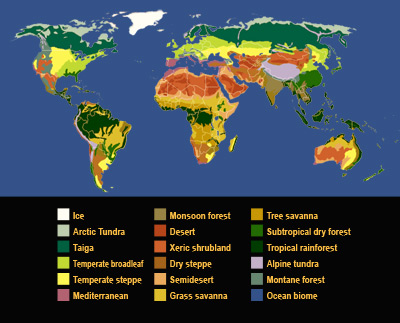
“Taiga” is a Russian word meaning dense evergreen forest. The taiga biome, the largest biome on land, is full of dense evergreen forests. Located just south of the tundra in the northern parts of Europe, Asia, and North America, these forests of conifer trees are also known as boreal forests.

It is very cold and snowy in the taiga during winter, with below freezing average temperatures. During winter it can get as cold as −50°C in the taiga and is typically below freezing. There is a very large temperature difference in winter and summer. While it is not uncommon for temperatures to dive below freezing during the summer as well, it is generally warmer then. During summer the taiga can be as warm to 30°C. Days are long during summer in the taiga, ice thaws, snow melts, and it is often rainy.

The land surface of the taiga was covered with ice until about ten thousand years ago when the glaciers of the last Ice Age retreated. As they melted back, they left the land surface with depressions that have since become small lakes and bogs. Soils have only had a relatively short amount of time to form since the glaciers retreated and so are often thin and they can be nutrient poor because of the cold climate too.

Conifer trees like spruce and fir thrive in this climate. The trees grow close together. This protects them from cold and wind. Their dark color makes their albedo low and they absorb solar energy readily, keeping them a bit warmer. There are a few deciduous tree species that can live in the taiga as well including birch and aspen, but they are not common.

Many animals make their home in the taiga for at least part of the year. Some stay year-round. In the summer, birds and insects are abundant. Many bird species migrate to the taiga and breed and nest there during summer. Other birds, such as sparrows and crows, stay in the taiga year-round. Mammals include herbivores like rabbits and voles as well as carnivores such as lynx, wolverines, and bobcats.


Last modified October 23, 2008 by Lisa Gardiner.

Shop Windows to the Universe Science Store!

Our online store includes issues of NESTA's quarterly journal, The Earth Scientist, full of classroom activities on different topics in Earth and space science, as well as books on science education!

Windows to the Universe Community

News

Opportunities

You might also be interested in:

Cool It! Game

Check out our online store - minerals, fossils, books, activities, jewelry, and household items!...more

Biomes and Ecosystems

Biomes are large regions of the world with similar plants, animals, and other living things that are adapted to the climate and other conditions. Explore the links below to learn more about some of the...more

Tundra Biome

In the very cold places of the world, survival isn't easy. The soil is frozen, its top surface thawing only during summer, and no trees can grow. Yet plants and animals that are adapted for the harsh...more

The Cryosphere

The cryosphere includes the parts of the Earth system where water is in its frozen (solid) form. This includes snow, sea ice, icebergs, ice shelves, glaciers, ice sheets, and permafrost soils. Approximately...more

Glaciers and Ice Sheets

For a glacier to develop, the amount of snow that falls must be more than the amount of snow that melts each year. This means that glaciers are only found in places where a large amount of snow falls each...more

What Is Climate?

Climate in your place on the globe is called regional climate. It is the average weather pattern in a place over more than thirty years, including the variations in seasons. To describe the regional climate...more

Albedo

This picture shows a part of the Earth surface as seen from the International Space Station high above the Earth. A perspective like this reminds us that there are lots of different things that cover the...more

Desert Birds

Like the other inhabitants of the desert, birds come up with interesting ways to survive in the harsh climate. The sandgrouse has special feathers that soak up water. It can then carry the water to its...more

Shop Windows to the Universe

Hands On Mineral Identification helps you to identify over 14,500 minerals! By M. Darby Dyar, Ph.D. See our DVD collection.

Windows to the Universe, a project of the National Earth Science Teachers Association, is sponsored in part by the National Science Foundation and NASA, our Founding Partners (the American Geophysical Union and American Geosciences Institute) as well as through Institutional, Contributing, and Affiliate Partners, individual memberships and generous donors. Thank you for your support! NASA AGU AGI NSF