Current Events

  • Kansas Legislator Proposes Bill to Outlaw Sustainability Education
    A bill has been introduced in the Kansas legislature this week that would prohibit the promotion of ...Read more

    x

    Kansas Legislator Proposes Bill to Outlaw Sustainability Education

    A bill has been introduced in the Kansas legislature this week that would prohibit the promotion of sustainability. Here is a link to the one-page bill: http://www.kslegislature.org/li/b2013_14/measures/documents/hb2366_00_0000.pdf. See report on Bloomberg News.
  • Earth's Center Is 1,000 Degrees Hotter Than Previously Thought, Synchrotron X-Ray Experiment Shows
    Scientists have determined the temperature near the Earth’s center to be 6000 degrees Celsius, 1000 ...Read more

    x

    Earth's Center Is 1,000 Degrees Hotter Than Previously Thought, Synchrotron X-Ray Experiment Shows

    Scientists have determined the temperature near the Earth’s center to be 6000 degrees Celsius, 1000 degrees hotter than in a previous experiment run 20 years ago. These measurements confirm geophysical models that the temperature difference between the solid core and the mantle above, must be at least 1500 degrees to explain why the Earth has a magnetic field. For more information about this study, see the press release from the European Synchrotron Radiation Facility.
  • Ocean Volcanic Rocks Contain Samples of Recycled Crust
    Scientists have long believed that lava erupted from certain oceanic volcanoes contains materials fr...Read more

    x

    Ocean Volcanic Rocks Contain Samples of Recycled Crust

    Scientists have long believed that lava erupted from certain oceanic volcanoes contains materials from the early Earth’s crust. But decisive evidence for this phenomenon has proven elusive. New research from a team including Carnegie’s Erik Hauri demonstrates that oceanic volcanic rocks contain samples of recycled crust dating back to the Archean era 2.5 billion years ago. Their work is published in Nature. Oceanic crust sinks into the Earth’s mantle at so-called subduction zones, where two plates come together. Much of what happens to the crust during this journey is unknown. Model-dependent studies for how long subducted material can exist in the mantle are uncertain and evidence of very old crust returning to Earth’s surface via upwellings of magma has not been found until now. For more information about these results, see the press release from the Carnegie Institution.
Here a German researcher is fixing an instrument called a pyranometer (in the tube). He is trying to collect weather data while on an Arctic ice floe. A pyranometer measures solar radiation.
Figure from the NSIDC Arctic Climatology and Meteorology Primer

Arctic Weather

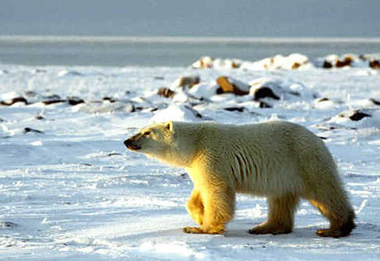
The Arctic or the Earth's Northern Polar Region has pretty extreme weather!

Ok, so you know the Arctic is cold, right? But did you know that minimum temperatures of -90°Fahrenheit (-68° Celsius) can be reached in Greenland and northern Siberia during winter months?!? That's pretty cold! Now it's not that cold all the time all over the Arctic. The average Arctic winter temperature is -30° F (-34°C), while the average Arctic summer temperature is 37-54° F (3-12° C).

In general, Arctic winters are long and cold while summers are short and cool. And some places in the Arctic are actually warmer then you might expect because they are near the coast and are warmed by the warm ocean water.

The clouds found most in the Arctic are low stratus and stratocumulus clouds. Springtime is the cloudiest while Winter is the least cloudy.

Arctic places don't get much precipitation. What they do get is usually snow during Fall and in Spring. They usually get less than 10 inches of precipitation a year. This means they can be officially classified as a dessert!

The Arctic can also be windy! With little in the way to slow them, winds can sweep over huge areas of land dropping loads of snow when an obstacle is hit. The summer months in the Arctic are the windiest.

It is not very humid in the Arctic. The cold air just can't hold much moisture!

Last modified June 28, 2007 by Jennifer Bergman.

Shop Windows to the Universe Science Store!

The Summer 2010 issue of The Earth Scientist, available in our online store, includes articles on rivers and snow, classroom planetariums, satellites and oceanography, hands-on astronomy, and global warming.

Windows to the Universe Community

News

Opportunities

You might also be interested in:

Traveling Nitrogen Classroom Activity Kit

Check out our online store - minerals, fossils, books, activities, jewelry, and household items!...more

The Arctic: Earth's North Polar Region

North of the Arctic Circle (at 66.5°N latitude) you will find the Arctic Ocean surrounded by the continents of Europe, Asia, and North America. You will find the geographic North Pole and the magnetic...more

Low Clouds

The low cloud group consists of Stratus, Stratocumulus, and Nimbostratus clouds. Low clouds consist of water droplets. The base of a low cloud is from the ground surface to 2000m....more

Wind

Wind is moving air. Warm air rises, and cool air comes in to take its place. This movement creates different pressures in the atmosphere which creates the winds around the globe. Since the Earth spins,...more

The Polar Atmosphere

Phenomena in the Polar Atmosphere There are some unique phenomena that happen in the atmosphere that is above the Earth's polar regions. Read on to discover more about some of the unique parts of the polar...more

Exploration of the Poles of the Earth

Polar exploration includes the physical exploration of the Arctic and the Antarctica. The Arctic is the area around the Earth's north pole and includes parts of Canada, Greenland, Russia, the United States...more

The Antarctic Region

What Will You Find There? South of the Antarctic Circle (at 66.5°S latitude) you will find the continent of Antarctica surrounded by the Southern Ocean, the geographic South Pole and the magnetic South...more

Antarctica

Antarctica is unique. It is the coldest, windiest, and driest continent on Earth. The land is barren and mostly covered with a thick sheet of ice. Antarctica is almost entirely south of the Antarctic Circle...more

Shop Windows to the Universe

Science, Evolution, and Creationism, by the National Academies, focuses on teaching evolution in today's classrooms. Check out the other publications in our online store.

Windows to the Universe, a project of the National Earth Science Teachers Association, is sponsored in part by the National Science Foundation and NASA, our Founding Partners (the American Geophysical Union and American Geosciences Institute) as well as through Institutional, Contributing, and Affiliate Partners, individual memberships and generous donors. Thank you for your support! NASA AGU AGI NSF