Current Events

  • Atmospheric CO2 Level Tops 400 ppm
    During the week of May 13th, the CO2 level at the Mauna Loa Observatory in Hawaii topped 400 ppm rep...Read more

    x

    Atmospheric CO2 Level Tops 400 ppm

    During the week of May 13th, the CO2 level at the Mauna Loa Observatory in Hawaii topped 400 ppm repeatedly. Daily levels of CO2 can vary due to weather, and there are seasonal trends as well. The level of atmospheric greenhouse gases continues to increase, now over 120 ppm since the Industrial Revolution began. For more on the Keeling Curve, see http://keelingcurve.ucsd.edu/. Find out more about greenhouse gases and warming.
  • Massive Tornado Outbreak on Tornado Alley
    The week of May 19 brings dozens of tornadoes to Tornado Alley in the states of Oklahoma, Kansas, Io...Read more

    x

    Massive Tornado Outbreak on Tornado Alley

    The week of May 19 brings dozens of tornadoes to Tornado Alley in the states of Oklahoma, Kansas, Iowa, Illinois and Missouri. On May 20th, a massive tornado struck Moore, Oklahoma, devastating communities - destroying over 100 homes and hitting two elementary schools and a hospital - with many casualties and deaths. Our thoughts are with our friends and colleagues suffering from these storms. For more on the May 20th storms, see the NOAA Storm Prediction Center Storm Report.
  • Kansas Legislator Proposes Bill to Outlaw Sustainability Education
    A bill has been introduced in the Kansas legislature this week that would prohibit the promotion of ...Read more

    x

    Kansas Legislator Proposes Bill to Outlaw Sustainability Education

    A bill has been introduced in the Kansas legislature this week that would prohibit the promotion of sustainability. Here is a link to the one-page bill: http://www.kslegislature.org/li/b2013_14/measures/documents/hb2366_00_0000.pdf. See report on Bloomberg News.

Sea Ice in the Arctic and Antarctic

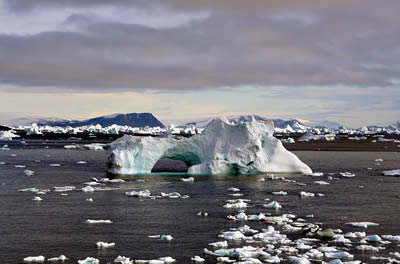
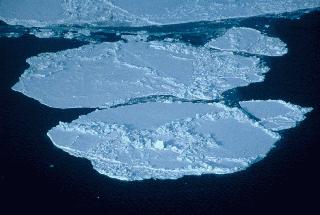
Sea ice is frozen seawater. It floats on the oceans that are in Earth's polar regions. The salt in the seawater does not freeze. Very salty water gets trapped in the sea ice when it forms. The pockets of salty water work their way out of the sea ice over a few years. During the summer much of the sea ice melts and during the winter months it forms again. Some sea ice stays around all year long.

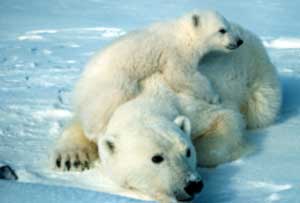
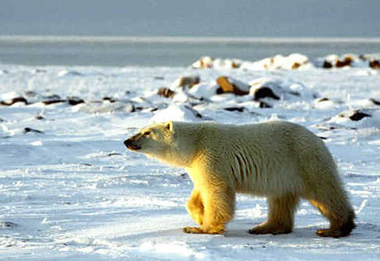
The Arctic Ocean has a large amount of sea ice floating at its surface, especially in winter. Sea ice is very important for the people and animals that live in the Arctic region. Animals like polar bears live on the sea ice and find their food in the ocean below it. Marine animals live under the Arctic sea ice too. In the South Polar Region, sea ice is important for penguins like the Emperor penguins in the movie "March of the Penguins".

Because of global warming, more sea ice is melting each year. Scientists are studying how animals like polar bears and penguins are affected by melting sea ice.

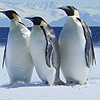
Last modified April 13, 2007 by Randy Russell.

Shop Windows to the Universe Science Store!

The Winter 2009 issue of The Earth Scientist, focuses on Earth System science, including articles on student inquiry, differentiated instruction, geomorphic concepts, the rock cycle, and much more!

Windows to the Universe Community

News

Opportunities

You might also be interested in:

Cool It! Game

Check out our online store - minerals, fossils, books, activities, jewelry, and household items!...more

The Antarctic Region

What Will You Find There? If you travel to the South Pole, you will find the continent of Antarctica surrounded by the Southern Ocean. The geographic South Pole is marked by a large sign that scientists...more

Polar Bears on Thin Ice

Polar bears live in one of our planet’s most extreme environments, the Arctic . They thrive in the freezing cold. But because of global warming, polar bears might be in trouble. Scientists are studying...more

The Cryosphere

Frozen water is found in many different places on Earth. Snow blankets the ground at mid and high latitudes during winter. Sea ice and icebergs float in the chilly waters of polar oceans. Ice shelves are...more

The Arctic: Earth's North Polar Region

In the Arctic, you will find the Arctic Ocean surrounded by the continents of Europe, Asia, and North America. You will find the geographic North Pole and the magnetic North Pole there; both are in the...more

The Warming Arctic

The climate had become warmer during the past few decades in the north polar region . Temperatures are rising twice as fast as they are elsewhere in the world. Warmer temperatures cause other things to...more

Ice-Albedo Feedback: How Melting Ice Causes More Ice to Melt

All winter long in the chilly Arctic, sea ice grows larger as the ocean water freezes. A blanket of fresh white snow covers it. The white snow reflects the sunshine that hits it. As summer begins, the...more

Greenland’s Ice Is Melting Faster

There is a lot of ice on Greenland. But as our planet gets warmer, Greenland’s ice is melting. Scientists have figured out that the ice is melting faster now. More ice melted during the summer of 2007...more

Shop Windows to the Universe

Become a nitrogen atom in the nitrogen cycle in our Traveling Nitrogen Classroom Activity Kit/Game. See all our games, activity kits and classroom activities.

Windows to the Universe, a project of the National Earth Science Teachers Association, is sponsored in part by the National Science Foundation and NASA, our Founding Partners (the American Geophysical Union and American Geosciences Institute) as well as through Institutional, Contributing, and Affiliate Partners, individual memberships and generous donors. Thank you for your support! NASA AGU AGI NSF