The Arctic Ocean in the North Polar Region of Earth
US CIA
The Arctic Ocean
The Arctic Ocean is the smallest of Earth’s five oceans. It is located almost entirely within the Arctic Circle in the North Polar Region. Surrounding the Arctic Ocean are the northernmost parts of Europe, Asia, and North America. The ocean is connected to the Pacific Ocean at the Bearing Straight, the waterway between Siberia (Russia) and Alaska (USA). The Arctic Ocean is connected to the Atlantic Ocean at the Greenland Sea, east of Greenland.
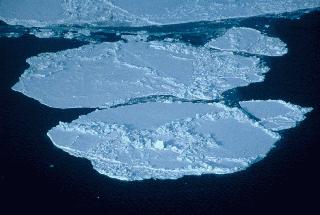
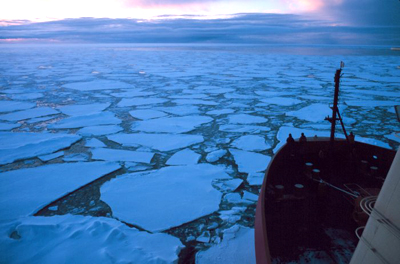
A layer of sea ice covers a large part of the Arctic Ocean for at least part of the year. More sea ice forms during the winter, when it is the coldest. In the summer, when it is warmer, much of the sea ice melts. Because our planet is warming, the amount of sea ice that stays around all year long is shrinking. In fact, at some point within the next few decades there will likely be no sea ice during summer in the Arctic Ocean.
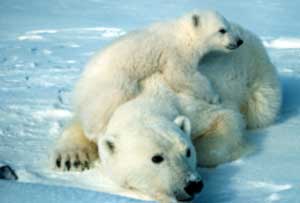
Marine life in the Arctic Ocean include a few large mammals such as walruses and whales, as well as smaller animals such as fish, species of invertebrate animals that live in the water and on the ocean floor. Phytoplankton, tiny marine plants, are the start most marine food chains. During the summer, when the days are very long, these plants can photosynthesizefor a long time each day, and they reproduce quickly. In winter, phytoplankton struggle to get enough sunlight to survive. There are species of algae and small animals that live within the sea ice and small animals that live underneath the sea ice. There is still much that is not known about the organisms that live within and under the Arctic sea ice.


Shop Windows to the Universe Science Store!
The
Summer 2010 issue of The Earth Scientist, available in our
online store, includes articles on rivers and snow, classroom planetariums, satellites and oceanography, hands-on astronomy, and global warming.
You might also be interested in:

North of the Arctic Circle (at 66.5°N latitude) you will find the Arctic Ocean surrounded by the continents of Europe, Asia, and North America. You will find the geographic North Pole and the magnetic
...more
Sea ice is frozen seawater. It can be several meters thick and it moves over time. Although the salts in the seawater do not freeze, pockets of concentrated salty water become trapped in the sea ice when
...more
Photosynthesis is the name of the process by which autotrophs (self-feeders) convert water, carbon dioxide, and solar energy into sugars and oxygen. It is a complex chemical process by which plants and
...more
The majority of the world's population does not live in the Arctic. But even if you don't live in the Arctic, it is very important to understand how the Arctic Ocean works because it has an impact on surrounding
...more
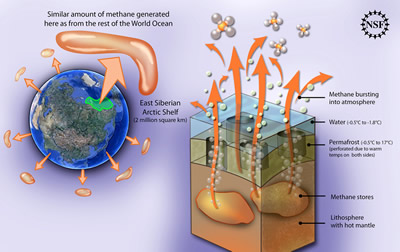
Natalia Shakhova and Igor Semiletov, scientists from the University of Alaska Fairbanks, have led a research team to study a section of the sea floor of the Arctic Ocean in an area called the East Siberian
...more
“Polar bears are one of nature’s ultimate survivors, able to live and thrive in one of the world’s harshest environments, but we are concerned the polar bears’ habitat may literally be melting” said US
...more
There are two oceans in Earth's polar regions. The Arctic Ocean is in the north polar region. The Southern Ocean is in the south polar region. The oceans that are in the polar regions are a bit different
...more