Current Events

  • Atmospheric CO2 Level Tops 400 ppm
    During the week of May 13th, the CO2 level at the Mauna Loa Observatory in Hawaii topped 400 ppm rep...Read more

    x

    Atmospheric CO2 Level Tops 400 ppm

    During the week of May 13th, the CO2 level at the Mauna Loa Observatory in Hawaii topped 400 ppm repeatedly. Daily levels of CO2 can vary due to weather, and there are seasonal trends as well. The level of atmospheric greenhouse gases continues to increase, now over 120 ppm since the Industrial Revolution began. For more on the Keeling Curve, see http://keelingcurve.ucsd.edu/. Find out more about greenhouse gases and warming.
  • Massive Tornado Outbreak on Tornado Alley
    The week of May 19 brings dozens of tornadoes to Tornado Alley in the states of Oklahoma, Kansas, Io...Read more

    x

    Massive Tornado Outbreak on Tornado Alley

    The week of May 19 brings dozens of tornadoes to Tornado Alley in the states of Oklahoma, Kansas, Iowa, Illinois and Missouri. On May 20th, a massive tornado struck Moore, Oklahoma, devastating communities - destroying over 100 homes and hitting two elementary schools and a hospital - with many casualties and deaths. Our thoughts are with our friends and colleagues suffering from these storms. For more on the May 20th storms, see the NOAA Storm Prediction Center Storm Report.
  • Kansas Legislator Proposes Bill to Outlaw Sustainability Education
    A bill has been introduced in the Kansas legislature this week that would prohibit the promotion of ...Read more

    x

    Kansas Legislator Proposes Bill to Outlaw Sustainability Education

    A bill has been introduced in the Kansas legislature this week that would prohibit the promotion of sustainability. Here is a link to the one-page bill: http://www.kslegislature.org/li/b2013_14/measures/documents/hb2366_00_0000.pdf. See report on Bloomberg News.
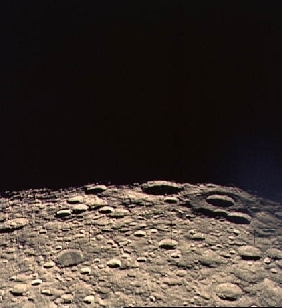
An image of the heavily-cratered far side of the Moon.
NASA.

The Moon's Geological History

Scientists have studied the ages of rocks in regions with craters and determined when in the Moon's past the craters were forming most quickly. By studying the light-colored regions, called highlands, they found that from about 4.6 to 3.8 billion years ago rocky debris rained down on the surface of the young Moon, forming craters very quickly. Then the rocky rain subsided, and fewer craters have formed since then.

Rock samples from very large craters (called basins) showed that about 3.8 to 3.1 billion years ago several huge, asteroid-like objects struck the Moon, just as the rocky rain was ending. This was shortly followed by lava flows which filled in the basins and formed the dark maria. This explains why there are so few craters on the maria, but dense, overlapping craters in the highlands. No lava flows occurred on the highlands to erase the original blanket of craters from the time when the Moon's surface was showered with the debris of the early solar system.

The far side of the Moon has only one small maria. So lunar geologists believe that the far side is very representative of how the Moon looked 4 billion years ago.

Shop Windows to the Universe Science Store!

Windows to the Universe Community

News

Opportunities

You might also be interested in:

Traveling Nitrogen Classroom Activity Kit

Check out our online store - minerals, fossils, books, activities, jewelry, and household items!...more

Albedo

This picture of the Earth surface was taken from high above the planet in the International Space Station. In this view from above, we can see that there are lots of different things that cover the Earth....more

Desert Birds

Like the other creatures of the desert, birds come up with interesting ways to survive in the harsh climate. The sandgrouse has special feathers that soak up water. It can then carry the water to its...more

The Desert Biome

Deserts are full of interesting questions. How can anything survive in a place with hardly any water? Why is it so dry to begin with? You can find at least one desert on every continent except Europe....more

Desert Insects and Arachnids

You can find insects almost anywhere in the world. So it should be of no surprise that there are plenty of insects in the desert. One of the most common and destructive pests is the locust. A locust is...more

Desert Mammals

There are several species of mammals in the desert. They range in size from a few inches to several feet in length. Like other desert wildlife, mammals have to find ways to stay cool and drink plenty...more

Biomes and Ecosystems

Biomes are large regions of the world with similar plants, animals, and other living things that are adapted to the climate and other conditions. Explore the links below to learn more about different biomes....more

Temperate Forests

The temperate forest biome is found in regions where winters are cold and summers are warm. Regions with this climate are common in the mid-latitudes, far from both the equator and the poles. Tropical...more

Shop Windows to the Universe

Earth Science Rocks! Select one of our four cool NESTA t-shirts from our online store, and express your love of Earth and space science!

Windows to the Universe, a project of the National Earth Science Teachers Association, is sponsored in part by the National Science Foundation and NASA, our Founding Partners (the American Geophysical Union and American Geosciences Institute) as well as through Institutional, Contributing, and Affiliate Partners, individual memberships and generous donors. Thank you for your support! NASA AGU AGI NSF