Current Events

  • Kansas Legislator Proposes Bill to Outlaw Sustainability Education
    A bill has been introduced in the Kansas legislature this week that would prohibit the promotion of ...Read more

    x

    Kansas Legislator Proposes Bill to Outlaw Sustainability Education

    A bill has been introduced in the Kansas legislature this week that would prohibit the promotion of sustainability. Here is a link to the one-page bill: http://www.kslegislature.org/li/b2013_14/measures/documents/hb2366_00_0000.pdf. See report on Bloomberg News.
  • Earth's Center Is 1,000 Degrees Hotter Than Previously Thought, Synchrotron X-Ray Experiment Shows
    Scientists have determined the temperature near the Earth’s center to be 6000 degrees Celsius, 1000 ...Read more

    x

    Earth's Center Is 1,000 Degrees Hotter Than Previously Thought, Synchrotron X-Ray Experiment Shows

    Scientists have determined the temperature near the Earth’s center to be 6000 degrees Celsius, 1000 degrees hotter than in a previous experiment run 20 years ago. These measurements confirm geophysical models that the temperature difference between the solid core and the mantle above, must be at least 1500 degrees to explain why the Earth has a magnetic field. For more information about this study, see the press release from the European Synchrotron Radiation Facility.
  • Ocean Volcanic Rocks Contain Samples of Recycled Crust
    Scientists have long believed that lava erupted from certain oceanic volcanoes contains materials fr...Read more

    x

    Ocean Volcanic Rocks Contain Samples of Recycled Crust

    Scientists have long believed that lava erupted from certain oceanic volcanoes contains materials from the early Earth’s crust. But decisive evidence for this phenomenon has proven elusive. New research from a team including Carnegie’s Erik Hauri demonstrates that oceanic volcanic rocks contain samples of recycled crust dating back to the Archean era 2.5 billion years ago. Their work is published in Nature. Oceanic crust sinks into the Earth’s mantle at so-called subduction zones, where two plates come together. Much of what happens to the crust during this journey is unknown. Model-dependent studies for how long subducted material can exist in the mantle are uncertain and evidence of very old crust returning to Earth’s surface via upwellings of magma has not been found until now. For more information about these results, see the press release from the Carnegie Institution.
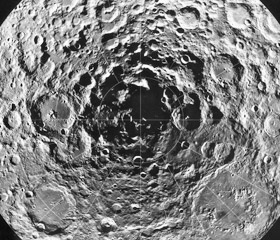
This picture shows the Moon's South Pole. Some areas near the pole are in dark shadows all of the time. There might be water ice in some of those shady places.
Click on image for full size
Image courtesy NASA.

The Moon's Poles

The North and South Pole of the Moon are interesting places. Some areas near the Moon's poles are almost always in sunlight. Other places near the poles are always in dark shadows.

Earth is tilted on its axis by 23°. This tilt causes our seasons. During summer it is always light near the pole, but in the winter it is dark all the time. The Moon is hardly tilted at all (less than 2°), so it doesn't have seasons. Places near the Moon's poles are always on the edge between day and night.

High mountains near the Moon's poles might get sunlight almost all of the time. That would be a great place for explorers to build solar panels. The panels would make electricity almost all of the time, since they would almost always be in sunlight. There are peaks near the North Pole and near the South Pole on the Moon that are probably lit nearly all of the time.

There are also some really dark, cold places near the Moon's poles. The bottoms of some deep craters may be in dark shadows all of the time. That would make them very cold, since they wouldn't be heated by sunlight. There might even be water ice in some of those dark craters. Ice could tell us a lot about the Moon's history. It could also be used by astronauts as drinking water, to make oxygen to breath, and to create rocket fuel.

Last modified August 24, 2009 by Randy Russell.

Shop Windows to the Universe Science Store!

Learn about Earth and space science, and have fun while doing it! The games section of our online store includes a climate change card game and the Traveling Nitrogen game!

Windows to the Universe Community

News

Opportunities

You might also be interested in:

Ready, Set, SCIENCE!: Putting Research to Work in K-8 Science Classrooms

What types of instructional experiences help K-8 students learn science with understanding? What do science educators teachers, teacher leaders, science specialists, professional development staff, curriculum designers, school administrators need to know to create and support such experiences?...more

The Earth's Moon

The Earth's one natural satellite, the Moon, is more than one quarter the size of Earth itself (3,474 km diameter). Because of its smaller size, the Moon's gravity is one-sixth of the Earth's gravity,...more

The Earth's Rotation

The Earth is rotating around an axis (called its rotational axis). Some objects rotate about a horizontal axis, like a rolling log. Some objects, such as a skater, rotate about a vertical axis. The Earth's...more

Earth's Tilt Is the Reason for the Seasons!

During the year, the seasons change depending on the amount of sunlight reaching the Earth as it revolves around the Sun. The seasons are caused as the Earth, tilted on its axis, travels in a loop around...more

The Summer Solstice

Let's pretend, for the moment, that you're the person standing on the Earth in the picture to the left, living in Topeka, Kansas, around 40° N latitude. The picture on the left shows the view from the...more

The Winter Solstice

Let's pretend, for the moment, that you're the person standing on the Earth in the picture to the left, living in Topeka, Kansas, around 40° N latitude. The picture on the left shows the view from the...more

Water on the Moon?

The tiny Lunar Prospector probe launched in January 1998 has found the answer to the most controversial question in lunar science. The Lunar Prospector has found that there is indeed water-ice located...more

About Lunar Water

In decades past is was accepted that the Moon contained no water. Moon rocks collected by Apollo astronauts (at lunar equatorial regions) contained no traces of water. Lunar mapping performed by the Galileo...more

Shop Windows to the Universe

The Spring 2011 issue of The Earth Scientist is focused on modernizing seismology education. Thanks to IRIS, you can download this issue for free as a pdf. Print copies are available in our online store.

Windows to the Universe, a project of the National Earth Science Teachers Association, is sponsored in part by the National Science Foundation and NASA, our Founding Partners (the American Geophysical Union and American Geosciences Institute) as well as through Institutional, Contributing, and Affiliate Partners, individual memberships and generous donors. Thank you for your support! NASA AGU AGI NSF