Current Events

  • Irish Chronicles Document Links Between Volcanoes and Weather
    A study of over 40,000 written entries in Irish Annals and ice core measurements shows a strong corr...Read more

    x

    Irish Chronicles Document Links Between Volcanoes and Weather

    A study of over 40,000 written entries in Irish Annals and ice core measurements shows a strong correlation between the occurrence of volcanic eruptions and extreme cold weather in Ireland over a 1200 year period. Data analyzed in this study cover the period from 431 to 1649, during which time up to 48 volcanic eruptions are identified in Greenland ice core records through deposition of volcanic sulfate in annual layers of ice. You can find the study (open access), published on 6 June 2013 in IOP Publishing's journal Environmental Research Letters, at http://iopscience.iop.org/1748-9326/8/2/024035/article. Find out more about how volcanoes can influence climate.
  • EF-5 Tornado in El Reno, Oklahoma Widest Ever Recorded in US
    The EF-5 tornado that hit El Reno, Oklahoma on May 31st was the widest ever recorded in the US, acco...Read more

    x

    EF-5 Tornado in El Reno, Oklahoma Widest Ever Recorded in US

    The EF-5 tornado that hit El Reno, Oklahoma on May 31st was the widest ever recorded in the US, according to the National Weather Service in Norman Oklahoma. The tornado, which remained on the ground for 40 minutes and reached 2.6 miles across (4.2 km), took the lives of 18 people including storm chasers Tim Samaras, Paul Samaras and Carl Young. For more information on the tornado, visit http://ow.ly/i/2hfDG.
  • Atmospheric CO2 Level Tops 400 ppm
    During the week of May 13th, the CO2 level at the Mauna Loa Observatory in Hawaii topped 400 ppm rep...Read more

    x

    Atmospheric CO2 Level Tops 400 ppm

    During the week of May 13th, the CO2 level at the Mauna Loa Observatory in Hawaii topped 400 ppm repeatedly. Daily levels of CO2 can vary due to weather, and there are seasonal trends as well. The level of atmospheric greenhouse gases continues to increase, now over 120 ppm since the Industrial Revolution began. For more on the Keeling Curve, see http://keelingcurve.ucsd.edu/. Find out more about greenhouse gases and warming.
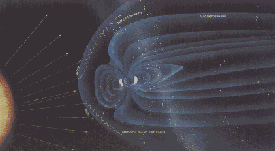
This is a view of the Earth's magnetosphere.
Click on image for full size
Aris Multimedia Entertainment, Inc. 1994

The Moon's Magnetosphere

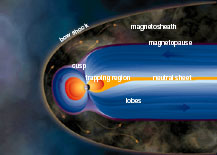
Unlike the Earth, which has a protective shield around it called the magnetosphere, the surface of the moon is not protected from the solar wind. This picture shows the magnetosphere surrounding the Earth, with the Earth a small object in the center.

A planet's magnetosphere is provided through its magnetic field. To create a magnetic field, a planet or moon must have magnetic material such has iron, which is warm enough to move around to form currents within the planet.

Over time planets and moons freeze completely through. It is possible that the moon has little magnetic field because it's iron core has frozen solid. Further exploration of the Moon through missions such as Lunar Prospector will help scientists figure out what happened to the Moon's magnetic field.


Shop Windows to the Universe Science Store!

Our online store includes issues of NESTA's quarterly journal, The Earth Scientist, full of classroom activities on different topics in Earth and space science, as well as books on science education!

Windows to the Universe Community

News

Opportunities

You might also be interested in:

Traveling Nitrogen Classroom Activity Kit

Check out our online store - minerals, fossils, books, activities, jewelry, and household items!...more

The Earth's Magnetic Field

The Earth has a magnetic field with north and south poles. The Earth's magnetic field reaches 36,000 miles into space. The magnetic field of the Earth is surrounded in a region called the magnetosphere....more

The Magnetic Field

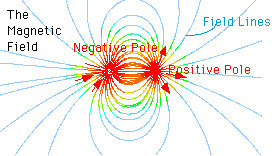
The force of magnetism causes material to point along the direction the magnetic force points. As shown in the diagram to the left, the force of magnetism is illustrated by lines, which represent the force....more

How do we know what the inside of a Planet or Moon is like?

You may wonder how it is that scientists know what the inside of a planet is like. The interior of a moon or planet can be closely determined from spacecraft navigation data when a spacecraft passes by...more

The Lunar Atmosphere

People used to think that moons such as the Earth's moon or the moons of Jupiter had no atmosphere whatsoever. Now, however, measurements have shown that most of these moons are surrounded by a *very*...more

The Co-Formation Theory

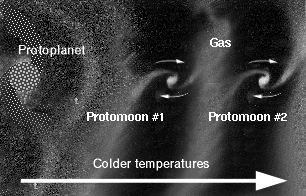
The co-formation theory explains the origin of the moon as an object which formed out of the primitive solar nebula at the same time and roughly the same place as the Earth. As shown in this picture, while...more

The Moon's Magnetosphere

Unlike the Earth, which has a protective shield around it called the magnetosphere, the surface of the moon is not protected from the solar wind. This picture shows the magnetosphere surrounding the Earth,...more

The Many Names for the Full Moon

Sometimes, in the fall, you may hear people call a Full Moon the "Harvest Moon". That's because farmers can stay in their fields late, after sunset, harvesting their crops by the bright light of a Full...more

Shop Windows to the Universe

The Winter 2010 issue of The Earth Scientist includes a variety of educational resources, ranging from astronomy to glaciers. Check out the other publications and classroom materials in our online store.

Windows to the Universe, a project of the National Earth Science Teachers Association, is sponsored in part by the National Science Foundation and NASA, our Founding Partners (the American Geophysical Union and American Geosciences Institute) as well as through Institutional, Contributing, and Affiliate Partners, individual memberships and generous donors. Thank you for your support! NASA AGU AGI NSF