Current Events

  • Atmospheric CO2 Level Tops 400 ppm
    During the week of May 13th, the CO2 level at the Mauna Loa Observatory in Hawaii topped 400 ppm rep...Read more

    x

    Atmospheric CO2 Level Tops 400 ppm

    During the week of May 13th, the CO2 level at the Mauna Loa Observatory in Hawaii topped 400 ppm repeatedly. Daily levels of CO2 can vary due to weather, and there are seasonal trends as well. The level of atmospheric greenhouse gases continues to increase, now over 120 ppm since the Industrial Revolution began. For more on the Keeling Curve, see http://keelingcurve.ucsd.edu/. Find out more about greenhouse gases and warming.
  • Massive Tornado Outbreak on Tornado Alley
    The week of May 19 brings dozens of tornadoes to Tornado Alley in the states of Oklahoma, Kansas, Io...Read more

    x

    Massive Tornado Outbreak on Tornado Alley

    The week of May 19 brings dozens of tornadoes to Tornado Alley in the states of Oklahoma, Kansas, Iowa, Illinois and Missouri. On May 20th, a massive tornado struck Moore, Oklahoma, devastating communities - destroying over 100 homes and hitting two elementary schools and a hospital - with many casualties and deaths. Our thoughts are with our friends and colleagues suffering from these storms. For more on the May 20th storms, see the NOAA Storm Prediction Center Storm Report.
  • Kansas Legislator Proposes Bill to Outlaw Sustainability Education
    A bill has been introduced in the Kansas legislature this week that would prohibit the promotion of ...Read more

    x

    Kansas Legislator Proposes Bill to Outlaw Sustainability Education

    A bill has been introduced in the Kansas legislature this week that would prohibit the promotion of sustainability. Here is a link to the one-page bill: http://www.kslegislature.org/li/b2013_14/measures/documents/hb2366_00_0000.pdf. See report on Bloomberg News.
This is a drawing of how a hot spot under the crust builds land on the surface.
Click on image for full size
Image copyright 1997 by the American Geophysical Union. Further electronic distribution is not allowed.

Plume Volcanism

This drawing shows another way that islands are made. A rising hot bubble of material finds it's way into the crust of the Earth from the deep interior, and begins to erupt. This bubble or "plume" is called a "hot spot". Lava from the eruption turns to layers of rock and builds a volcanic "cone". Continual eruptions eventually build a whole island on the surface, with a volcano in the middle.

A similar process built the Tharsis Ridge of Marsand many volcanic rises on Venus. The volcanoes of Mars which were built this way became *very* large.


Shop Windows to the Universe Science Store!

Our online store includes issues of NESTA's quarterly journal, The Earth Scientist, full of classroom activities on different topics in Earth and space science, as well as books on science education!

Windows to the Universe Community

News

Opportunities

You might also be interested in:

Cool It! Game

Check out our online store - minerals, fossils, books, activities, jewelry, and household items!...more

Plumes

A "mantle plume" is a bubble of material which rises to the surface from deep inside a planet. The plume is the red portion shown in the drawing to the left. Deep inside a planet it is very hot! Even so,...more

Volcano Formation

Volcanoes form when hot material from below rises and leaks into the crust. The hot material, called magma, rising from lower ground, gathers in a reservoir called the magma chamber. Eventually, but not...more

Volcanic Ash

Ash is formed as a volcano erupts when rocks made by the volcano blow apart into millions of tiny pieces. The rocks are still very hot, because they just formed from lava. If the hot rocks come into contact...more

Cinder Cones

Cinder cones are simple volcanoes which have a cone shape and are not very big. Compare the size of this volcano to the strato-volcano in this image. They are usually made of piles of lava, not ash. During...more

Flowing Lava

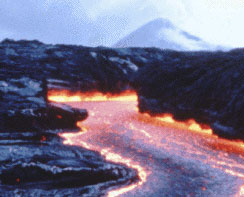
Lava can move in two ways, wide flat lava flows, or through channels which squeeze the lava into a small area. The fastest lava flows move at about 6 mi/hr, an easy jog, but they average between 2/3 and...more

How Do Plates Move?

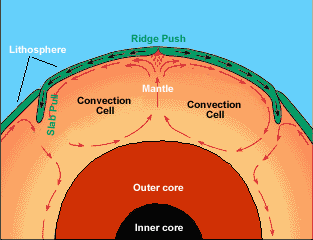
Plates at our planet’s surface move because heat in the Earth’s core causes molten rock in the mantle layer to flow. We used to think the Earth’s plates just surfed on top of the moving mantle, but now...more

Clues to Plate Movements

Many kinds of surface features are clues to a sliding lithosphere. Two types of features can form when plates move apart. At ocean ridges, the crust splits apart to make room for molten mantle rock. Continental...more

Windows to the Universe, a project of the National Earth Science Teachers Association, is sponsored in part by the National Science Foundation and NASA, our Founding Partners (the American Geophysical Union and American Geosciences Institute) as well as through Institutional, Contributing, and Affiliate Partners, individual memberships and generous donors. Thank you for your support! NASA AGU AGI NSF