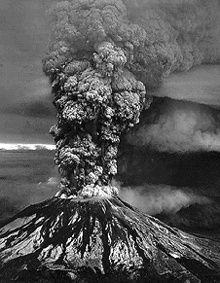
This is an image of Mt. St. Helens, in Washington, USA.
Click on image for full size
Image from: USGS, courtesy of Volcano World

Do Other Planets have a surface in Motion?

Let's look at the evidence:

What about Jupiter, Saturn, Uranus, Neptune, Titan, or Pluto? These planets or moons either have no surface, or the surface cannot be seen from the Earth.



Shop Windows to the Universe Science Store!

Windows to the Universe Community

News

Opportunities

You might also be interested in:

The Earth Scientist, Volume XXVI, Issue 1, Spring 2010

This very special issue of The Earth Scientist (our biggest ever!) is sponsored by the Cooperative Institute for Climate and Ocean Research at the Woods Hole Oceanographic Institution and is focused on the world’s oceans....more

Surface of Europa

The picture to the left shows examples of the many amazing different surface features of Europa. Many exciting discoveries were made about Europa during the Galileo mission. The surface of Europa is unusual,...more

Does Ganymede Have a Surface in Motion?

There has been no icy volcanism on Ganymede, nor continental drift, but it does seem that there have been movements of the surface. Examination of the surface of Ganymede reveals many kinds of faulting....more

The Structure of Jupiter's Interior

There is no surface to the giant planets, only a gradual change from the atmosphere, as shown in this drawing. The gases which Jupiter is mostly made of change to liquid inside Jupiter, but the change...more

The Structure of Saturn's Interior

There is no surface to the giant planets, only a gradual change from the atmosphere, as shown in this drawing. The gases which Saturn is mostly made of change to liquid inside Saturn, but the change is...more

The Structure of Uranus' Interior

There is no surface to the giant planets, only a gradual change from the atmosphere, as shown in this drawing. Therefore the giant planets do not have strict layers, as the earth-like planets do. Ice begins...more

The Structure of Neptune's Interior

There is no surface to the giant planets, only a gradual change from the atmosphere, as pictured in this drawing. Therefore the giant planets do not have strict layers, as the earth-like planets do. Ice...more

Clues to Plate Movements

Many kinds of surface features are clues that our lithosphere is sliding. Two types of features can form when plates move apart. At mid ocean ridges, the bottom of the sea splits apart and new crust is...more

Shop Windows to the Universe

The Fall 2010 issue of The Earth Scientist focuses on rocks and minerals. Check out the other publications in our online store, as well as classroom materials.

Generous sponsorship of Windows to the Universe is provided by the Hewlett Foundation, the American Geological Institute, the American Geophysical Union, the National Science Foundation, NASA, NCAR, and the CISM and CMMAP projects. NASA CMMAP AGU CISM NCAR Hewlett AGI NSF