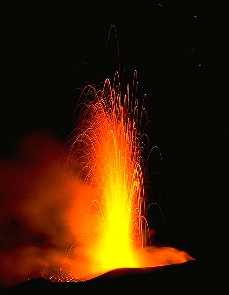
This is an image of the eruption of Stromboli volcano.
Click on image for full size
Image from Dr. J. Alean, Eglisau, Switzerland
For more information, images and video about Stromboli volcano see Stromboli On-Line.
Lava
Lava is the word for magma (molten rock) which is on the surface of the Earth. After being released from the magma chamber and cooling, lava hardens into rock. The term lava can describe active flows, cooled rock, and pieces hurled into the air during eruptions.
Lava comes in many different forms, among them are:
- 'A'a - lava which has a blocky or spiny surface. A'a' is pronounced ah-ah because that is the sound someone will make if they walk over a new flow that can look like fresh dirt.
- Pahoehoe - Lava with a smooth or ropy appearance that can lead to weird shapes.
- Block lava - A solid rock chunk greater than 64mm in diameter which was ejected from a volcano or lava flow.
- Bomb lava - Also known as volcanic bombs; lava chunk greater than 64mm in diameter which were ejected while still partially melted.
- Pillow lava - Lava underwater forms long pillow-shaped formations.
Lava coming out the the volcano's mouth can flow at different
speeds. It usually moves at speeds between 2/3 and 1/3 mi/hr. Lava in a tube or channel can flow quite a bit faster, speeding at a top speed of around 23 mi/hr. A normal walking speed is 2-4 mi/hr, while an athlete can run the 100 meter dash at just about 23 mi/hr. In other words, lava flows can usually be walked away from, but you should still be careful!
You might also be interested in:

Magma consists of remelted material from Earth's crust and fresh material from other regions near the Earth's surface. When magma is erupted onto the surface in the form of lava, it becomes silicate rock.
...more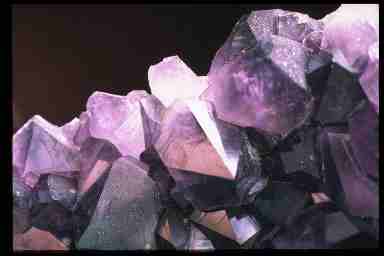
Minerals are the building blocks of rocks. They are non-living, solid, and, like all matter, are made of atoms of elements. There are many different types of minerals and each type is made of particular
...more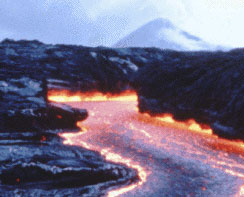
Lava can move in broad flat lava flows, or it can move through tight channels or tubes. Lava flows tend to cool quickly and flow slowly. The fastest lava outside of channels moves at about 6 mi/hr an easy
...more Here is an example from terrestrial volcanism of what it might have looked like when Europan lava poured out onto the surface of Europa. In the case of Europa, the lavge is really warm water. When it
...moreEarth's surface was still very hot at this time, like a bubbling pot, and there was a lot of volcanic activity. Thus the surface of the Earth was covered with igneous rocks, there was no ocean, and no
...more
Ash is made of millions of tiny fragments of rock and glass formed during a volcanic eruption. Volcanic ash particles are less than 2 mm in size and can be much smaller. Volcanic ash forms in several ways
...more
Cinder cones are simple volcanoes which have a bowl-shaped crater at the summit and only grow to about a thousand feet, the size of a hill. They usually are created of eruptions from a single opening,
...more