Current Events

  • Kansas Legislator Proposes Bill to Outlaw Sustainability Education
    A bill has been introduced in the Kansas legislature this week that would prohibit the promotion of ...Read more

    x

    Kansas Legislator Proposes Bill to Outlaw Sustainability Education

    A bill has been introduced in the Kansas legislature this week that would prohibit the promotion of sustainability. Here is a link to the one-page bill: http://www.kslegislature.org/li/b2013_14/measures/documents/hb2366_00_0000.pdf. See report on Bloomberg News.
  • Earth's Center Is 1,000 Degrees Hotter Than Previously Thought, Synchrotron X-Ray Experiment Shows
    Scientists have determined the temperature near the Earth’s center to be 6000 degrees Celsius, 1000 ...Read more

    x

    Earth's Center Is 1,000 Degrees Hotter Than Previously Thought, Synchrotron X-Ray Experiment Shows

    Scientists have determined the temperature near the Earth’s center to be 6000 degrees Celsius, 1000 degrees hotter than in a previous experiment run 20 years ago. These measurements confirm geophysical models that the temperature difference between the solid core and the mantle above, must be at least 1500 degrees to explain why the Earth has a magnetic field. For more information about this study, see the press release from the European Synchrotron Radiation Facility.
  • Ocean Volcanic Rocks Contain Samples of Recycled Crust
    Scientists have long believed that lava erupted from certain oceanic volcanoes contains materials fr...Read more

    x

    Ocean Volcanic Rocks Contain Samples of Recycled Crust

    Scientists have long believed that lava erupted from certain oceanic volcanoes contains materials from the early Earth’s crust. But decisive evidence for this phenomenon has proven elusive. New research from a team including Carnegie’s Erik Hauri demonstrates that oceanic volcanic rocks contain samples of recycled crust dating back to the Archean era 2.5 billion years ago. Their work is published in Nature. Oceanic crust sinks into the Earth’s mantle at so-called subduction zones, where two plates come together. Much of what happens to the crust during this journey is unknown. Model-dependent studies for how long subducted material can exist in the mantle are uncertain and evidence of very old crust returning to Earth’s surface via upwellings of magma has not been found until now. For more information about these results, see the press release from the Carnegie Institution.
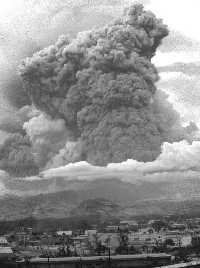
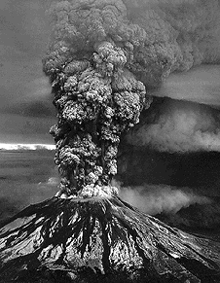
This is an image of the eruption of Mt. Pinatubo.
Click on image for full size
Image from: U.S. Geological Survey

Eruptions

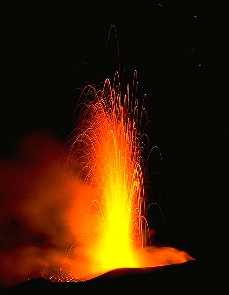
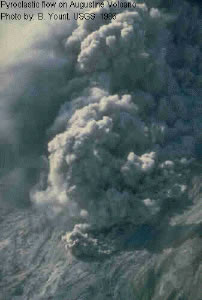
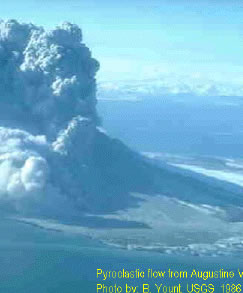
Volcanic eruptions come in many different forms. Shield volcanoes usually only spew lava and hot gases. These lavas flow slowly down the mountain with speeds of 15 miles per hour or slower. Composite volcanoes can put forth lava accompanied by clouds of ash, bombs, lava fragments, crystallized, glassy material, as well as hot gases. In some eruptions, ash and lava are buoyied by hot vapors and pour down the slopes of a volcano very rapidly, with speeds up to 100 miles per hour. This special type of eruption destroyed the city of St. Pierre in 1902. In other cases hot material from the volcano can melt snow and ice at the volcano summit and the whole mass of mud and lava can sweep rapidly down the mountain, destroying everything in its path. This type of flow is called a lahar.

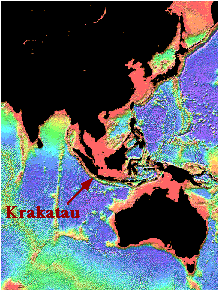
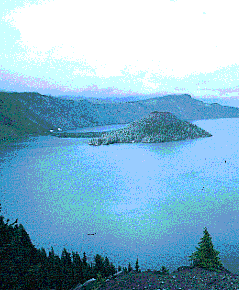
There have been some spectacular eruptions in Earth history. These include Mt. Pelee, Krakatoa, Crater Lake (formerly Mt. Mazama), Mt. Vesuvius, Mt. St. Helens, Mt. Pinatubo.


Last modified May 22, 2008 by Becca Hatheway.

Shop Windows to the Universe Science Store!

Windows to the Universe Community

News

Opportunities

You might also be interested in:

Science, Evolution, and Creationism

How did life evolve on Earth? The answer to this question can help us understand our past and prepare for our future. Although evolution provides credible and reliable answers, polls show that many people turn away from science, seeking other explanations with which they are more comfortable....more

Lava

Lava is the word for magma (molten rock) which is on the surface of the Earth. After being released from the magma chamber and cooling, lava hardens into rock. The term lava can describe active flows,...more

Pyroclastic Material

Pyroclastic material is another name for a cloud of ash, lava fragments carried through the air, and vapor. Such a flow is usually *very* hot, and moves *rapidly* due to buoyancy provided by the vapors....more

Mt. Pelee

Mt. Pelee is not a very tall volcano, in fact it is an example of what is called a "lava dome". An extremely destructive eruption of Mount Pelee occurred in 1902. A coastal town, about 4 miles downslope...more

Lahar

Lahars are mudslides caused by the mixing of volcanic ash and debris with water. They can occur when the heat from a volcano melts snow and ice on the volcano's summit, or if an eruption disturbs a crater...more

Krakatoa

One of the most powerful volcanic explosions in the history of the world occured at Krakatoa in the last century. Krakatoa was formerly a volcanic island located between Java and Sumatra. It was located...more

Crater Lake

Mt. Mazama was once among a cluster of stratovolcanoes stretching along the Washington and Oregon coast. This cluster of volcanoes includes Mt. Hood, Mt. Rainier, and Mt. St. Helens. The magma chamber...more

Shop Windows to the Universe

The Winter 2010 issue of The Earth Scientist includes a variety of educational resources, ranging from astronomy to glaciers. Check out the other publications and classroom materials in our online store.

Windows to the Universe, a project of the National Earth Science Teachers Association, is sponsored in part by the National Science Foundation and NASA, our Founding Partners (the American Geophysical Union and American Geosciences Institute) as well as through Institutional, Contributing, and Affiliate Partners, individual memberships and generous donors. Thank you for your support! NASA AGU AGI NSF