Current Events

  • Atmospheric CO2 Level Tops 400 ppm
    During the week of May 13th, the CO2 level at the Mauna Loa Observatory in Hawaii topped 400 ppm rep...Read more

    x

    Atmospheric CO2 Level Tops 400 ppm

    During the week of May 13th, the CO2 level at the Mauna Loa Observatory in Hawaii topped 400 ppm repeatedly. Daily levels of CO2 can vary due to weather, and there are seasonal trends as well. The level of atmospheric greenhouse gases continues to increase, now over 120 ppm since the Industrial Revolution began. For more on the Keeling Curve, see http://keelingcurve.ucsd.edu/. Find out more about greenhouse gases and warming.
  • Massive Tornado Outbreak on Tornado Alley
    The week of May 19 brings dozens of tornadoes to Tornado Alley in the states of Oklahoma, Kansas, Io...Read more

    x

    Massive Tornado Outbreak on Tornado Alley

    The week of May 19 brings dozens of tornadoes to Tornado Alley in the states of Oklahoma, Kansas, Iowa, Illinois and Missouri. On May 20th, a massive tornado struck Moore, Oklahoma, devastating communities - destroying over 100 homes and hitting two elementary schools and a hospital - with many casualties and deaths. Our thoughts are with our friends and colleagues suffering from these storms. For more on the May 20th storms, see the NOAA Storm Prediction Center Storm Report.
  • Kansas Legislator Proposes Bill to Outlaw Sustainability Education
    A bill has been introduced in the Kansas legislature this week that would prohibit the promotion of ...Read more

    x

    Kansas Legislator Proposes Bill to Outlaw Sustainability Education

    A bill has been introduced in the Kansas legislature this week that would prohibit the promotion of sustainability. Here is a link to the one-page bill: http://www.kslegislature.org/li/b2013_14/measures/documents/hb2366_00_0000.pdf. See report on Bloomberg News.
This is an image of the Earth.
Click on image for full size
NASA

The Cooling of Earth

Planets cool off for many different reasons.

When Earth formed about 4 Billion Years ago, it became relatively large and warm. Earth also contains many warming elements such as the radioactive minerals, so it has not cooled as rapidly as some other planets.

Earth has had a long a complicated cooling history. An understanding of the Earth's history might begin with the record of geologic time.


Shop Windows to the Universe Science Store!

Windows to the Universe Community

News

Opportunities

You might also be interested in:

Traveling Nitrogen Classroom Activity Kit

Check out our online store - minerals, fossils, books, activities, jewelry, and household items!...more

How a proto-planet sweeps up nearby material

As shown in this picture, while they were forming in the solar nebula, the nucleii of the planets-to-be (called protoplanets) drew material to themselves from the cloud of gas and dust around them. The...more

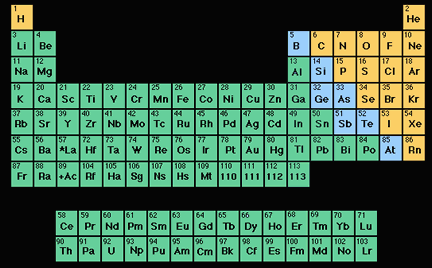
Element (Chemical Element)

An element (also called a "chemical element") is a substance made up entirely of atoms having the same atomic number; that is, all of the atoms have the same number of protons. Hydrogen, helium, oxygen,...more

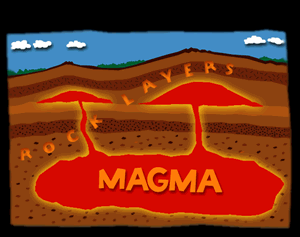
Magma

If you could travel to the center of the Earth, you would find that it gets hotter and hotter as you travel deeper. The heat is naturally produced when radioactive elements break apart. Within the Earth’s...more

Volcanic Ash

Ash is made of millions of tiny fragments of rock and glass formed during a volcanic eruption. Volcanic ash particles are less than 2 mm in size and can be much smaller. Volcanic ash forms in several ways...more

Cinder Cones

Cinder cones are simple volcanoes which have a bowl-shaped crater at the summit and only grow to about a thousand feet, the size of a hill. They usually are created of eruptions from a single opening,...more

Flowing Lava

Lava can move in broad flat lava flows, or it can move through tight channels or tubes. Lava flows tend to cool quickly and flow slowly. The fastest lava outside of channels moves at about 6 mi/hr an easy...more

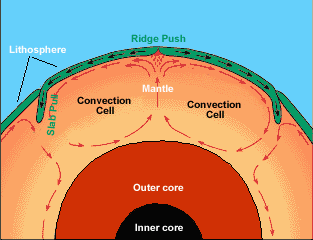
How Do Plates Move?

Plates at our planet’s surface move because of the intense heat in the Earth’s core that causes molten rock in the mantle layer to move. It moves in a pattern called a convection cell that forms when...more

Shop Windows to the Universe

Our Glaciers: Then and Now activity kit helps you see the changes taking place in glaciers around the world. See all our activity kits and classroom activities.

Windows to the Universe, a project of the National Earth Science Teachers Association, is sponsored in part by the National Science Foundation and NASA, our Founding Partners (the American Geophysical Union and American Geosciences Institute) as well as through Institutional, Contributing, and Affiliate Partners, individual memberships and generous donors. Thank you for your support! NASA AGU AGI NSF