Current Events

  • Atmospheric CO2 Level Tops 400 ppm
    During the week of May 13th, the CO2 level at the Mauna Loa Observatory in Hawaii topped 400 ppm rep...Read more

    x

    Atmospheric CO2 Level Tops 400 ppm

    During the week of May 13th, the CO2 level at the Mauna Loa Observatory in Hawaii topped 400 ppm repeatedly. Daily levels of CO2 can vary due to weather, and there are seasonal trends as well. The level of atmospheric greenhouse gases continues to increase, now over 120 ppm since the Industrial Revolution began. For more on the Keeling Curve, see http://keelingcurve.ucsd.edu/. Find out more about greenhouse gases and warming.
  • Massive Tornado Outbreak on Tornado Alley
    The week of May 19 brings dozens of tornadoes to Tornado Alley in the states of Oklahoma, Kansas, Io...Read more

    x

    Massive Tornado Outbreak on Tornado Alley

    The week of May 19 brings dozens of tornadoes to Tornado Alley in the states of Oklahoma, Kansas, Iowa, Illinois and Missouri. On May 20th, a massive tornado struck Moore, Oklahoma, devastating communities - destroying over 100 homes and hitting two elementary schools and a hospital - with many casualties and deaths. Our thoughts are with our friends and colleagues suffering from these storms. For more on the May 20th storms, see the NOAA Storm Prediction Center Storm Report.
  • Kansas Legislator Proposes Bill to Outlaw Sustainability Education
    A bill has been introduced in the Kansas legislature this week that would prohibit the promotion of ...Read more

    x

    Kansas Legislator Proposes Bill to Outlaw Sustainability Education

    A bill has been introduced in the Kansas legislature this week that would prohibit the promotion of sustainability. Here is a link to the one-page bill: http://www.kslegislature.org/li/b2013_14/measures/documents/hb2366_00_0000.pdf. See report on Bloomberg News.
This is an image of the Alvin being recovered by divers.
Click on image for full size
Image from: Woods Hole Oceanographic Institute, photo by Rod Castiac

The Alvin

Deep sea trenches are just that - really deep! They can be a couple miles deeper than the average depth of the ocean floor (4 miles). It is hard for humans to travel there because the pressures along the ocean bottom are so extreme.

The Alvin was the first deep-sea submersible. It was designed by scientists to explore the ocean floor, including the deep sea trenches. Between 1964 and 1999, the Alvin made 3,535 dives. The average depth for a dive was 1.28 miles (2,055 meters). The total number of people carried by the Alvin was 10,540. So, most dives carried 3 people aboard. The Alvin helps scientists to carry out research underwater in the areas of geology, biology and chemistry. It also helps inspect underwater structures and search for sunken vessels.

Research vessels like the Alvin allow humans to find such creatures as tube worms which live near vents along the ocean floor. The next image shows a view of the Alvin underwater.


Last modified May 5, 2003 by Lisa Gardiner.

Shop Windows to the Universe Science Store!

Windows to the Universe Community

News

Opportunities

You might also be interested in:

Traveling Nitrogen Classroom Activity Kit

Check out our online store - minerals, fossils, books, activities, jewelry, and household items!...more

Creatures which live in Harsh Environments

There are many types of living things that are able to live in difficult environments on Earth. The picture to the left shows an example of some of these creatures. These are tubeworms that live at the...more

The Abyss: Deepest Part of the Oceans No Longer Hidden

A new remotely operated vehicle (ROV) called Nereus has dived 10,902 meters, the deepest dive to date. The robot spent about 10 hours in the Mariana Trench, the deepest part of the ocean and the boundary...more

Volcanic Ash

Ash is made of millions of tiny fragments of rock and glass formed during a volcanic eruption. Volcanic ash particles are less than 2 mm in size and can be much smaller. Volcanic ash forms in several ways...more

Cinder Cones

Cinder cones are simple volcanoes which have a bowl-shaped crater at the summit and only grow to about a thousand feet, the size of a hill. They usually are created of eruptions from a single opening,...more

Flowing Lava

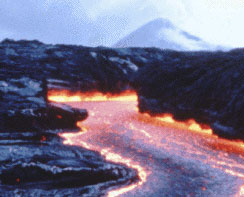
Lava can move in broad flat lava flows, or it can move through tight channels or tubes. Lava flows tend to cool quickly and flow slowly. The fastest lava outside of channels moves at about 6 mi/hr an easy...more

How Do Plates Move?

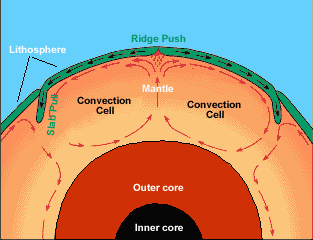
Plates at our planet’s surface move because of the intense heat in the Earth’s core that causes molten rock in the mantle layer to move. It moves in a pattern called a convection cell that forms when...more

Clues to Plate Movements

Many kinds of surface features are clues that our lithosphere is sliding. Two types of features can form when plates move apart. At mid ocean ridges, the bottom of the sea splits apart and new crust is...more

Shop Windows to the Universe

Check out the fun Earth science related bumper stickers in our online store! Express yourself!

Windows to the Universe, a project of the National Earth Science Teachers Association, is sponsored in part by the National Science Foundation and NASA, our Founding Partners (the American Geophysical Union and American Geosciences Institute) as well as through Institutional, Contributing, and Affiliate Partners, individual memberships and generous donors. Thank you for your support! NASA AGU AGI NSF