Current Events

  • Irish Chronicles Document Links Between Volcanoes and Weather
    A study of over 40,000 written entries in Irish Annals and ice core measurements shows a strong corr...Read more

    x

    Irish Chronicles Document Links Between Volcanoes and Weather

    A study of over 40,000 written entries in Irish Annals and ice core measurements shows a strong correlation between the occurrence of volcanic eruptions and extreme cold weather in Ireland over a 1200 year period. Data analyzed in this study cover the period from 431 to 1649, during which time up to 48 volcanic eruptions are identified in Greenland ice core records through deposition of volcanic sulfate in annual layers of ice. You can find the study (open access), published on 6 June 2013 in IOP Publishing's journal Environmental Research Letters, at http://iopscience.iop.org/1748-9326/8/2/024035/article. Find out more about how volcanoes can influence climate.
  • EF-5 Tornado in El Reno, Oklahoma Widest Ever Recorded in US
    The EF-5 tornado that hit El Reno, Oklahoma on May 31st was the widest ever recorded in the US, acco...Read more

    x

    EF-5 Tornado in El Reno, Oklahoma Widest Ever Recorded in US

    The EF-5 tornado that hit El Reno, Oklahoma on May 31st was the widest ever recorded in the US, according to the National Weather Service in Norman Oklahoma. The tornado, which remained on the ground for 40 minutes and reached 2.6 miles across (4.2 km), took the lives of 18 people including storm chasers Tim Samaras, Paul Samaras and Carl Young. For more information on the tornado, visit http://ow.ly/i/2hfDG.
  • Atmospheric CO2 Level Tops 400 ppm
    During the week of May 13th, the CO2 level at the Mauna Loa Observatory in Hawaii topped 400 ppm rep...Read more

    x

    Atmospheric CO2 Level Tops 400 ppm

    During the week of May 13th, the CO2 level at the Mauna Loa Observatory in Hawaii topped 400 ppm repeatedly. Daily levels of CO2 can vary due to weather, and there are seasonal trends as well. The level of atmospheric greenhouse gases continues to increase, now over 120 ppm since the Industrial Revolution began. For more on the Keeling Curve, see http://keelingcurve.ucsd.edu/. Find out more about greenhouse gases and warming.
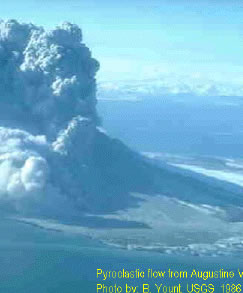
This is an image of a pyroclastic flow going down the slopes of a volcano to the sea.
Click on image for full size
Image from: U.S. Geological Survey, photo by B. Yount

Mt. Pelee

Mt. Pelee is not a very tall volcano, in fact it is an example of what is called a "lava dome".

An extremely destructive eruption of Mount Pelee occurred in 1902. A coastal town, about 4 miles downslope to the south, was demolished and nearly 30,000 inhabitants were killed almost instantly. During the eruption, a burning cloud of hot ash and gases swept into the town at a speed of 100 miles per hour. This picture illustrates the same kind of flow coming down an Alaskan volcano.

Survivors of this eruption included one man who was in an underground jail cell, as well as sailors who were off-shore and witnessed the destruction of the city from a distance. Comments by these eyewitnesses included the following:

  • "The mountain was blown to pieces, there was no warning."
  • "It was like a giant oil refinery."
  • "There was hurled straight toward us a solid wall of flame. It sounded like a thousand cannon."
  • "The wave of fire was on us and over us like a flash of lightning. It was like a hurricane of fire."
  • "The town vanished before our eyes."

Shop Windows to the Universe Science Store!

Windows to the Universe Community

News

Opportunities

You might also be interested in:

Traveling Nitrogen Classroom Activity Kit

Check out our online store - minerals, fossils, books, activities, jewelry, and household items!...more

Volcanic Ash

Ash is made of millions of tiny fragments of rock and glass formed during a volcanic eruption. Volcanic ash particles are less than 2 mm in size and can be much smaller. Volcanic ash forms in several ways...more

Cinder Cones

Cinder cones are simple volcanoes which have a bowl-shaped crater at the summit and only grow to about a thousand feet, the size of a hill. They usually are created of eruptions from a single opening,...more

Flowing Lava

Lava can move in broad flat lava flows, or it can move through tight channels or tubes. Lava flows tend to cool quickly and flow slowly. The fastest lava outside of channels moves at about 6 mi/hr an easy...more

How Do Plates Move?

Plates at our planet’s surface move because of the intense heat in the Earth’s core that causes molten rock in the mantle layer to move. It moves in a pattern called a convection cell that forms when...more

Clues to Plate Movements

Many kinds of surface features are clues that our lithosphere is sliding. Two types of features can form when plates move apart. At mid ocean ridges, the bottom of the sea splits apart and new crust is...more

Magma Chamber

Magma consists of remelted material from Earth's crust and fresh material from other regions near the Earth's surface. When magma is erupted onto the surface in the form of lava, it becomes silicate rock....more

Mid-Ocean Spreading Ridge

As the Earth cools, hot material from the deep interior rises to the surface. Hot material is depicted in red in this drawing, under an ocean shown in blue green. The hotter material elevates the nearby...more

Shop Windows to the Universe

Science, Evolution, and Creationism, by the National Academies, focuses on teaching evolution in today's classrooms. Check out the other publications in our online store.

Windows to the Universe, a project of the National Earth Science Teachers Association, is sponsored in part by the National Science Foundation and NASA, our Founding Partners (the American Geophysical Union and American Geosciences Institute) as well as through Institutional, Contributing, and Affiliate Partners, individual memberships and generous donors. Thank you for your support! NASA AGU AGI NSF