Current Events

  • Atmospheric CO2 Level Tops 400 ppm
    During the week of May 13th, the CO2 level at the Mauna Loa Observatory in Hawaii topped 400 ppm rep...Read more

    x

    Atmospheric CO2 Level Tops 400 ppm

    During the week of May 13th, the CO2 level at the Mauna Loa Observatory in Hawaii topped 400 ppm repeatedly. Daily levels of CO2 can vary due to weather, and there are seasonal trends as well. The level of atmospheric greenhouse gases continues to increase, now over 120 ppm since the Industrial Revolution began. For more on the Keeling Curve, see http://keelingcurve.ucsd.edu/. Find out more about greenhouse gases and warming.
  • Massive Tornado Outbreak on Tornado Alley
    The week of May 19 brings dozens of tornadoes to Tornado Alley in the states of Oklahoma, Kansas, Io...Read more

    x

    Massive Tornado Outbreak on Tornado Alley

    The week of May 19 brings dozens of tornadoes to Tornado Alley in the states of Oklahoma, Kansas, Iowa, Illinois and Missouri. On May 20th, a massive tornado struck Moore, Oklahoma, devastating communities - destroying over 100 homes and hitting two elementary schools and a hospital - with many casualties and deaths. Our thoughts are with our friends and colleagues suffering from these storms. For more on the May 20th storms, see the NOAA Storm Prediction Center Storm Report.
  • Kansas Legislator Proposes Bill to Outlaw Sustainability Education
    A bill has been introduced in the Kansas legislature this week that would prohibit the promotion of ...Read more

    x

    Kansas Legislator Proposes Bill to Outlaw Sustainability Education

    A bill has been introduced in the Kansas legislature this week that would prohibit the promotion of sustainability. Here is a link to the one-page bill: http://www.kslegislature.org/li/b2013_14/measures/documents/hb2366_00_0000.pdf. See report on Bloomberg News.
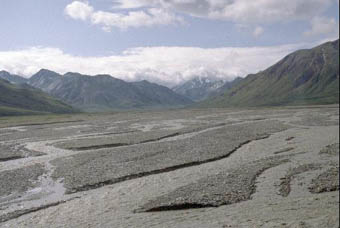
This stream carries sediment that has weathered from nearby mountains at Polychrome Pass, Alaska.
Click on image for full size
Courtesy of Bruce Molnia, Terra Photographics

Step 2: Erosion and Transport (Sediments on the Move!)

Sneeze into a pile of dust and the particles fly everywhere. Sneeze into a pile of rocks and they stay put. That’s because they have more mass. You need more force than a sneeze to move those rocks. Wind and water can have enough force to move rocks. Just compare what’s on the bottom of a fast moving river with what’s at the bottom of a calm lake. The fast moving river will carry away the smaller sediments leaving large gravel and even boulders. The calm lake allows even very small sediments carried in the water to settle to the bottom.

Moving water in rivers and moving air in wind sort particles by size. Larger particles can be carried in a stronger current, like fast moving water. Very small particles like silt and clay settle very slowly and so they only form layers at the bottom of quiet water areas like lakes, swamps, or lagoons.

The size of the sediments in a clastic sedimentary rock usually relates directly to the energy of the wind or water that they were deposited in. Particles that can sink to the bottom in a fast moving river must be very large and heavy. Smaller particles are carried away. However, in a calm lake, even very small pieces of sediment are able to settle to the bottom.

Last modified August 25, 2003 by Lisa Gardiner.

Shop Windows to the Universe Science Store!

TES XXVI, 3 fall 2010 The Fall 2010 issue of The Earth Scientist, focuses on rocks and minerals, including articles on minerals and mining, the use of minerals in society, and rare earth minerals, and includes 3 posters!

Windows to the Universe Community

News

Opportunities

You might also be interested in:

Traveling Nitrogen Classroom Activity Kit

Check out our online store - minerals, fossils, books, activities, jewelry, and household items!...more

What is mass?

Would it be more difficult to pull an elephant or a mouse? If you pulled each animal with the same amount of force, the elephant would respond less to pulling, even if he didn’t pull back at all. That’s...more

Wind

Wind is moving air. Warm air rises, and cool air comes in to take its place. This movement creates different pressures in the atmosphere which creates the winds around the globe. Since the Earth spins,...more

Rivers

Rivers are very important to Earth because they are major forces that shape the landscape. Also, they provide transportation and water for drinking, washing and farming. Rivers can flow on land or underground...more

Step 2: Erosion and Transport (Sediments on the Move!)

Sneeze into a pile of dust and the particles fly everywhere. Sneeze into a pile of rocks and they stay put. That’s because they have more mass. You need more force than a sneeze to move those rocks. Wind...more

Step 3: Deposition (Sediments Settling Down!)

When water or wind loses energy and slows down, sediment can no longer be carried in it. The particles of sediment fall through the water or air and form a blanket of sediment on the bottom of a river,...more

Living, Meandering River Constructed

In a feat of reverse-engineering, Christian Braudrick of University of California at Berkeley and three coauthors have successfully built and maintained a scale model of a living meandering gravel-bed...more

Aquifer

An aquifer is the name for a layer of rock which is capable of holding a large amount of water. Some layers are better at holding water than others, for example a layer of sandstone can hold a good deal...more

Shop Windows to the Universe

Please help support Windows to the Universe, and our activities to help Earth and space science teachers, with a tax-exempt donation today!

Windows to the Universe, a project of the National Earth Science Teachers Association, is sponsored in part by the National Science Foundation and NASA, our Founding Partners (the American Geophysical Union and American Geosciences Institute) as well as through Institutional, Contributing, and Affiliate Partners, individual memberships and generous donors. Thank you for your support! NASA AGU AGI NSF