Current Events

  • Kansas Legislator Proposes Bill to Outlaw Sustainability Education
    A bill has been introduced in the Kansas legislature this week that would prohibit the promotion of ...Read more

    x

    Kansas Legislator Proposes Bill to Outlaw Sustainability Education

    A bill has been introduced in the Kansas legislature this week that would prohibit the promotion of sustainability. Here is a link to the one-page bill: http://www.kslegislature.org/li/b2013_14/measures/documents/hb2366_00_0000.pdf. See report on Bloomberg News.
  • Earth's Center Is 1,000 Degrees Hotter Than Previously Thought, Synchrotron X-Ray Experiment Shows
    Scientists have determined the temperature near the Earth’s center to be 6000 degrees Celsius, 1000 ...Read more

    x

    Earth's Center Is 1,000 Degrees Hotter Than Previously Thought, Synchrotron X-Ray Experiment Shows

    Scientists have determined the temperature near the Earth’s center to be 6000 degrees Celsius, 1000 degrees hotter than in a previous experiment run 20 years ago. These measurements confirm geophysical models that the temperature difference between the solid core and the mantle above, must be at least 1500 degrees to explain why the Earth has a magnetic field. For more information about this study, see the press release from the European Synchrotron Radiation Facility.
  • Ocean Volcanic Rocks Contain Samples of Recycled Crust
    Scientists have long believed that lava erupted from certain oceanic volcanoes contains materials fr...Read more

    x

    Ocean Volcanic Rocks Contain Samples of Recycled Crust

    Scientists have long believed that lava erupted from certain oceanic volcanoes contains materials from the early Earth’s crust. But decisive evidence for this phenomenon has proven elusive. New research from a team including Carnegie’s Erik Hauri demonstrates that oceanic volcanic rocks contain samples of recycled crust dating back to the Archean era 2.5 billion years ago. Their work is published in Nature. Oceanic crust sinks into the Earth’s mantle at so-called subduction zones, where two plates come together. Much of what happens to the crust during this journey is unknown. Model-dependent studies for how long subducted material can exist in the mantle are uncertain and evidence of very old crust returning to Earth’s surface via upwellings of magma has not been found until now. For more information about these results, see the press release from the Carnegie Institution.
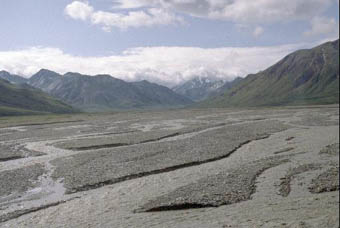
This stream carries sediment that has weathered from mountains in Alaska.
Click on image for full size
Courtesy of Bruce Molnia, Terra Photographics

Step 2: Sediments on the Move!

If you sneeze into a pile of dust the little particles fly everywhere, but if you sneeze into a pile of rocks, they will stay put. It takes more force than a sneeze to move those rocks. Winds and water can have enough force to move rocks.

Very small pieces of sediment like mud and clay are picked up very easily by moving wind and water. But they can settle to the bottom of calm lakes or to the ground when the air or water stops moving.

Larger pieces of sediment can be carried in a stronger current, like fast moving water. Sediment that can sink to the bottom in a fast moving river must be very large and heavy.

Last modified August 25, 2003 by Lisa Gardiner.

Shop Windows to the Universe Science Store!

The Fall 2010 issue of The Earth Scientist, focuses on rocks and minerals, including articles on minerals and mining, the use of minerals in society, and rare earth minerals, and includes 3 posters!

Windows to the Universe Community

News

Opportunities

You might also be interested in:

Traveling Nitrogen Classroom Activity Kit

Check out our online store - minerals, fossils, books, activities, jewelry, and household items!...more

Wind

Wind is moving air. Warm air rises, and cool air comes in to take its place. This movement creates the winds around the globe. Winds move at different speeds and have different names based on their speed....more

Rivers

Rivers are very important to Earth because they are major forces that shape the landscape. Also, they provide transportation and water for drinking, washing and farming. Rivers can flow on land or underground...more

Step 2: Sediments on the Move!

If you sneeze into a pile of dust the little particles fly everywhere, but if you sneeze into a pile of rocks, they will stay put. It takes more force than a sneeze to move those rocks. Winds and water...more

Step 3: Sediments Settling Down!

When water or wind slows down, sediment can no longer be carried in it. The particles of sediment fall through the water or air and form a blanket of sediment on the bottom of a river, a lake, ocean,...more

Living, Meandering River Constructed

Scientists have used a model of a river to learn more about how healthy rivers are formed. Healthy rivers have sections that are shallow, and other sections that are deep. These different types of water...more

Aquifer

An aquifer is the name for a layer of rock which is capable of holding a large amount of water. Some layers are better at holding water than others, for example a layer of sandstone can hold a good deal...more

Currents at the Coast

When waves get to the beach at an angle, water moves along the coast in a longshore current. Longshore currents grow stronger when the waves come towards the beach at a large angle, if the waves are large,...more

Shop Windows to the Universe

Please help support Windows to the Universe, and our activities to help Earth and space science teachers, with a tax-exempt donation today!

Windows to the Universe, a project of the National Earth Science Teachers Association, is sponsored in part by the National Science Foundation and NASA, our Founding Partners (the American Geophysical Union and American Geosciences Institute) as well as through Institutional, Contributing, and Affiliate Partners, individual memberships and generous donors. Thank you for your support! NASA AGU AGI NSF