Current Events

  • Kansas Legislator Proposes Bill to Outlaw Sustainability Education
    A bill has been introduced in the Kansas legislature this week that would prohibit the promotion of ...Read more

    x

    Kansas Legislator Proposes Bill to Outlaw Sustainability Education

    A bill has been introduced in the Kansas legislature this week that would prohibit the promotion of sustainability. Here is a link to the one-page bill: http://www.kslegislature.org/li/b2013_14/measures/documents/hb2366_00_0000.pdf. See report on Bloomberg News.
  • Earth's Center Is 1,000 Degrees Hotter Than Previously Thought, Synchrotron X-Ray Experiment Shows
    Scientists have determined the temperature near the Earth’s center to be 6000 degrees Celsius, 1000 ...Read more

    x

    Earth's Center Is 1,000 Degrees Hotter Than Previously Thought, Synchrotron X-Ray Experiment Shows

    Scientists have determined the temperature near the Earth’s center to be 6000 degrees Celsius, 1000 degrees hotter than in a previous experiment run 20 years ago. These measurements confirm geophysical models that the temperature difference between the solid core and the mantle above, must be at least 1500 degrees to explain why the Earth has a magnetic field. For more information about this study, see the press release from the European Synchrotron Radiation Facility.
  • Ocean Volcanic Rocks Contain Samples of Recycled Crust
    Scientists have long believed that lava erupted from certain oceanic volcanoes contains materials fr...Read more

    x

    Ocean Volcanic Rocks Contain Samples of Recycled Crust

    Scientists have long believed that lava erupted from certain oceanic volcanoes contains materials from the early Earth’s crust. But decisive evidence for this phenomenon has proven elusive. New research from a team including Carnegie’s Erik Hauri demonstrates that oceanic volcanic rocks contain samples of recycled crust dating back to the Archean era 2.5 billion years ago. Their work is published in Nature. Oceanic crust sinks into the Earth’s mantle at so-called subduction zones, where two plates come together. Much of what happens to the crust during this journey is unknown. Model-dependent studies for how long subducted material can exist in the mantle are uncertain and evidence of very old crust returning to Earth’s surface via upwellings of magma has not been found until now. For more information about these results, see the press release from the Carnegie Institution.
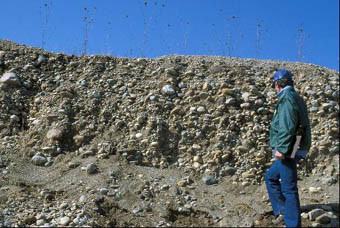
These pebbles were deposited in a stream that once flowed over this area in Indiana, USA thousands of years ago. Now they are part of a clastic sedimentary rock called conglomerate.
Click on image for full size
Courtesy of Bruce Molnia, Terra Photographics

Step 3: Deposition (Sediments Settling Down!)

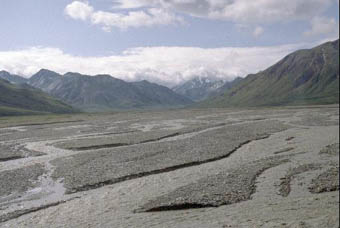
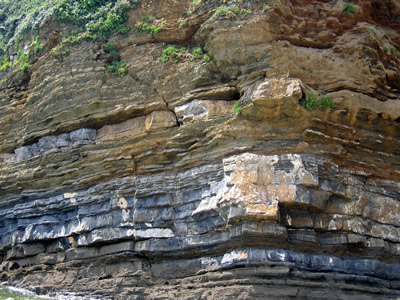
When water or wind loses energy and slows down, sediment can no longer be carried in it. The particles of sediment fall through the water or air and form a blanket of sediment on the bottom of a river, a lake, ocean, or on the surface of the land. This process is called deposition.

Settling out of the wind or water depends on the size of the clast. Larger clasts with high mass will settle more quickly than smaller clasts with less mass. Conversely, it takes more energy to move larger clasts through the water or air (a process called entrainment).

How does deposition happen?
Try this and find out!

  1. Add a handful or two of sediment to a jar that includes particles of different sizes such as pebbles, sand and mud.
  2. Fill the jar with water and seal the lid on top.
  3. Shake the jar and watch the pebbles and dirt become entrained in the water.
  4. Let the jar sit still for a few minutes. What has been deposited on the bottom of the jar? Are any of the small particles still in the water? (The heaviest items fall out of the water more quickly than the small ones once you stop shaking the jar.)

Last modified August 25, 2003 by Lisa Gardiner.

Shop Windows to the Universe Science Store!

TES XXVI, 3 fall 2010 The Fall 2010 issue of The Earth Scientist, focuses on rocks and minerals, including articles on minerals and mining, the use of minerals in society, and rare earth minerals, and includes 3 posters!

Windows to the Universe Community

News

Opportunities

You might also be interested in:

Cool It! Game

Check out our online store - minerals, fossils, books, activities, jewelry, and household items!...more

Wind

Wind is moving air. Warm air rises, and cool air comes in to take its place. This movement creates different pressures in the atmosphere which creates the winds around the globe. Since the Earth spins,...more

Step 3: Deposition (Sediments Settling Down!)

When water or wind loses energy and slows down, sediment can no longer be carried in it. The particles of sediment fall through the water or air and form a blanket of sediment on the bottom of a river,...more

Step 2: Erosion and Transport (Sediments on the Move!)

Sneeze into a pile of dust and the particles fly everywhere. Sneeze into a pile of rocks and they stay put. That’s because they have more mass. You need more force than a sneeze to move those rocks. Wind...more

Robert (Bob) Williams

I'm a New Zealand teacher. I teach geography to high school students before some of them go on to university. We try to teach as much geology and earth science as we can, and we go on lots of field trips....more

Currents at the Coast

Ocean waves often approach a coastline at an angle. This moves water along the coast in a longshore current. Longshore currents grow stronger when the incoming waves are closer to perpendicular to the...more

Paleozoic "Sediment Curve" Provides New Tool for Tracking Sea-floor Sediment Movements

As the world looks for more energy, the oil industry will need more refined tools for discoveries in places where searches have never before taken place, geologists say. One such tool is a new sediment...more

Earth Science Literacy - Big Idea 5

Earth is the water planet. Big Idea 5.1 Water is found everywhere on Earth, from the heights of the atmosphere to the depths of the mantle. Early in Earth’s history, surface water accumulated through both...more

Shop Windows to the Universe

Ready, Set, SCIENCE!, by the National Research Council, focuses on K-8 science classsrooms. Check out the other publications in our online store, as well as classroom materials.

Windows to the Universe, a project of the National Earth Science Teachers Association, is sponsored in part by the National Science Foundation and NASA, our Founding Partners (the American Geophysical Union and American Geosciences Institute) as well as through Institutional, Contributing, and Affiliate Partners, individual memberships and generous donors. Thank you for your support! NASA AGU AGI NSF