Current Events

  • Irish Chronicles Document Links Between Volcanoes and Weather
    A study of over 40,000 written entries in Irish Annals and ice core measurements shows a strong corr...Read more

    x

    Irish Chronicles Document Links Between Volcanoes and Weather

    A study of over 40,000 written entries in Irish Annals and ice core measurements shows a strong correlation between the occurrence of volcanic eruptions and extreme cold weather in Ireland over a 1200 year period. Data analyzed in this study cover the period from 431 to 1649, during which time up to 48 volcanic eruptions are identified in Greenland ice core records through deposition of volcanic sulfate in annual layers of ice. You can find the study (open access), published on 6 June 2013 in IOP Publishing's journal Environmental Research Letters, at http://iopscience.iop.org/1748-9326/8/2/024035/article. Find out more about how volcanoes can influence climate.
  • EF-5 Tornado in El Reno, Oklahoma Widest Ever Recorded in US
    The EF-5 tornado that hit El Reno, Oklahoma on May 31st was the widest ever recorded in the US, acco...Read more

    x

    EF-5 Tornado in El Reno, Oklahoma Widest Ever Recorded in US

    The EF-5 tornado that hit El Reno, Oklahoma on May 31st was the widest ever recorded in the US, according to the National Weather Service in Norman Oklahoma. The tornado, which remained on the ground for 40 minutes and reached 2.6 miles across (4.2 km), took the lives of 18 people including storm chasers Tim Samaras, Paul Samaras and Carl Young. For more information on the tornado, visit http://ow.ly/i/2hfDG.
  • Atmospheric CO2 Level Tops 400 ppm
    During the week of May 13th, the CO2 level at the Mauna Loa Observatory in Hawaii topped 400 ppm rep...Read more

    x

    Atmospheric CO2 Level Tops 400 ppm

    During the week of May 13th, the CO2 level at the Mauna Loa Observatory in Hawaii topped 400 ppm repeatedly. Daily levels of CO2 can vary due to weather, and there are seasonal trends as well. The level of atmospheric greenhouse gases continues to increase, now over 120 ppm since the Industrial Revolution began. For more on the Keeling Curve, see http://keelingcurve.ucsd.edu/. Find out more about greenhouse gases and warming.
Dogtooth calcite
Click on image for full size
Courtesy of Corel Photography

Friedrich Mohs

Friedrich Mohs was a scientist who lived about 200 years ago in Europe.

Friedrich's liked to identify minerals. He looked at a crystal closely and checked its hardness to decide which kind it was. He knew that some minerals could scratch other minerals. If one mineral can scratch another, it must be harder than the mineral it scratched. He found that diamonds are the hardest mineral because they can scratch any other.

Friedrich made a scale from one to ten to describe the hardness of different minerals. He gave harder minerals larger numbers and softer minerals smaller numbers.

We still use Friedrich's scale today! It's called Mohs Hardness Scale.

Last modified May 6, 2003 by Lisa Gardiner.

Shop Windows to the Universe Science Store!

The Fall 2010 issue of The Earth Scientist, focuses on rocks and minerals, including articles on minerals and mining, the use of minerals in society, and rare earth minerals, and includes 3 posters!

Windows to the Universe Community

News

Opportunities

You might also be interested in:

Traveling Nitrogen Classroom Activity Kit

Check out our online store - minerals, fossils, books, activities, jewelry, and household items!...more

What Is a Mineral?

Minerals are the building blocks of rocks. There are many different types of minerals. All of them are solid and all are made of atoms of elements. Minerals can grow even though they are not alive. Most...more

What’s That Mineral?

Spotting minerals is fun! There are many different types of minerals. Each has a different name and special traits. You can learn more about minerals by looking closely at them to understand their special...more

Quartz

This mineral is called quartz! Sometimes it looks white like milk but usually it looks clear like glass, sometimes with a little pink or gray tinge of color. You can find crystals of quartz in many different...more

Mica Minerals

Mica minerals make some rocks sparkle! Look for them in your igneous and metamorphic rocks. Do they make your rocks sparkle? They break into flat plates because they have cleavage. ...more
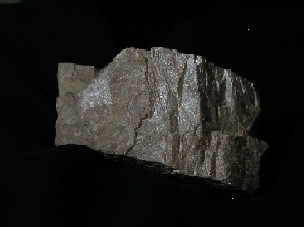
Feldspar

This is a feldspar mineral! Look for it in igneous rocks where it looks like white or pink crystals. You might find it in other types of rocks as well. ...more
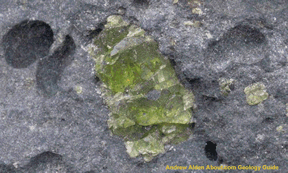
Olivine

The mineral that is green is called olivine! Look for it in igneous and metamorphic rocks. In this picture, olivine is filling a hole in the igneous rock. ...more
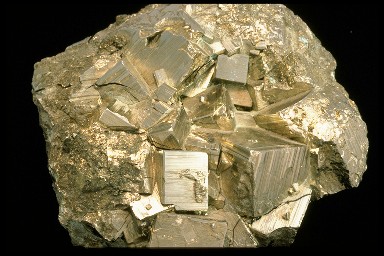
Type of Minerals

There are at least 2000 minerals on Earth. That's a lot of minerals! But you don't need to know all of them to spot the minerals lurking in the rocks of your backyard. That is because only a small number...more

Shop Windows to the Universe

Our Glaciers: Then and Now activity kit helps you see the changes taking place in glaciers around the world. See all our activity kits and classroom activities.

Windows to the Universe, a project of the National Earth Science Teachers Association, is sponsored in part by the National Science Foundation and NASA, our Founding Partners (the American Geophysical Union and American Geosciences Institute) as well as through Institutional, Contributing, and Affiliate Partners, individual memberships and generous donors. Thank you for your support! NASA AGU AGI NSF