Mohs Hardness Scale
Mohs hardness is measured on a scale from 1 to 10. The scale was made about 200 years ago by Friedrich Mohs. Softer minerals have low numbers and harder minerals have high numbers.
Mohs scale number (mineral example)
1 (Talc)
2 (Gypsum)
3 (Calcite)
4 (Fluorite)
5 (Apatite)
6 (Orthoclase
Feldspar)
7 (Quartz)
8 (Topaz)
9 (Corundum)
10 (Diamond)
Hardness of other common objects
Fingernail: 2.5
Copper penny: 3
Glass: 5.5
To figure out the hardness of a mineral, try to scratch it with an object of known hardness. For instance, if a fingernail cannot scratch a mystery mineral, we know it has a hardness of more than 2.5. If the mystery mineral can't scratch glass, we know it has a hardness of less than 5.5.
Last modified May 1, 2003 by Lisa Gardiner.
You might also be interested in:
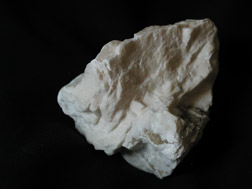
You can find gypsum in sedimentary rocks, deserts, and caves. Large amounts can form in layers on a salty sea or lake bottom when water evaporates leaving the mineral behind. Gypsum sometimes forms when
...more
Calcite is typically found in the sedimentary rock called limestone. Calcite is also in marble, a metamorphic rock, which forms when limestone is put under strong heat and pressure. Calcite crystals have
...more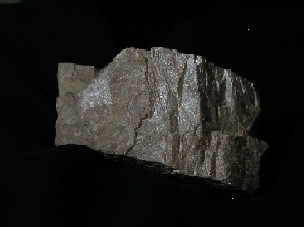
Feldspar is the most common mineral in the Earth’s crust, so you are very likely to find it in the rocks you collect! It is found it all of the three rock types, but is most common in intrusive igneous
...more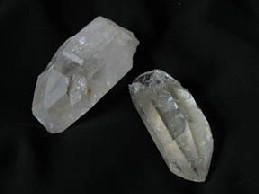
Quartz is one of the most common mineral in Earth’s crust! Silica (Si) and Oxygen (O) are the only elements within pure quartz. If a cooling magma has silica leftover after feldspars form, quartz is likely
...more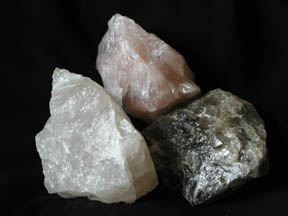
Spotting minerals is fun! There are many different types of minerals, each with a different name and a special set of characteristics. So, if you find a mineral that you do not recognize, you can use
...more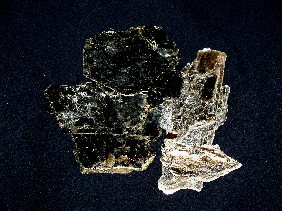
Mica minerals make some rocks sparkle! They are often found in igneous rocks such as granite and metamorphic rocks such as schist. They sparkle because light is reflected on their flat surfaces, which
...more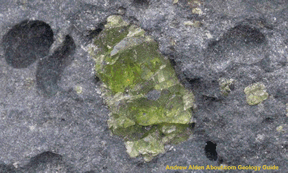
Olivine looks like little green crystals. It is typically found in some igneous and metamorphic rocks. Often the crystals are so small that you need to use your hand lens or magnifying glass to see them
...more