Current Events

  • Atmospheric CO2 Level Tops 400 ppm
    During the week of May 13th, the CO2 level at the Mauna Loa Observatory in Hawaii topped 400 ppm rep...Read more

    x

    Atmospheric CO2 Level Tops 400 ppm

    During the week of May 13th, the CO2 level at the Mauna Loa Observatory in Hawaii topped 400 ppm repeatedly. Daily levels of CO2 can vary due to weather, and there are seasonal trends as well. The level of atmospheric greenhouse gases continues to increase, now over 120 ppm since the Industrial Revolution began. For more on the Keeling Curve, see http://keelingcurve.ucsd.edu/. Find out more about greenhouse gases and warming.
  • Massive Tornado Outbreak on Tornado Alley
    The week of May 19 brings dozens of tornadoes to Tornado Alley in the states of Oklahoma, Kansas, Io...Read more

    x

    Massive Tornado Outbreak on Tornado Alley

    The week of May 19 brings dozens of tornadoes to Tornado Alley in the states of Oklahoma, Kansas, Iowa, Illinois and Missouri. On May 20th, a massive tornado struck Moore, Oklahoma, devastating communities - destroying over 100 homes and hitting two elementary schools and a hospital - with many casualties and deaths. Our thoughts are with our friends and colleagues suffering from these storms. For more on the May 20th storms, see the NOAA Storm Prediction Center Storm Report.
  • Kansas Legislator Proposes Bill to Outlaw Sustainability Education
    A bill has been introduced in the Kansas legislature this week that would prohibit the promotion of ...Read more

    x

    Kansas Legislator Proposes Bill to Outlaw Sustainability Education

    A bill has been introduced in the Kansas legislature this week that would prohibit the promotion of sustainability. Here is a link to the one-page bill: http://www.kslegislature.org/li/b2013_14/measures/documents/hb2366_00_0000.pdf. See report on Bloomberg News.
Bright yellow sulfur!
Click on image for full size
Windows to the Universe/L.Gardiner

Sulfur

Yuck! What's that smell?

When water mixes with the mineral sulfur, a chemical reaction causes a small amount of hydrogen sulfide (H2S) gas is produced. Hydrogen sulfide is the same gas that makes rotten eggs smell bad. That's what smells so horrible!

Keep your sulfur minerals dry and they won't make a stink in your mineral collection! Sulfur is brittle when heated and can actually crack if held tightly in a person's hand.

  • Shape: Orthorhombic (mostly massive or powdery forms with poor crystal shape)
  • Luster: Often resinous butometimes glassy or earthy
  • Color: Bright yellow
  • Streak: Yellow
  • Hardness: 2 on Mohs Hardness Scale
  • Cleavage: Poor in two directions
  • Fracture: Conchoidal

Last modified April 25, 2003 by Lisa Gardiner.

Shop Windows to the Universe Science Store!

TES XXVI, 3 fall 2010 The Fall 2010 issue of The Earth Scientist, focuses on rocks and minerals, including articles on minerals and mining, the use of minerals in society, and rare earth minerals, and includes 3 posters!

Windows to the Universe Community

News

Opportunities

You might also be interested in:

Cool It! Game

Check out our online store - minerals, fossils, books, activities, jewelry, and household items!...more

What’s That Mineral?

Spotting minerals is fun! There are many different types of minerals, each with a different name and a special set of characteristics. So, if you find a mineral that you do not recognize, you can use...more

Quartz

Quartz is one of the most common mineral in Earth’s crust! Silica (Si) and Oxygen (O) are the only elements within pure quartz. If a cooling magma has silica leftover after feldspars form, quartz is likely...more

Mica Minerals

Mica minerals make some rocks sparkle! They are often found in igneous rocks such as granite and metamorphic rocks such as schist. They sparkle because light is reflected on their flat surfaces, which...more

Feldspar

Feldspar is the most common mineral in the Earth’s crust, so you are very likely to find it in the rocks you collect! It is found it all of the three rock types, but is most common in intrusive igneous...more

Olivine

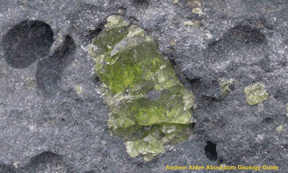
Olivine looks like little green crystals. It is typically found in some igneous and metamorphic rocks. Often the crystals are so small that you need to use your hand lens or magnifying glass to see them...more

Type of Minerals

So far, over 2000 minerals have been found, and every year new ones are discovered. That's a lot of minerals! Don't worry! You don't need to know them all to be a rock hound. In fact, only a few dozen...more

What Is a Mineral?

Minerals are the building blocks of rocks. They are non-living, solid, and, like all matter, are made of atoms of elements. There are many different types of minerals and each type is made of particular...more

Shop Windows to the Universe

Warnings: The True Story of How Science Tamed the Weather by Mike Smith tells the story of our storm warning system. See our online store book collection.

Windows to the Universe, a project of the National Earth Science Teachers Association, is sponsored in part by the National Science Foundation and NASA, our Founding Partners (the American Geophysical Union and American Geosciences Institute) as well as through Institutional, Contributing, and Affiliate Partners, individual memberships and generous donors. Thank you for your support! NASA AGU AGI NSF