Current Events

  • Irish Chronicles Document Links Between Volcanoes and Weather
    A study of over 40,000 written entries in Irish Annals and ice core measurements shows a strong corr...Read more

    x

    Irish Chronicles Document Links Between Volcanoes and Weather

    A study of over 40,000 written entries in Irish Annals and ice core measurements shows a strong correlation between the occurrence of volcanic eruptions and extreme cold weather in Ireland over a 1200 year period. Data analyzed in this study cover the period from 431 to 1649, during which time up to 48 volcanic eruptions are identified in Greenland ice core records through deposition of volcanic sulfate in annual layers of ice. You can find the study (open access), published on 6 June 2013 in IOP Publishing's journal Environmental Research Letters, at http://iopscience.iop.org/1748-9326/8/2/024035/article. Find out more about how volcanoes can influence climate.
  • EF-5 Tornado in El Reno, Oklahoma Widest Ever Recorded in US
    The EF-5 tornado that hit El Reno, Oklahoma on May 31st was the widest ever recorded in the US, acco...Read more

    x

    EF-5 Tornado in El Reno, Oklahoma Widest Ever Recorded in US

    The EF-5 tornado that hit El Reno, Oklahoma on May 31st was the widest ever recorded in the US, according to the National Weather Service in Norman Oklahoma. The tornado, which remained on the ground for 40 minutes and reached 2.6 miles across (4.2 km), took the lives of 18 people including storm chasers Tim Samaras, Paul Samaras and Carl Young. For more information on the tornado, visit http://ow.ly/i/2hfDG.
  • Atmospheric CO2 Level Tops 400 ppm
    During the week of May 13th, the CO2 level at the Mauna Loa Observatory in Hawaii topped 400 ppm rep...Read more

    x

    Atmospheric CO2 Level Tops 400 ppm

    During the week of May 13th, the CO2 level at the Mauna Loa Observatory in Hawaii topped 400 ppm repeatedly. Daily levels of CO2 can vary due to weather, and there are seasonal trends as well. The level of atmospheric greenhouse gases continues to increase, now over 120 ppm since the Industrial Revolution began. For more on the Keeling Curve, see http://keelingcurve.ucsd.edu/. Find out more about greenhouse gases and warming.
Tools for mineral identification include hand lenses (lower left), a penny for testing hardness (center), a streak plate (lower right), and an identification guidebook (top).
Click on image for full size
Windows to the Universe

Books to Help You Identify Minerals and Rocks!

Are you going out to search for rocks and minerals?

How will you know what types you have found?

Identification guidebooks for rocks and minerals can be very helpful. Pick one that has nice color pictures and language you can understand. Look for the titles below at a bookstore or library near you!


There are many books that are good for overall identification of rocks and minerals including:

  • National Audubon Society Field Guide to North American Rocks and Minerals by Charles Wesley Chesterman
  • Handbook of Rocks, Minerals and Gemstones by Walter Schumann
  • Rocks and Minerals (Smithsonian Handbooks) by Chris Pellant and others.

There are rock and mineral identification books for kids such as:

  • Peterson First Guide to Rocks and Minerals by Frederick Pough
  • Rocks and minerals of the world by Michael O'Donoghue and others
Last modified April 18, 2003 by Lisa Gardiner.

Shop Windows to the Universe Science Store!

The Fall 2010 issue of The Earth Scientist, focuses on rocks and minerals, including articles on minerals and mining, the use of minerals in society, and rare earth minerals, and includes 3 posters!

Windows to the Universe Community

News

Opportunities

You might also be interested in:

Traveling Nitrogen Classroom Activity Kit

Check out our online store - minerals, fossils, books, activities, jewelry, and household items!...more

What’s That Mineral?

Each type of mineral is made of a unique group of elements that are arranged in a unique pattern. However, to identify minerals you don’t need to look at the elements with sophisticated chemical tests....more

Make Your Own Mineral Identification Kit!

Stick the following items into a small bag so that you can take them with you whenever you go hunting for minerals. Hand lens is helpful for identifying small mineral crystals or fossils. A small, white...more

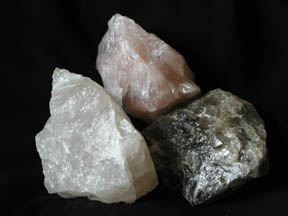
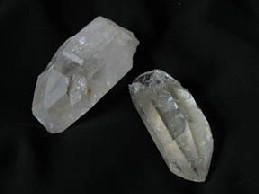
Quartz

Quartz is the second most common mineral in Earth’s crust. It is a member of the quartz group, which includes less common minerals such as opal, crystobalite, and coesite. Silica (Si) and Oxygen (O) are...more

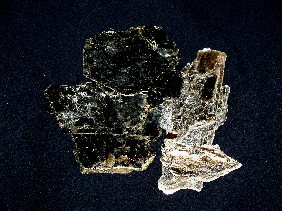
Mica Minerals

Mica minerals make some rocks sparkle! They are often found in igneous rocks such as granite and metamorphic rocks such as schist. They sparkle because light is reflected on their flat surfaces, which...more

Feldspar

Feldspar is the most common mineral in the Earth’s crust, so you are very likely to find it in the rocks you collect! It is found it all of the three rock types, but is most common in intrusive igneous...more

Olivine

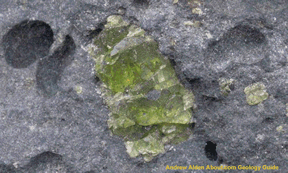
Olivine looks like little green crystals. It is typically found in some igneous and metamorphic rocks. Often the crystals are so small that you need to use your hand lens or magnifying glass to see them...more

Type of Minerals

So far, over 2000 minerals have been found, and every year new ones are discovered. This is a pretty overwhelming number of different types of minerals, however, you don't need to know them all to be...more

Shop Windows to the Universe

With Explore the Planets, investigate the planets, their moons, and understand the processes that shape them. By G. Jeffrey Taylor, Ph.D. See our DVD collection.

Windows to the Universe, a project of the National Earth Science Teachers Association, is sponsored in part by the National Science Foundation and NASA, our Founding Partners (the American Geophysical Union and American Geosciences Institute) as well as through Institutional, Contributing, and Affiliate Partners, individual memberships and generous donors. Thank you for your support! NASA AGU AGI NSF