Current Events

  • Irish Chronicles Document Links Between Volcanoes and Weather
    A study of over 40,000 written entries in Irish Annals and ice core measurements shows a strong corr...Read more

    x

    Irish Chronicles Document Links Between Volcanoes and Weather

    A study of over 40,000 written entries in Irish Annals and ice core measurements shows a strong correlation between the occurrence of volcanic eruptions and extreme cold weather in Ireland over a 1200 year period. Data analyzed in this study cover the period from 431 to 1649, during which time up to 48 volcanic eruptions are identified in Greenland ice core records through deposition of volcanic sulfate in annual layers of ice. You can find the study (open access), published on 6 June 2013 in IOP Publishing's journal Environmental Research Letters, at http://iopscience.iop.org/1748-9326/8/2/024035/article. Find out more about how volcanoes can influence climate.
  • EF-5 Tornado in El Reno, Oklahoma Widest Ever Recorded in US
    The EF-5 tornado that hit El Reno, Oklahoma on May 31st was the widest ever recorded in the US, acco...Read more

    x

    EF-5 Tornado in El Reno, Oklahoma Widest Ever Recorded in US

    The EF-5 tornado that hit El Reno, Oklahoma on May 31st was the widest ever recorded in the US, according to the National Weather Service in Norman Oklahoma. The tornado, which remained on the ground for 40 minutes and reached 2.6 miles across (4.2 km), took the lives of 18 people including storm chasers Tim Samaras, Paul Samaras and Carl Young. For more information on the tornado, visit http://ow.ly/i/2hfDG.
  • Atmospheric CO2 Level Tops 400 ppm
    During the week of May 13th, the CO2 level at the Mauna Loa Observatory in Hawaii topped 400 ppm rep...Read more

    x

    Atmospheric CO2 Level Tops 400 ppm

    During the week of May 13th, the CO2 level at the Mauna Loa Observatory in Hawaii topped 400 ppm repeatedly. Daily levels of CO2 can vary due to weather, and there are seasonal trends as well. The level of atmospheric greenhouse gases continues to increase, now over 120 ppm since the Industrial Revolution began. For more on the Keeling Curve, see http://keelingcurve.ucsd.edu/. Find out more about greenhouse gases and warming.
Temperate forest in the Great Smoky Mountains (Tennessee, U.S.)
Click on image for full size
DAAC - Oak Ridge National Laboratory / NASA

Temperate Forests

The temperate forest biome is found in regions where there is large difference in temperature between winter and summer. Regions with this climate are generally found in the mid-latitudes, far from both the equator and the poles. Tropical rainforests are in regions that are consistently warm all year long, close to the equator.

Temperate forests are almost always made of two types of trees, deciduous and evergreen. Deciduous trees are trees that lose their leaves in the winter. Evergreens are trees that keep their leaves all year long, like pine trees. Forests can either have deciduous trees, evergreens, or a combination of both. Another kind of forest is a temperate rain forest. These are found in California, Oregon and Washington in the United States. These forests are made of redwoods and sequoias, the tallest trees in the world.

The amount of rainfall in an area determines if a forest is present. If there is enough rain to support trees, than a forest will usually develop. Otherwise, the region will become grassland.

Last modified October 15, 2011 by Jennifer Bergman.

Shop Windows to the Universe Science Store!

Our online store includes issues of NESTA's quarterly journal, The Earth Scientist, full of classroom activities on different topics in Earth and space science, as well as books on science education!

Windows to the Universe Community

News

Opportunities

You might also be interested in:

Traveling Nitrogen Classroom Activity Kit

Check out our online store - minerals, fossils, books, activities, jewelry, and household items!...more

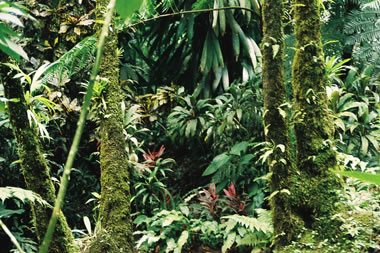
Tropical Rainforests

Tropical rainforests are home to thousands of species of animals, plants, fungi and microbes. Scientists suspect that there are many species living in rainforests have not yet been found or described....more

Grasslands

Over one quarter of the Earth's surface is covered by grasslands. Grasslands are found on every continent except Antarctica, and they make up most of Africa and Asia. There are several types of grassland.They...more

Biomes and Ecosystems

Biomes are large regions of the world with similar plants, animals, and other living things that are adapted to the climate and other conditions. Explore the links below to learn more about some of the...more

Explore the Wetlands of Brazil!

"The Pantanal has the greatest concentration of fauna in the Americas. People outside Brazil know only the Amazon. . . it's a shame because the Pantanal is a very important ecological place." -- Dr. Maria...more

Giant Redwoods Attacked by Tiny Fungus

Redwood trees are the tallest trees in the world, but even they are at risk of getting the deadly fungus called Sudden Oak Death (SOD). The trees grow in Northern California, can reach heights of more...more

Wildfires are Burning in the Western United States

There are 19 large wildfires burning over 550,000 acres in the United States (as of June 13, 2002). Most of the fires are within western states such as California, Utah, Colorado, New Mexico, Wyoming and...more

Climate Changes with Latitude

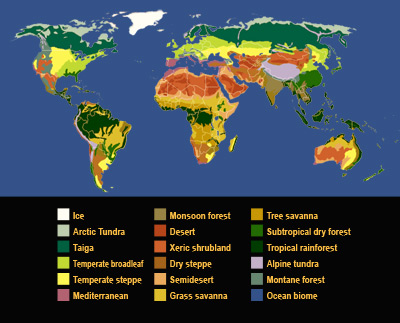
Latitude determines the amount of sunlight received. The amount of sunlight and the amount of moisture received determines the ecosystem or biome. Listed below are the types of ecosystems that exist in...more

Shop Windows to the Universe

The Spring 2011 issue of The Earth Scientist is focused on modernizing seismology education. Thanks to IRIS, you can download this issue for free as a pdf. Print copies are available in our online store.

Windows to the Universe, a project of the National Earth Science Teachers Association, is sponsored in part by the National Science Foundation and NASA, our Founding Partners (the American Geophysical Union and American Geosciences Institute) as well as through Institutional, Contributing, and Affiliate Partners, individual memberships and generous donors. Thank you for your support! NASA AGU AGI NSF