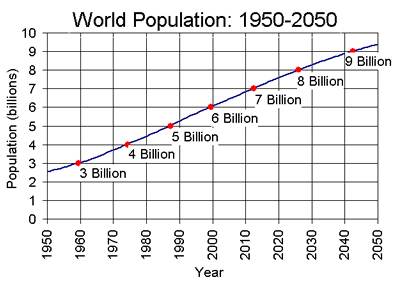
Estimated world population from 1950 to 2050
Click on image for full size
US Census Bureau
Population & Urbanization
As of March 2008, the total number of human beings on the Earth is estimated to be more than 6.6 billion. The actual population is never known for certain, since these numbers rely on national censuses, which are conducted at different times. The United States Census Bureau’s currently estimates that the world population will increase to more than 9.4 billion people by 2050.
In 1800, only 3 percent of the world's population lived in cities. By the end of the 20th century, the percentage had risen to 47%. Later this year (2008), the world’s population will reach a major milestone: For the first time in history, more than half of the human population will live in urban areas (defined as a population center with more than 50,000 inhabitants). According to a recent United Nations report, the world’s urban population is expected to swell to almost 5 billion by 2030, when three out of five people will live in cities. By the year 2050, the percentage of urban dwellers worldwide is expected to reach 70 percent.
Although the world’s urban population grew very rapidly (from 220 million to 2.8 billion) during the 20th century, the developing world will experience an unprecedented rate of urban growth during the next
The next few decades will see an unprecedented amount of urban growth in the developing world. This will be particularly visible in Africa and Asia where the urban population is expected to double between 2000 and 2030. In fact, the accumulated urban growth of these two regions during the entire span of human history will be duplicated within a single generation. By 2030, the towns and cities of the developing world will make up 81 percent of urban humanity.


Shop Windows to the Universe Science Store!
Cool It! is the new card game from the Union of Concerned Scientists that teaches kids about the choices we have when it comes to climate change—and how policy and technology decisions made today will matter. Cool It! is available in our
online store.
You might also be interested in:

Leaders from 192 nations of the world are trying to make an agreement about how to limit emissions of heat-trapping greenhouse gases, mitigate climate change, and adapt to changing environmental conditions.
...more
Climate in your place on the globe is called regional climate. It is the average weather pattern in a place over more than thirty years, including the variations in seasons. To describe the regional climate
...more
Less than 1% of the gases in Earth's atmosphere are called greenhouse gases. Even though they are not very abundant, these greenhouse gases have a major effect. Carbon dioxide (CO2), water vapor (H2O),
...more
Television weather forecasts in the space age routinely feature satellite views of cloud cover. Cameras and other instruments on spacecraft provide many types of valuable data about Earth's atmosphere
...more
Predicting how our climate will change in the next century or beyond requires tools for assessing how planet responds to change. Global climate models, which are run on some of the world's fastest supercomputers,
...more
The world's surface air temperature increased an average of 0.6° Celsius (1.1°F) during the last century according to the Intergovernmental Panel on Climate Change (IPCC). This may not sound like very
...more
A factor that has an affect on climate is called a “forcing.” Some forcings, like volcanic eruptions and changes in the amount of solar energy, are natural. Others, like the addition of greenhouse gases
...more