Current Events

  • Atmospheric CO2 Level Tops 400 ppm
    During the week of May 13th, the CO2 level at the Mauna Loa Observatory in Hawaii topped 400 ppm rep...Read more

    x

    Atmospheric CO2 Level Tops 400 ppm

    During the week of May 13th, the CO2 level at the Mauna Loa Observatory in Hawaii topped 400 ppm repeatedly. Daily levels of CO2 can vary due to weather, and there are seasonal trends as well. The level of atmospheric greenhouse gases continues to increase, now over 120 ppm since the Industrial Revolution began. For more on the Keeling Curve, see http://keelingcurve.ucsd.edu/. Find out more about greenhouse gases and warming.
  • Massive Tornado Outbreak on Tornado Alley
    The week of May 19 brings dozens of tornadoes to Tornado Alley in the states of Oklahoma, Kansas, Io...Read more

    x

    Massive Tornado Outbreak on Tornado Alley

    The week of May 19 brings dozens of tornadoes to Tornado Alley in the states of Oklahoma, Kansas, Iowa, Illinois and Missouri. On May 20th, a massive tornado struck Moore, Oklahoma, devastating communities - destroying over 100 homes and hitting two elementary schools and a hospital - with many casualties and deaths. Our thoughts are with our friends and colleagues suffering from these storms. For more on the May 20th storms, see the NOAA Storm Prediction Center Storm Report.
  • Kansas Legislator Proposes Bill to Outlaw Sustainability Education
    A bill has been introduced in the Kansas legislature this week that would prohibit the promotion of ...Read more

    x

    Kansas Legislator Proposes Bill to Outlaw Sustainability Education

    A bill has been introduced in the Kansas legislature this week that would prohibit the promotion of sustainability. Here is a link to the one-page bill: http://www.kslegislature.org/li/b2013_14/measures/documents/hb2366_00_0000.pdf. See report on Bloomberg News.
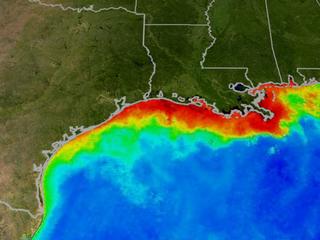
This satellite image of summer conditions in the Gulf of Mexico south of Texas, Louisiana and Mississippi (US) is from the MODIS/Aqua satellite. Red and orange colors indicate the large amounts of phytoplankton that have multiplied because of nitrogen-rich water entering the Gulf at the Mississippi River Delta. When the phytoplankton die and decompose, oxygen is taken from the water and other marine life can not survive. This is known as a dead zone.
NASA - MODIS/Aqua

Fertilizing the Earth with Nitrogen

Plants need nitrogen to grow. Plants get the nitrogen they need from the soil. In an effort to grow more crops, people have been making nitrogen fertilizers and adding them to crops. This has been very successful. It has allowed people to farm on lands that had not been very fertile. However, fertilizers are often overused, and that can cause problems.

Nitrogen from fertilizers sinks into soils and then washes into waterways causing too many nutrients. In freshwater lakes, rivers, and streams the nitrogen causes aquatic weeds to grow, filling the entire lake, river, or stream. Algae cloud the water green and slimy algal scum coats shallow rocks.

When the nitrogen-rich water gets to the ocean, it causes algae to grow and reproduce very quickly. As the huge amounts of algae use up the nitrogen, die, and decompose, oxygen in the water is used up. Animals can not survive without oxygen. They flee to another part of the ocean if they can, or they die. This happens where the Mississippi River enters the sea at the Gulf of Mexico. It also happens in about 150 other places in the world’s oceans.

Last modified January 19, 2010 by Randy Russell.

Shop Windows to the Universe Science Store!

The Spring 2010 issue of The Earth Scientist focuses on the ocean, including articles on polar research, coral reefs, ocean acidification, and climate. Includes a gorgeous full color poster!

Windows to the Universe Community

News

Opportunities

You might also be interested in:

Cool It! Game

Check out our online store - minerals, fossils, books, activities, jewelry, and household items!...more

Kingdom Plantae

Kingdom Plantae has almost 300,000 different kinds of plants. Plants are found all over planet Earth. They can live in fields, in swamps, in oceans and in the desert. They can live where it is hot and...more

Nitrogen

There is more nitrogen gas in the air than any other kind of gas. About four out of five of the molecules in Earth's atmosphere is nitrogen gas! A molecule of nitrogen gas is made up of two nitrogen atoms....more

Changing the Nitrogen Cycle, Changing the Planet

You can’t see air molecules. But if you could, you would see that most of them are made of two atoms of nitrogen bonded together. Nitrogen is not just in the sky. It is found all over the planet. It is...more

A New Plan to Help Earth’s Changing Climate

Leaders from the countries of the world are heading to Copenhagen, Denmark in December 2009 to decide how the world will deal with climate change. They will make decisions about how to send less greenhouse...more

What Is Climate?

How do you know to pack your bathing suit and sunhat for a trip to a tropical island or pack warm sweaters and coats for a trip to Alaska? If you know a little about regional climates, then you know what...more

Earth's Greenhouse Gases

Only a tiny amount of the gases in Earth’s atmosphere are greenhouse gases. But they have a huge effect on climate. There are several different types of greenhouse gases, but they all have something in...more

Space Missions to study Earth's Atmosphere & Climate

Some satellites study Earth from space. Some of them study our atmosphere and weather. Some take pictures of clouds. Others use special instruments to make measurements of temperature, humidity, or the...more

Shop Windows to the Universe

Learn about planets outside our solar system through Exoplanets and Alien Solar Systems by Tahir Yaqoob, Ph.D., a book in our online store book collection.

Windows to the Universe, a project of the National Earth Science Teachers Association, is sponsored in part by the National Science Foundation and NASA, our Founding Partners (the American Geophysical Union and American Geosciences Institute) as well as through Institutional, Contributing, and Affiliate Partners, individual memberships and generous donors. Thank you for your support! NASA AGU AGI NSF