Current Events

  • Kansas Legislator Proposes Bill to Outlaw Sustainability Education
    A bill has been introduced in the Kansas legislature this week that would prohibit the promotion of ...Read more

    x

    Kansas Legislator Proposes Bill to Outlaw Sustainability Education

    A bill has been introduced in the Kansas legislature this week that would prohibit the promotion of sustainability. Here is a link to the one-page bill: http://www.kslegislature.org/li/b2013_14/measures/documents/hb2366_00_0000.pdf. See report on Bloomberg News.
  • Earth's Center Is 1,000 Degrees Hotter Than Previously Thought, Synchrotron X-Ray Experiment Shows
    Scientists have determined the temperature near the Earth’s center to be 6000 degrees Celsius, 1000 ...Read more

    x

    Earth's Center Is 1,000 Degrees Hotter Than Previously Thought, Synchrotron X-Ray Experiment Shows

    Scientists have determined the temperature near the Earth’s center to be 6000 degrees Celsius, 1000 degrees hotter than in a previous experiment run 20 years ago. These measurements confirm geophysical models that the temperature difference between the solid core and the mantle above, must be at least 1500 degrees to explain why the Earth has a magnetic field. For more information about this study, see the press release from the European Synchrotron Radiation Facility.
  • Ocean Volcanic Rocks Contain Samples of Recycled Crust
    Scientists have long believed that lava erupted from certain oceanic volcanoes contains materials fr...Read more

    x

    Ocean Volcanic Rocks Contain Samples of Recycled Crust

    Scientists have long believed that lava erupted from certain oceanic volcanoes contains materials from the early Earth’s crust. But decisive evidence for this phenomenon has proven elusive. New research from a team including Carnegie’s Erik Hauri demonstrates that oceanic volcanic rocks contain samples of recycled crust dating back to the Archean era 2.5 billion years ago. Their work is published in Nature. Oceanic crust sinks into the Earth’s mantle at so-called subduction zones, where two plates come together. Much of what happens to the crust during this journey is unknown. Model-dependent studies for how long subducted material can exist in the mantle are uncertain and evidence of very old crust returning to Earth’s surface via upwellings of magma has not been found until now. For more information about these results, see the press release from the Carnegie Institution.
A weather balloon rises in the atmosphere. The air in the atmosphere is mostly nitrogen molecules.
Click on image for full size
UCAR

Changing the Nitrogen Cycle, Changing the Planet

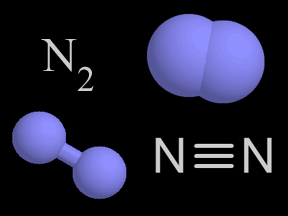
You can’t see air molecules. But if you could, you would see that most of them are made of two atoms of nitrogen bonded together. Nitrogen is not just in the sky. It is found all over the planet. It is in living things, air, water, and even animal poop. It travels between living and non-living parts of our planet via a process called the nitrogen cycle, one of the biogeochemical cycles.

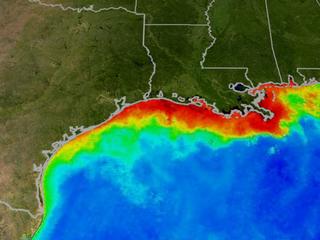
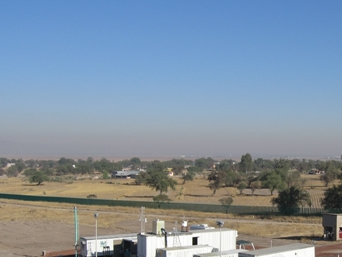
As humans change the way we live on the planet, the way that nitrogen moves around the Earth also changes. Nitrogen atoms may be very small, but changes in the nitrogen cycle are having a large impact on our planet. Lakes are clogged with aquatic weeds. Dead zones have formed in areas of the oceans where animals can not survive. Air pollution that contains nitrogen makes the air quality worse. Greenhouse gases that contain nitrogen are becoming more common.

Read on to explore two examples of how humans affect the nitrogen cycle and how the changing nitrogen cycle affects humans and ecosystems.

Last modified May 7, 2007 by Lisa Gardiner.

Shop Windows to the Universe Science Store!

The Spring 2010 issue of The Earth Scientist focuses on the ocean, including articles on polar research, coral reefs, ocean acidification, and climate. Includes a gorgeous full color poster!

Windows to the Universe Community

News

Opportunities

You might also be interested in:

Cool It! Game

Check out our online store - minerals, fossils, books, activities, jewelry, and household items!...more

Nitrogen

There is more nitrogen gas in the air than any other kind of gas. About four out of five of the molecules in Earth's atmosphere is nitrogen gas! A molecule of nitrogen gas is made up of two nitrogen atoms....more

Fertilizing the Earth with Nitrogen

Plants need nitrogen to grow. Plants get the nitrogen they need from the soil. In an effort to grow more crops, people have been making nitrogen fertilizers and adding them to crops. This has been very...more

Releasing Nitrogen Pollutants to the Air

While most of the air in our atmosphere is made of nitrogen gas, there are other gases in our atmosphere that contain nitrogen too. They may make up only a small percentage of the air molecules in our...more

Earth's Greenhouse Gases

Only a tiny amount of the gases in Earth’s atmosphere are greenhouse gases. But they have a huge effect on climate. There are several different types of greenhouse gases, but they all have something in...more

A New Plan to Help Earth’s Changing Climate

Leaders from the countries of the world are heading to Copenhagen, Denmark in December 2009 to decide how the world will deal with climate change. They will make decisions about how to send less greenhouse...more

What Is Climate?

How do you know to pack your bathing suit and sunhat for a trip to a tropical island or pack warm sweaters and coats for a trip to Alaska? If you know a little about regional climates, then you know what...more

Space Missions to study Earth's Atmosphere & Climate

Some satellites study Earth from space. Some of them study our atmosphere and weather. Some take pictures of clouds. Others use special instruments to make measurements of temperature, humidity, or the...more

Shop Windows to the Universe

The Spring 2011 issue of The Earth Scientist is focused on modernizing seismology education. Thanks to IRIS, you can download this issue for free as a pdf. Print copies are available in our online store.

Windows to the Universe, a project of the National Earth Science Teachers Association, is sponsored in part by the National Science Foundation and NASA, our Founding Partners (the American Geophysical Union and American Geosciences Institute) as well as through Institutional, Contributing, and Affiliate Partners, individual memberships and generous donors. Thank you for your support! NASA AGU AGI NSF