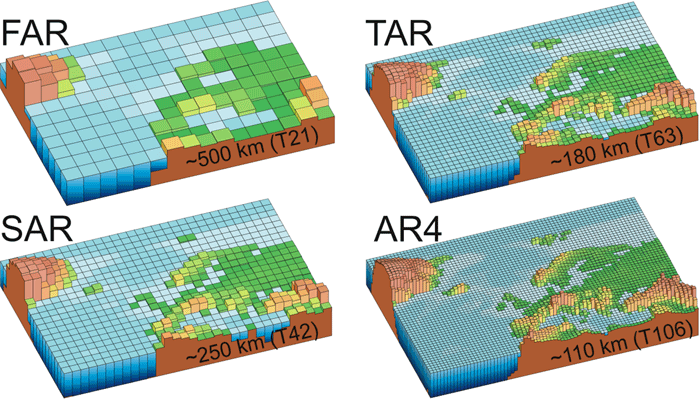
These images illustrate the typical spatial resolution used in state-of-the-art climate models around the times of each of the four IPCC Assessment Reports. Around the time of the First Assessment Report (FAR) in 1990, many climate models used a grid with cells of about 500 km (311 miles) on a side (upper left image). By the time of the the Second Assessment Report (SAR) in 1996, resolution had improved by a factor of two, producing grid cells 250 km (155 miles) on a side. Models references in the Third Assessment Report (TAR) in 2001 generally had reduced grid cells sizes to about 180 km (112 miles), while Fourth Assessment Report (AR4) models typically used a 110 km (68 mile) wide grid cell, further improving resolution. Vertical resolution is not depicted in these images, but has also improved over the years. Typical FAR models had a single-layer "slab ocean" and 10 atmospheric layers; AR4 models often include 30 layers in the oceans and another 30 in the atmosphere.
Notice how elements of topography, such as the Alps Mountains, are shown in much greater detail in higher-resolution models. This allows such models to begin to make reasonable forecasts of regional climate in the future, a currently emerging capability.
Image courtesy of the IPCC (AR4 WG 1 Chapter 1 page 113 Fig. 1.4)


Shop Windows to the Universe Science Store!
The
Fall 2009 issue of The Earth Scientist, which includes articles on student research into building design for earthquakes and a classroom lab on the composition of the Earth’s ancient atmosphere, is available in our
online store.
You might also be interested in:

Leaders from the countries of the world are heading to Copenhagen, Denmark in December 2009 to decide how the world will deal with climate change. They will make decisions about how to send less greenhouse
...more
How do you know to pack your bathing suit and sunhat for a trip to a tropical island or pack warm sweaters and coats for a trip to Alaska? If you know a little about regional climates, then you know what
...more
Only a tiny amount of the gases in Earth’s atmosphere are greenhouse gases. But they have a huge effect on climate. There are several different types of greenhouse gases, but they all have something in
...more
Some satellites study Earth from space. Some of them study our atmosphere and weather. Some take pictures of clouds. Others use special instruments to make measurements of temperature, humidity, or the
...more
To figure out what the Earth might be like in the future, scientists need to know how Earth reacts to changes. Models help scientists to better understand how the Earth works and how it will react to climate
...more
Have you ever taken your temperature to see if you are getting sick? Scientists have been taking the Earth's temperature and have found that it is getting warmer. During the past 100 years, the Earth's
...more
The Sun Climate can change if there is a change in the amount of solar energy that gets to Earth. A change in the solar cycle can impact climate. The effect is too small to be the reason that global warming
...more