Current Events

  • Atmospheric CO2 Level Tops 400 ppm
    During the week of May 13th, the CO2 level at the Mauna Loa Observatory in Hawaii topped 400 ppm rep...Read more

    x

    Atmospheric CO2 Level Tops 400 ppm

    During the week of May 13th, the CO2 level at the Mauna Loa Observatory in Hawaii topped 400 ppm repeatedly. Daily levels of CO2 can vary due to weather, and there are seasonal trends as well. The level of atmospheric greenhouse gases continues to increase, now over 120 ppm since the Industrial Revolution began. For more on the Keeling Curve, see http://keelingcurve.ucsd.edu/. Find out more about greenhouse gases and warming.
  • Massive Tornado Outbreak on Tornado Alley
    The week of May 19 brings dozens of tornadoes to Tornado Alley in the states of Oklahoma, Kansas, Io...Read more

    x

    Massive Tornado Outbreak on Tornado Alley

    The week of May 19 brings dozens of tornadoes to Tornado Alley in the states of Oklahoma, Kansas, Iowa, Illinois and Missouri. On May 20th, a massive tornado struck Moore, Oklahoma, devastating communities - destroying over 100 homes and hitting two elementary schools and a hospital - with many casualties and deaths. Our thoughts are with our friends and colleagues suffering from these storms. For more on the May 20th storms, see the NOAA Storm Prediction Center Storm Report.
  • Kansas Legislator Proposes Bill to Outlaw Sustainability Education
    A bill has been introduced in the Kansas legislature this week that would prohibit the promotion of ...Read more

    x

    Kansas Legislator Proposes Bill to Outlaw Sustainability Education

    A bill has been introduced in the Kansas legislature this week that would prohibit the promotion of sustainability. Here is a link to the one-page bill: http://www.kslegislature.org/li/b2013_14/measures/documents/hb2366_00_0000.pdf. See report on Bloomberg News.
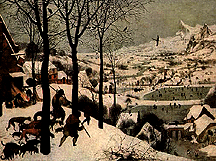
Hunters in the Snow by Pieter Breughel. Breughel captured the long winters of the Little Ice Age in this 1565 painting.
Click on image for full size
Caspar Ammann

The Little Ice Age

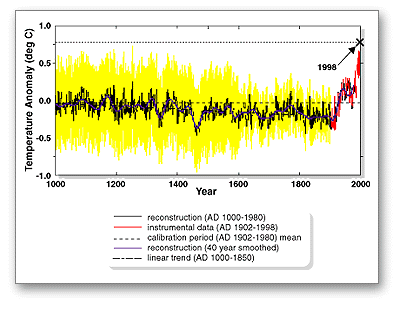
From about 1250 to 1850 temperatures were a bit colder than usual in most parts of the world. This time is called the Little Ice Age.

During the Little Ice Age, the average temperature of the planet was about a degree Celsius cooler than it is today (that’s 2-3 degrees Fahrenheit). Scientists think that the planet was cooler because there was less solar activity and more erupting volcanoes. The Little Ice Age was not a true ice age because it did not get cold enough for long enough to cause ice sheets to grow larger. The cooling likely affected areas around the world but we have the most records of how it changed daily life from Europe. Listed below were some of the things we know happened during the Little Ice Age.

  • Fur trappers reported that southern Hudson Bay remained frozen for about 3 weeks longer each spring.
  • Fishermen reported large amounts of sea ice floating in the North Atlantic.
  • British people saw Eskimos paddling canoes off the coast of England.
  • Alpine (mountain) glaciers grew larger.
  • Winters were longer and growing seasons shorter according to tree ring data and records of cherry tree flowering.
  • Wet weather caused disease that affected people, animals and crops including the plague. The plague is also called the Black Death. It was a disease that killed more than a third of Europeans.
  • Because farmers couldn’t grow food, people went hungry in areas of northern and Eastern Europe. Unlike today, there was no way to transport food from far away.
Last modified June 20, 2008 by Lisa Gardiner.
Shop Windows to the Universe Science Store!

The Winter 2009 issue of The Earth Scientist, focuses on Earth System science, including articles on student inquiry, differentiated instruction, geomorphic concepts, the rock cycle, and much more!

Windows to the Universe Community

News

Opportunities

You might also be interested in:

Cool It! Game

Check out our online store - minerals, fossils, books, activities, jewelry, and household items!...more

The Medieval Warm Period

The Medieval Warm Period was a time of warm climate in Europe. The warmest part of the Medieval Warm Period was from about 950 until 1100 A.D. The warm climate overlaps with a time of high solar activity...more

A New Plan to Help Earth’s Changing Climate

Leaders from the countries of the world are heading to Copenhagen, Denmark in December 2009 to decide how the world will deal with climate change. They will make decisions about how to send less greenhouse...more

What Is Climate?

How do you know to pack your bathing suit and sunhat for a trip to a tropical island or pack warm sweaters and coats for a trip to Alaska? If you know a little about regional climates, then you know what...more

Earth's Greenhouse Gases

Only a tiny amount of the gases in Earth’s atmosphere are greenhouse gases. But they have a huge effect on climate. There are several different types of greenhouse gases, but they all have something in...more

Space Missions to study Earth's Atmosphere & Climate

Some satellites study Earth from space. Some of them study our atmosphere and weather. Some take pictures of clouds. Others use special instruments to make measurements of temperature, humidity, or the...more

Modeling the Future of Climate Change

To figure out what the Earth might be like in the future, scientists need to know how Earth reacts to changes. Models help scientists to better understand how the Earth works and how it will react to climate...more

Effects of Climate Change Today

Have you ever taken your temperature to see if you are getting sick? Scientists have been taking the Earth's temperature and have found that it is getting warmer. During the past 100 years, the Earth's...more

Shop Windows to the Universe

Science, Evolution, and Creationism, by the National Academies, focuses on teaching evolution in today's classrooms. Check out the other publications in our online store.

Windows to the Universe, a project of the National Earth Science Teachers Association, is sponsored in part by the National Science Foundation and NASA, our Founding Partners (the American Geophysical Union and American Geosciences Institute) as well as through Institutional, Contributing, and Affiliate Partners, individual memberships and generous donors. Thank you for your support! NASA AGU AGI NSF